



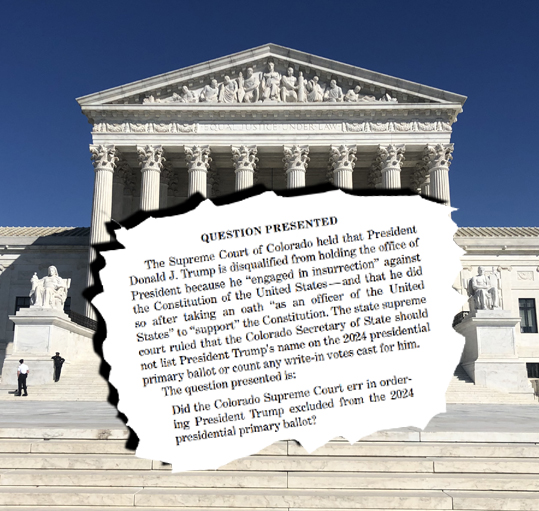
A prosecutor in President Lincoln’s assassination trial and three of Donald Trump’s judicial appointees may well determine the 2024 Presidential Election.
U.S. Representative John Bingham (R-OH) guided the Fourteenth Amendment through Congress to protect our Republic from insurrectionists. He has recently become one of the most Googled people by historians, political scientists, and journalists.
As a member of the Congressional Joint Committee on Reconstruction, Bingham was the primary architect of the Fourteenth Amendment which is perhaps the most powerful amendment to the U.S. Constitution. Historically, the Fourteenth Amendment has been used to extend civil liberties and, more recently, has been debated regarding birth citizenship, the national debt, and former President Trump’s ability to serve a second term.
Supporters of Trump and others have questioned the relevance of the Fourteenth Amendment’s Insurrection Clause to the January 6th attack on the U.S. Capitol. Their argument goes something like “Trump didn’t personally go to the Capitol, and if he did, the attacks aren’t an insurrection, and if it was, the Fourteenth Amendment refers to the Civil War, and if it did apply, it doesn’t say U.S. President, and if it did, it doesn’t matter because the President has immunity.”
It will be up to the U.S. Supreme Court to determine the applicability of the Insurrection Clause to Trump’s potential disqualification from office.
The 6-3 conservative supermajority of the Supreme Court includes three Trump appointees, and these conservative originalists espouse an alleged strict interpretation of the Constitution. This philosophy holds that the Constitution should be taken word-for-word, not interpreted or contextualized, and should consider the meaning of the terms in the manner the words were used at the time of the Constitution’s creation and ratification.
Indeed, the Constitution does not specify the President of the United States in Section 3 of the Fourteenth Amendment. It states:
“No person shall be a Senator or Representative in Congress, or elector of President and Vice President, or hold any office, civil or military, under the United States, or under any State, who, having previously taken an oath, as a member of Congress, or as an officer of the United States, or as a member of any State legislature, or as an executive or judicial officer of any State, to support the Constitution of the United States”
That is, it says that “no person shall… hold any office… under the United States… who, having previously taken an oath… as an officer of the United States… to support the Constitution of the United States” —any office.
Meanwhile, Article II of the Constitution refers to the Office of the President in Section 1, Clauses 1 and 5 as well as the term “Office” in Section One, Clauses 6 and 8. Clause 8 also requires the President to swear or affirm to “faithfully execute the Office of the President of the United States” and to “preserve, protect and defend the Constitution of the United States.” Thus, the Constitution has five references to the President as an officer under the United States.
[Under the doctrine of superseding authority, the more recent parts of the Constitution supersede earlier parts, so Section 3 of the Fourteenth Amendment is also an amendment to the requirements for the Office of President listed under Article 2, Section 1, Clause 5.]
But, the sliding argument goes, Section 3 of the Fourteenth Amendment referred to the Civil War. And yet, the so-called Insurrection Clause does not use the term Civil War. It disqualifies anyone who took an oath and then “engaged in insurrection or rebellion against the same, or given aid or comfort to the enemies thereof.”
Gaines Foster of Louisiana State University has noted that Abraham Lincoln frequently referred to the Civil War as the “Rebellion” and the war was also known concurrently as the War of the Rebellion, the Slaveholders’ Rebellion, the Insurrection, the Abolition War, the War Between the States, and the War of Northern Aggression.
Therefore, a literal interpretation of the Constitution would note that Section 3 does not capitalize insurrection or rebellion, nor does the grammatical article “the” precede the terms. Section 3 broadly refers to any insurrection or rebellion. In fact, 18 U.S. Code § 2383, written in 1948 and edited in 1994, also uses the similar phrase “rebellion or insurrection” and I doubt many former Confederates were alive in 1994. The same U.S. Code defines insurrection as inciting, assisting, or engaging in “any rebellion or insurrection against the authority of the United States or the laws thereof” and such a person is barred from any office.
In 2000, the judicial curtains of impartiality were ripped apart when the 5-4 conservative majority (including current Associate Justice Clarence Thomas) sided against States’ Rights and determined the 2000 Presidential Election in favor of the conservative candidate.
Trump v. Anderson might well be determined on March 19, the 124th anniversary of John Bingham’s death. If the conservatives on the Supreme Court stick to their espoused strict constructionism and originalist philosophies then Trump will be disqualified as a candidate for President of the United States.
Thomas Keefe lives in Branford.