


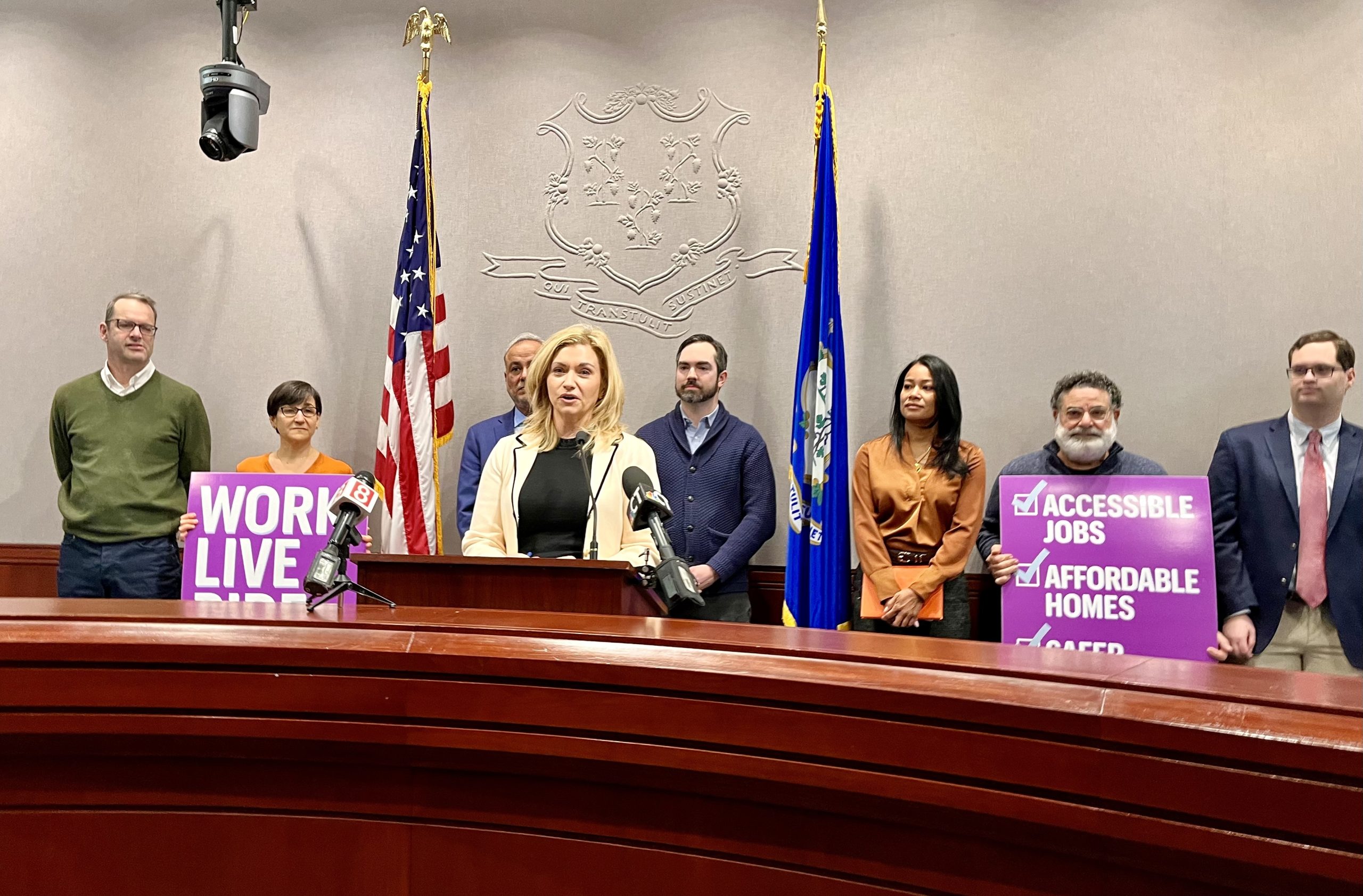
Young people in Connecticut told lawmakers during a Wednesday public hearing that they want to stay in the state, but can’t afford to rent a place to live.
College students and recent college graduates, among others, spoke in favor of House Bill 5390, also known as “Work, Live, Ride,” during a public hearing before the Planning and Development Committee. It’s another iteration of similar proposals Desegregate Connecticut put forward in past sessions to encourage more homes near public transit stations.
The bill is one of a few efforts this session to build more housing and alleviate the lack of supply that experts say has pushed housing costs up the past few years.
“Few young people can afford both the skyrocketing costs of housing as well as the cost associated with car ownership that is necessary in every part of our state,” said Sydney Elkhay, a transit-oriented communities organizer with Desegregate Connecticut and a recent UConn graduate. “At my age, my parents had moved into their own house in Connecticut, had married, and had begun to have kids. My generation lives with family members and roommates, unable to afford the lifestyle of our parents in our home state.”
Opponents said they fear a loss of local control and that towns that don’t opt to build more near transportation hubs will lose out on state funding if the bill passes.
Transit-oriented development
Transit-oriented development is a land use concept that means increasing density near public transportation. The idea is to have walkable communities where people can access shops, housing and transportation by foot.
Transit-oriented development ideas have amassed political support over the past few sessions in Connecticut. Gov. Ned Lamont has expressed support for the land use concept, and key lawmakers said it was a top priority this session.
The concept has grown in popularity in the United States in recent years as governments across the country seek ways to improve housing affordability and reduce sprawl. Connecticut lacks close to 92,500 units of housing that are affordable and available to its lowest-income renters, and apartment vacancy rates are low.
Members of the business community have said this makes it hard to hire employees who struggle to find a place to live. More use of public transportation and less sprawl is also better for the environment, advocates say.
H.B. 5390 would prioritize towns that create transit-oriented communities for certain discretionary state funds for infrastructure improvements such as brownfield remediation, public sewer and water expansion and economic development.
Transit-oriented districts would allow certain types of housing as-of-right, meaning developers wouldn’t have to get special permission from the town planning and zoning department or commissions to build. Some of that includes smaller multi-family housing of up to nine units, certain housing that’s set aside as affordable and accessory dwelling units.
The bill also sets up the state Office of Responsible Growth as the liaison between towns and the state. The office would assist with planning and determine whether towns comply with the regulations for a transit-oriented district.
The office’s coordinator could also set guidelines for municipalities regarding the districts including parking requirements, lot size, height restrictions and how far a structure needs to be from the property line. The coordinator would also ensure the districts are developed with proper environmental considerations.
Support
Supporters told members of the Planning and Development Committee that transit-oriented developments are the kind of neighborhoods people — particularly young people — want to live in. They want to be able to walk to businesses and take the bus or train to work.
Surveys have also shown that more people report they want to live in walkable communities.
“If we as a state actually want our college graduates to stay in their communities and use their education to the benefit of Connecticut, we have to build housing for them,” Elkhay said. “Otherwise young adults will move to places where they can find housing, which will be out of state.”
Tanner Marchese, a UConn student and member of the school’s Undergraduate Student Government, wrote in public testimony about housing affordability and concerns over climate change.
“As a young person growing up in the world today, I am also deeply concerned about the climate crisis and the contribution that car dependency has on this issue,” Marchese wrote. “On top of Hartford being completely impossible to get to if you don’t own a car and completely impossible to traverse without one, all of these cars are contributing to pollution and the climate crisis.”
The Integrated Immigrant & Refugee Services, or IRIS, a nonprofit based in New Haven, spoke in support, saying the bill would help people new to the country to find housing and transportation. A member of the American Lung Association also wrote testimony in support saying that more use of public transit could reduce pollutants and improve health in Connecticut.
Opposition
Opponents said they fear the discretion offered to the state’s Office of Responsible Growth will amount to a loss of local control. Under the bill, the office’s coordinator would work with an interagency council on housing development with other state agencies.
“What I read in this bill is that the responsible growth coordinator will have wide authority to make determinations on this TOD zone,” said committee member Sen. Tony Hwang, R-Fairfield. “I know there are some built-in exclusions and considerations of respect, but nevertheless, we’re granting considerable power and authority in regards to development growth to this state growth coordinator.”
Others said they were concerned that smaller towns without transit or towns that don’t opt to rezone for transit districts will be deprioritized for infrastructure funding.
“Those small towns with small town budgets rely upon the state helping them,” said Sen. Jeff Gordon, R-Woodstock, giving testimony. “ … I think the wording in this bill, to me, is concerning about a stick approach that could be done. That could be extremely hard for towns that are trying the best that they can.”
Gordon added that not all towns have public transit or existing infrastructure to support more people.
Ranking member Sen. Ryan Fazio, R-Greenwich, expressed similar concerns about deprioritization of some towns and questioned Ann O’Brien, the director of sponsorship at IRIS, about the organization’s support for the bill.
Fazio asked a few questions about the types of immigrants and refugees IRIS serves. O’Brien told him they work with “the broadest range of displaced people,” including Ukrainian refugees and people who were working with the U.S. military and evacuated from Afghanistan.
Fazio questioned whether some immigrated illegally and said that the needs and safety of U.S. citizens have to be balanced with those of immigrants.
“I get concerned that if we’re making policy, with the security concerns we currently have at the border, with the stress that’s putting on cities and communities across the country, just at our back door to my district in New York, that we are we’re running the risk of straining resources straining the well-being and safety and orderliness of our cities and towns and neighborhoods across Connecticut as well,” Fazio said.
Co-chair Rep. Eleni Kavros-DeGraw, D-Avon, said that the country benefits from immigration, pointing to her own background.
“My family was actually fleeing genocide,” Kavros DeGraw said. “So when I hear about our support or not support of folks, I always think back to ‘I wouldn’t be here today if it weren’t for them fleeing,’ and I wish that they had had an organization like IRIS to help them. To be blunt, I know several of them came illegally.”
Co-chair Sen. MD Rahman, D-Manchester, expressed similar sentiments, saying he came to this country with few possessions.
“MD came here with $200 and a backpack,” Rahman said. “Today I’m chairing the P&D meeting. This is the beauty of democracy and the beauty of the American dream.”
O’Brien told the committee that immigrants’ No. 1 need when they come to the U.S. is affordable housing. Close behind that, she said, is transportation.