



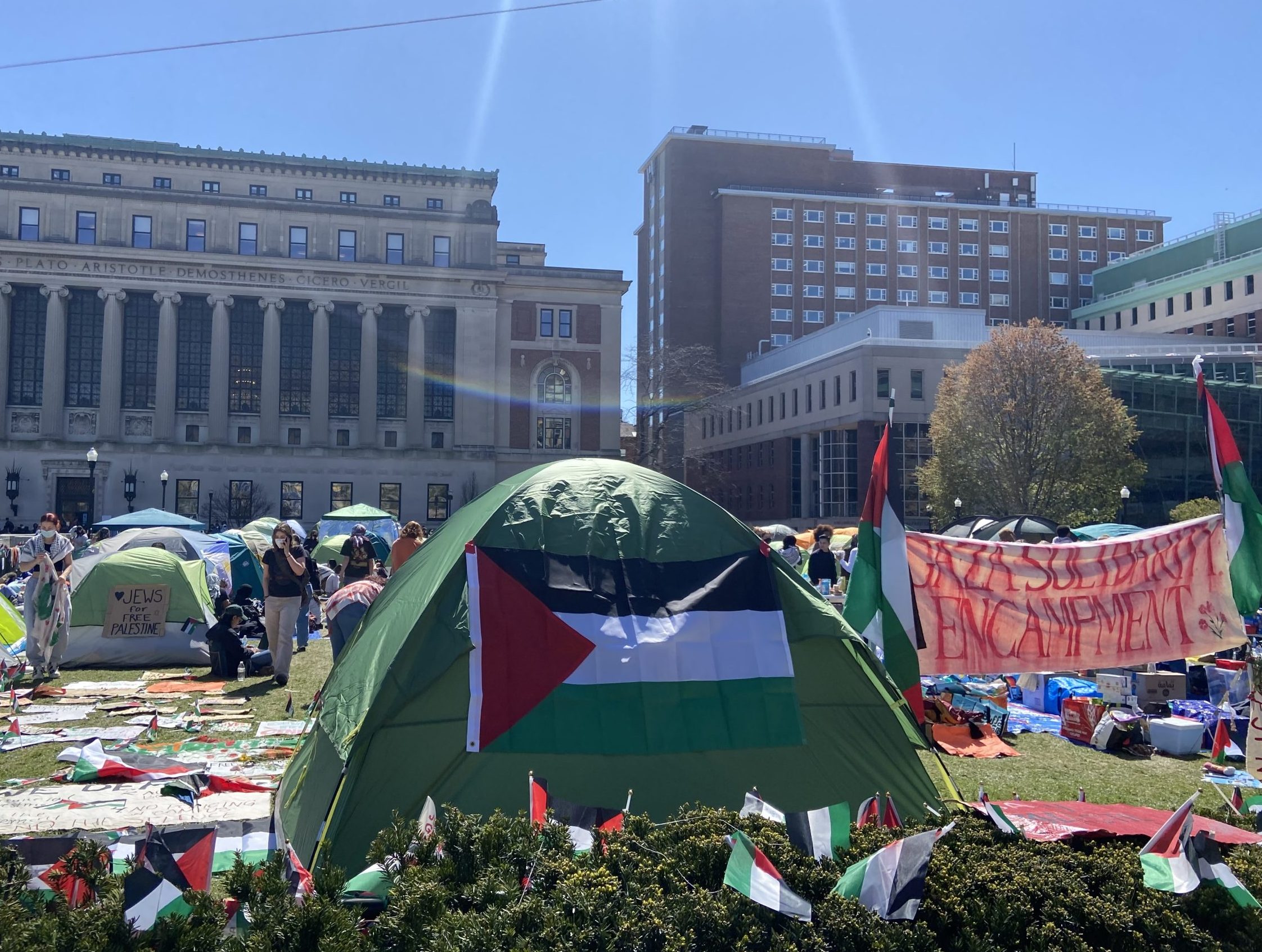
I raised my hand and yelled “freelance from Connecticut!” It didn’t sound right following “reporter from CNN” and “photographer for Bloomberg.” A recent college graduate, I was not much older than the student protesters I was covering. But there I was with established reporters, sectioned off from rows of tents by manila rope and Columbia student “press liaisons.”
It was April 22 when I first found myself at the Columbia Gaza Solidarity Encampment, on what began an unbelievable two weeks covering the protests and arrests in New York City. Walking around Columbia, I looked more like a protester than a journalist. Several networks approached me for interviews and a student gave me her friend’s matcha to hold while she spoke to a reporter.
Largely because of my age, I was privileged to hear student protesters’ unfiltered passion, instead of the defensive stance elicited by more skeptical senior reporters often looking for an angle with shock value. One of the first questions I heard another reporter ask was, “Are you hiding members of Hamas in the encampment?”
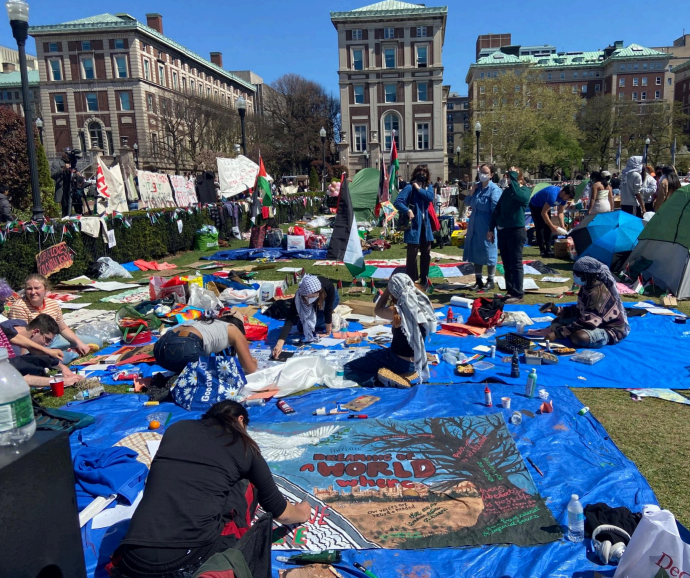
The students, predominantly 18- to 22-year-old women, many from Barnard, spent days eating, sleeping, and organizing at the encampment. Every half hour, students shared updates over a speaker like they were at summer camp. They encouraged their fellow protesters to wear “allergy armbands” to prevent a potential medical event at the food and supplies tables. They reminded each other to drink water and use electrolyte packets, which — along with sandwich wraps, Benadryl, toothbrushes, blankets, and other goods — were donated by faculty, community members and other students.
Looking around the campsite, I saw students from all backgrounds sitting and eating together, making signs, and escaping the sun in their tents. I noted the many “Jews for Free Palestine” signs displayed at the encampment and a whiteboard with that day’s programming announcing a 6 p.m. Seder. Several of the student spokespeople for the encampment were Jewish, and stressed to me that this was a diverse, interfaith movement, despite what one might see in mainstream media coverage.
It’s important to acknowledge the real instances of antisemitism that occurred in and around Columbia’s campus. One video in particular shows a protester holding up a sign to pro-Israeli demonstrators that read “Al-Qasam’s Next Targets.” It’s unclear whether the perpetrator was affiliated with Columbia University; nevertheless, this and other documented incidents are clearly unacceptable. However, if you are only watching the same four clips of these incidents amplified by mainstream and social media, you aren’t getting the full story.
The media likes to focus heavily on extremist fringes and the specific missteps of student movements or individuals. Protests movements are complicated and messy, in 1968 or 2024. After visiting the encampment and speaking to students, I’ve come away with a much clearer picture of the goals and behavior I believe defined the majority of protesters at the Columbia encampment.
Students spoke to me about the sense of community and love they felt among the tents. “Please eat, reserve your energy, stay hydrated” one student urged over the mic, to which 50 or so students yelled back “Thank you!” I walked by a student’s tent with a sign offering free tutoring to her peers. Students set up a library at the encampment and walked around handing out cold cloths to anyone who was overheating.
Dalia, a Palestinian freshman at Columbia, explained that her peers were more “united” than ever and overwhelmingly supported university divestment from companies with Israeli ties (76.55%). “As a Palestinian, and just as anyone of moral consciousness, we have a commitment to use the privilege of being at this Ivy League university as our platform.” One Barnard junior, who wished to remain anonymous, shared, “I think a lot of people try to put us in two camps: antizionist and Zionist, but I don’t believe that that’s accurate…It’s not about the other students on campus, it’s about the people who are dying in Gaza.”
Students talked about the gruesome images from Gaza that flooded their phones on a minute by minute basis. Sofia, a Columbia senior, called it the “first live streamed genocide.” The “moment calls us” a second anonymous student told me. After spending years in school learning about colonialism and American protest movements, and then watching horrific bloodshed on social media every day for the past seven months, it should be no surprise that these students felt “called.”
The protesters who took over Columbia’s Hamilton Hall renamed the building Hind’s Hall after Hind Rajab, the 6-year-old Palestinian girl trapped in a car with her dead family members, all of whom were shot by the IDF. She begged the Red Crescent for help over the phone. Twelve days later, she and the Red Crescent paramedics who’d come to her aid were found dead, with evidence of “direct fire munition” from the IDF.
Just one day after the arrests at Hamilton Hall and the NYPD shutdown of campus, students and protesters gathered outside the building and projected on it in enormous, bright lights: “Hind’s Hall Forever.” Despite arrests, suspensions, and doxing, these students remained steadfastly committed to each other and to their cause. I saw these young people for what they were: complex, passionate, loving and committed.
They are shouting at us whatever the cost. We will all hear them sooner or later.
Lily Forand is a freelance video journalist from West Hartford.