


This story has been updated.
Connecticut is contending with a growing trend of viral school shooting threats, with more than 30 assessed by the state’s central intelligence authority since the beginning of the school year.
The uptick is part of a broader spike in such threats nationwide, after four people were killed in a shooting at a Georgia high school on Sept. 4. Since then, schools across Connecticut have suspended classes as threats have come in via phone calls and social media. On Friday alone, schools were closed in Bristol, Torrington and Bridgeport.
Students in Norwalk, Bridgeport and New Haven have also arrived in school to see an additional police presence on their campuses following threats this month, while children in West Haven, New Britain and North Haven experienced lockdowns.
But officials say that while school closures and early dismissals may be frightening, the high numbers of reported threats can actually be read as a sign that efforts to instill a “see something, say something” mentality have paid off in a state that witnessed the deadliest shooting at an elementary school in U.S. history, at Sandy Hook Elementary School in Newtown.
“We’ve got a lot of people willing to tell us, and that’s important for prevention,” said Tim Silva, a manager at the Connecticut Intelligence Center, which assesses such threats.
Gov. Ned Lamont told reporters on Friday that most of the threats are just reposts.
“They think they’re being funny. They’re not. We have to respond to each and every one of them,” he said.
Officials say that in addition to encouraging people to continue to report concerning posts or comments, there should be consequences for those who make the threats. This includes arresting students who post threats online, to discourage others from reposting such messages, disrupting learning and putting communities on edge. Over the past month, children from Ansonia to Bridgeport have been arrested in connection with the threats.
“We hope people understand that there is a consequence to what they do,” Silva said. “They want to get out of a test, whatever it may be. This discourages them from doing it.”
Most of the state’s school districts that contended with threats managed to communicate effectively with their communities, according to Kate Dias, president of the Connecticut Education Association, the largest teachers union in the state. But in Bridgeport, angry and frightened parents and teachers spoke out at a Board of Education meeting on Monday night about what they say was a botched response.
For Jacqueline Colantonio, an ESL teacher, that meant finding out late in the day on Wednesday, Sept. 18, that a threat had been made in the morning that affected her school.
“The whole staff was in the cafeteria, where there’s a wall of windows and doors open to a courtyard that’s open to the public. We were sitting ducks and we knew nothing,” she said.
According to officials in the Bridgeport school district, that threat was non-credible. It was assessed and deemed to be a hoax, and parents received a notification from the school after that determination had been made. But teaching staff didn’t receive the same notification until hours later.
The superintendent emailed staff and apologized for that lag, writing that the school’s automated system had been corrected. “We are committed to continuous improvement to ensure that all staff members are notified simultaneously about critical matters,” Superintendent Carmela Levy-David wrote.
But Colantonio said that the lag in communication changed her perception of safety at the school.
“I’ve been teaching for 27 years, and I’ve never had a concern about coming to school — until now,” Colantonio said.
Bridgeport schools were cancelled on Friday after an additional threat led to an arrest. When students returned to school on Monday there was an increased police presence.
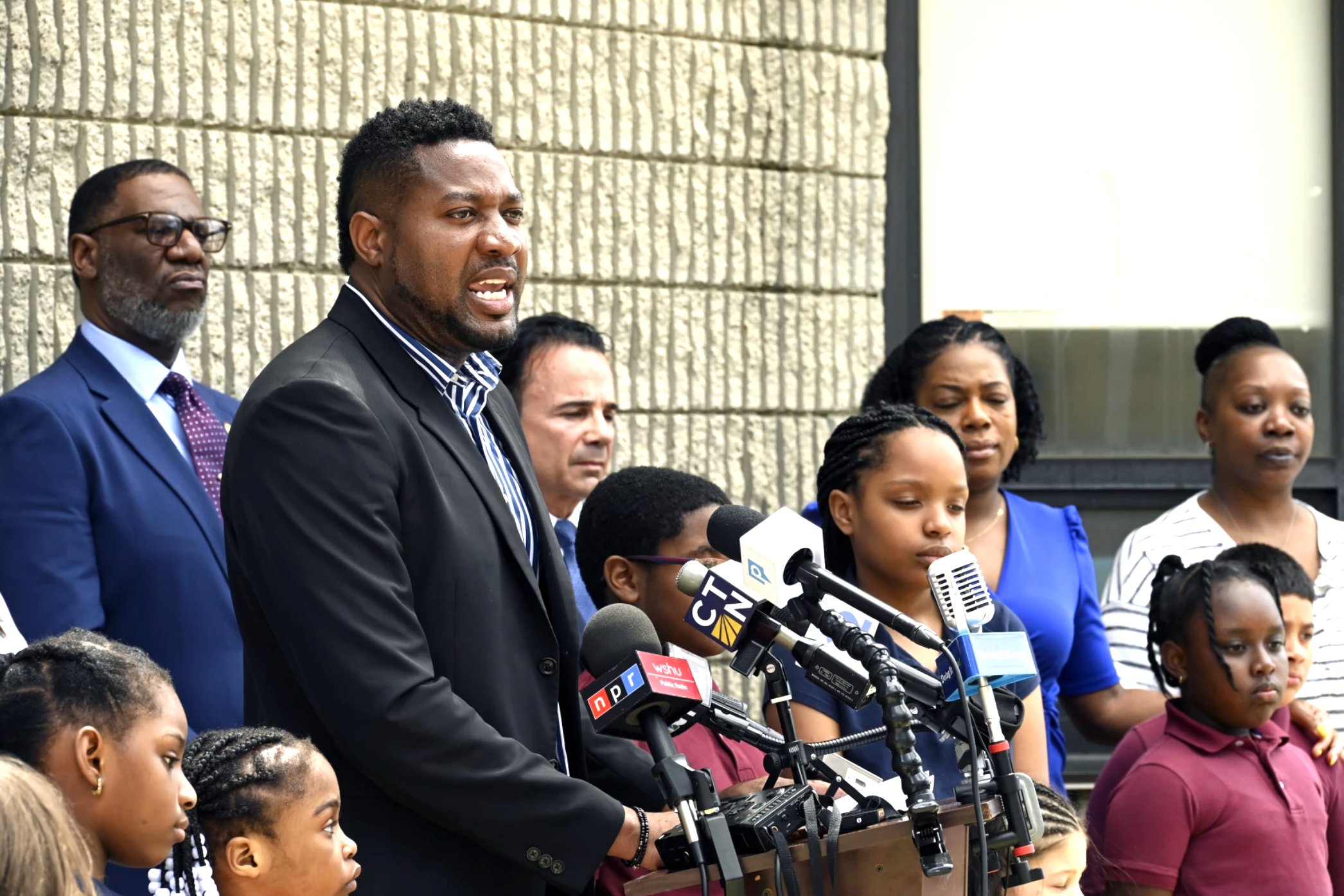
Sen. Herron Gaston, co-chair of the legislature’s Public Safety and Security Committee and a Democrat who represents Bridgeport, said schools must balance security concerns with the negative impact of over-surveillance.
“Black students are four times as likely as students of other races to be enrolled in high surveillance schools and communities. Students who are a part of these access-limited communities can find themselves paying a safety tax which impacts their academic outcomes,” Gaston said.
More support is needed to support students’ mental health, he said.
“We need to focus on providing services to our young people to address the root causes that lead to violent behavior,” Gaston said. “We need to invest in social programs that can reduce feelings of isolation, hopelessness and anger, which I believe research shows are common drivers of this violence.”
Tim Kearney, the chief behavioral health officer for Community Health Center, Inc, which has a presence in more than 150 Connecticut schools, says that students are afraid and they’re reaching out for support.
“There are more coming and the ones coming are more distressed,” Kearney said. “Every time they hear something, they wonder, ‘Is it gonna happen here? Is the next one gonna be me?'”
To combat that fear, Kearney encourages children and their parents to have open conversations.
“Try to talk about it together. Make a plan. Say, ‘We’re gonna do these things. We hope they never happen, but we need a plan to be safe.'”
Correction: A previous version of this story misspelled the last name of Jacqueline Colantonio, an ESL teacher in Bridgeport.