


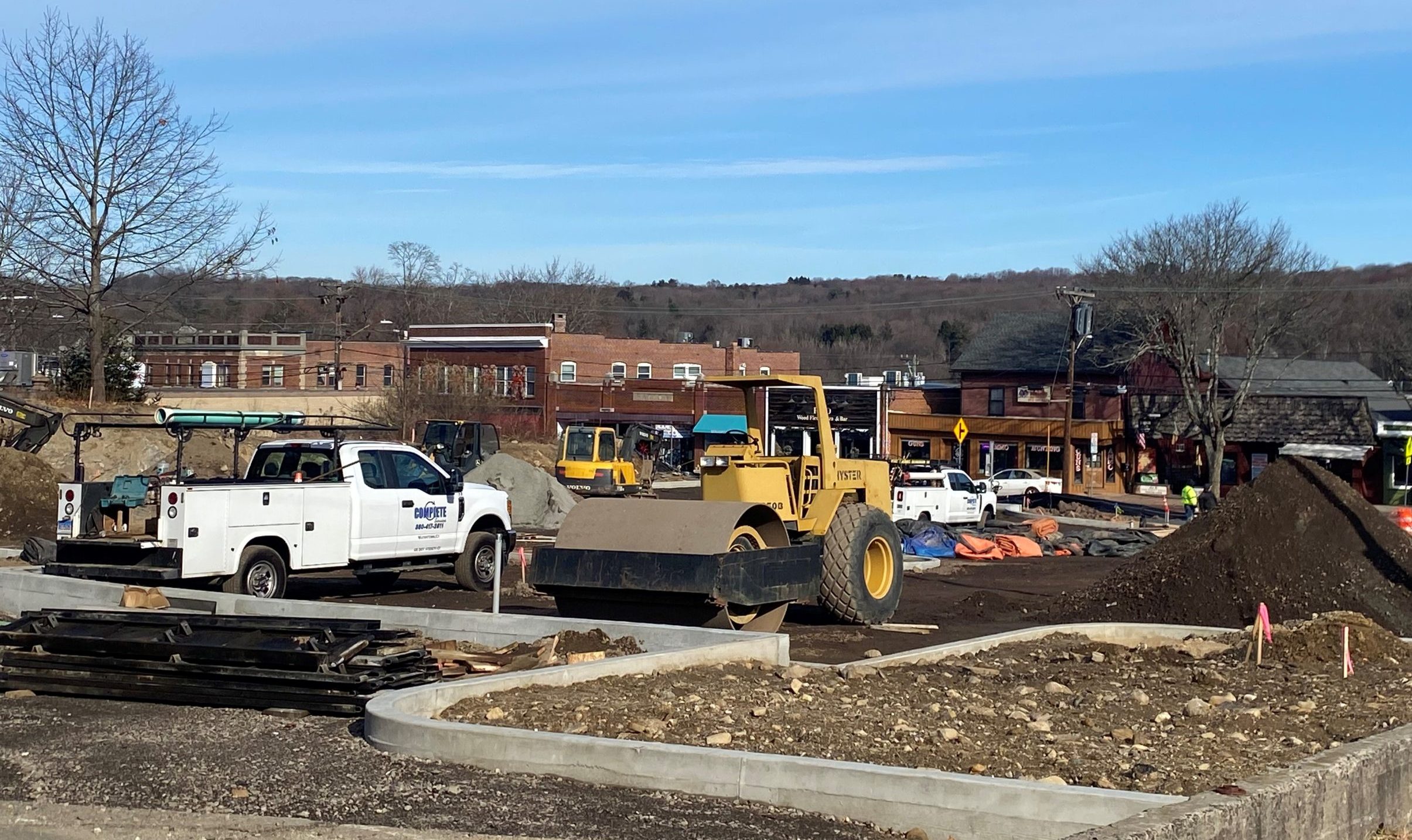
Erik Markiewicz, a former chairman of Watertown’s Republican town committee, cast a vote in early 2022 recommending the municipality spend more than $1.5 million in federal funds to purchase a property in town and build a new parking lot at that site.
Now, more than two years later, Markiewicz’s construction company — Complete Services — is being paid an undisclosed amount of money to construct that parking facility, prompting questions about how his business was selected for that work and whether his involvement in the project is ethical.
Markiewicz was one of 11 members of a town committee that provided recommendations to Watertown’s elected leaders about how to spend millions of dollars in federal relief funds that were provided to the town through the American Rescue Plan Act.
And he was one of nine people on that committee who supported the plan to purchase a 0.7-acre lot along Main Street where the town could construct a new parking lot.
Many Connecticut towns and cities established advisory committees to help municipal leaders decide how to spend the federal ARPA money they received in response to the coronavirus pandemic. In addition to the parking lot, Watertown also appropriated ARPA money for other sidewalk and paving projects.
Several officials in Watertown, including the chairwoman of the town council, said they don’t see any conflict between Markiewicz’s earlier vote as a member of the ARPA committee and his company being paid as part the ongoing construction project.
But not everyone in town agrees. A small number of elected officials and Watertown residents began questioning Markiewicz’s involvement in the parking lot project in recent months, after his company’s equipment was spotted the construction site.
“Seeing a member of the ARPA selection committee benefit financially from a decision he participated in is very poor optics and raises questions in the public’s mind about business ethics,” Richard Rozanski, a town resident, told the town council during a recent meeting.
Watertown’s ethics code and purchasing rules require town officials to advertise municipal contracts worth more than $25,000 and to solicit public bids for that work.
But Mary Ann Rosa, the Republican chairwoman of Watertown’s council, emphasized those laws do not apply to Markiewicz’s situation because the town did not hire his company directly.
“We didn’t have anything to do with it,” Rosa said.
Instead, Watertown officials structured the deal so that Mark Greenberg, the current owner of the property, would privately select a construction team to build the parking lot to the town’s specifications prior to the land changing hands, effectively circumventing the public bidding process.
Records reviewed by The Connecticut Mirror show the town estimated Greenberg’s property to be worth roughly $1 million, based on its tax value, and it agreed to pay Greenberg $1.5 million for the land and the finished parking lot.
Mark Raimo, the town manager, said the town initially intended to build the parking lot itself, but he recommended the town council drop that plan due to “frequent leadership changes” in the public works department and the town’s engineering team being tied up in other projects.
That decision ensured that members of the public were unable to review the bids for that construction work or to learn how much Markiewicz and other contractors are earning from the project.
Both Markiewicz and Greenberg declined to reveal how much Complete Services is being paid to build the new parking lot because they said it is a private business deal.
“That’s a private transaction between two businesses, and I’m not going to disclose that,” Markiewicz said.
“I do not want folks to start calculating what they think I may have netted on this transaction,” Greenberg added.
Greenberg, who owns a real estate company with properties across Connecticut, said he solicited a bid from one other construction firm prior to hiring Markiewicz’s company, but he said that business wanted far more money to build the parking lot.
Greenberg said he was already familiar with Markiewicz’s company, since they worked together on other construction projects in the past. But he said he was unaware that Markiewicz participated in the town’s ARPA committee until recently.
“I didn’t even know at the time that he was part of the panel that recommend the parking lot,” Greenberg said.
In an interview, Markiewicz said he played no role in the property negotiations between Greenberg and the town, and he said he consulted with an attorney prior to volunteering on the town’s ARPA committee in an attempt to clear up any ethical concerns that might arise.
“If I thought it was going to be an issue, I would not have sat on the ARPA committee,” he said.
Markiewicz pointed out that the town had been considering whether to build a new parking lot along Main Street for decades, and he emphasized that it was the town council, not the ARPA committee, that had final say over whether to use the federal funding to purchase the land and build the parking lot.
Raimo, who has served as the town manager for four years, acknowledged that Markiewicz’s involvement in the project might provide the appearance of a conflict. But he said it would ultimately be up to the ethics committee, which is made up town council members, to decide if Markiewicz actually violated Watertown’s ethics code.
“Although an ethical issue could be inferred, it should require further research to substantiate,” Raimo said, adding that no formal ethics complaint has been filed to this point.
At least one member of the town’s ethics committee is concerned about the public image that Markiewicz’s work on the project presents.
Rachael Ryan, one of two Democratic members of Watertown’s council, said it damages public trust to have someone making recommendations on a town committee and later profiting off the same projects they voted on.
Even if the town didn’t hire Markiewicz directly, Ryan said the project is still being paid for with public funds and undertaken with town oversight.
“I don’t know if any laws were broken, but many people in town are very concerned about this, and it certainly does not look good,” she said.
The town, she added, should do everything it can to avoid even the appearance of a conflict on taxpayer-funded projects.