



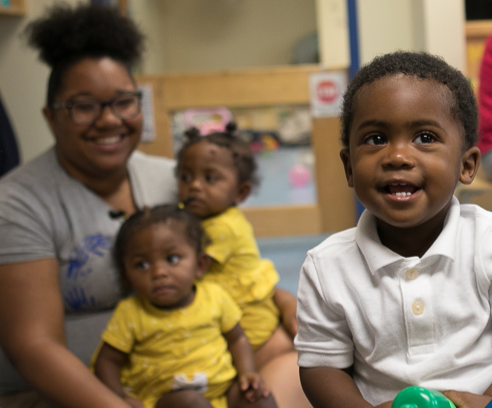
We live in challenging times, and children and families are struggling here in Connecticut, in America, and around the globe. Yet in times like these, there can also be great power in a public commitment to stand up for our young children. Ensuring no limits on their potential benefits everyone and provides hope for a better future.
We have a vision for all of our children.
Connecticut has a straight-forward vision for its young children, adopted nearly 20 years ago. All young children will grow up healthy, reach expected developmental milestones, come to kindergarten ready for the grand adventure of schooling, and leave the third grade reading well.
But data tell us we have not achieved this vision. Developmental screenings reveal that many young children are not on target at three. Six in ten require substantial instructional support at entry to kindergarten, and only half exit the third grade reading proficiently. In some communities that percentage is even higher.
Reclaiming early childhood
Standing with leaders in government, business, health and education, it is time to reclaim early childhood and declare the next ten years – from 2025 to 2035 – a “new decade for Connecticut’s young children and their families.”
We know what families and children need to build a strong and healthy next generation. An early childhood investment bundle would likely include universal screening and home visiting, early literacy, family and child preventive health and mental health care, early intervention, quality early care and education, and family economic and work supports.
We also desperately need real time data networks that can link child and family data to enable both accountability and quality improvement for the early childhood and family services that we do provide.
While it is certainly time for a sustained period of very focused investment in the early years of childhood across all of the service system, this becomes meaningless unless we have a goal in mind.
Here is one: By the end of the next decade (2035), all of this state’s young children will be healthy, safe and developmentally on target from birth to their exit from third grade, and their families will be supported to achieve early childhood optimal development. Children who are born this year, in 2025, will complete the third grade in 2034.
Fiscal responsibilities and challenges to meet
A first response to this goal is likely to be, “Oh, we have no money.” But here is the truth:
Recessions and other fiscal challenges come and go, and we have addressed those through our “fiscal guardrails.” Yet, while these guardrails now yield dramatic governmental savings and surpluses, they also prevent us from making investments in our children, families, organizations and communities. Part of the new decade for young children will require a re-examination of those guardrails, and this work has already begun at the state legislature.
Our elected leaders in state and federal government also come and go, sometimes bringing policy challenges with demonstrably negative impacts on children, their families, their communities and the economics of the state. Expected cuts to the federal Medicaid program is only the most recent example of these.
Yes, there will always be fiscal headwinds and other challenges to meet, but this fact cannot be accepted as an excuse for the lack of longer-term, strategic investment in the future of our young children.
A few concrete action steps. Here are five.
First, formally reclaim early childhood with a proclamation of Connecticut’s new decade for young children and their families. This could be accomplished by executive order or legislative action.
Second, assign each young child the current State Department of Education’s (SDE) unique identifier at birth. The SASID (State Assigned Student Identifier) is already assigned to children enrolled in the CT Birth to Three early intervention program and to all children entering kindergarten. It would simply be assigned earlier. This will help to ensure that children get the right supports at the right time, and its use will enable our policy makers to assert, based on data, that early investments do make a difference in early schooling.
Third, provide the CT Office of Early Childhood with one new position within the Birth to Three program to connect with the families of young children who are at risk of or experiencing mild early developmental delays. The criteria for enrollment in the state B-3 program addresses only a small percentage of children, leaving those with mild to moderate risk or delays without intervention. This small investment will reduce the need for later, more expensive special education services in preschool and elementary school.
Fourth, authorize the multi-year development of a Connecticut investment framework for young children and their families. This would include a first-ever fiscal mapping of “money in and money out” presently allocated to services for young children and their families. A national resource, the Children’s Finance Project, is eager to help us, and examining the current status of ARPA funds (and outcomes) is a good place to start.
The investment framework would also include the development of transparent cost models (including outcome data) for services known to produce results for young children and their families. A review of the state’s new universal home visiting program should be a starting point.
Then, align and integrate information from the mapping project and the investment portfolio as part of the new Connecticut Early Childhood Care and Education Fund.
Medicaid needs a special focus
Finally, one half of all Connecticut young children now receive their health care through Medicaid financing. The new administration in Washington says Medicaid will be on the chopping block. We must focus on using our Medicaid dollars to ensure annual developmental screening for all eligible young children, providing them with ongoing preventive care and needed interventions. Fulfilling the vision of the Medicaid EPSDT (Early Periodic Screening, Diagnostic, and Treatment) framework will result in child health benefits and a stronger partnership between parents and pediatricians.
The bottom line
Uncertainty about the future need not disable or defeat us. In fact, it should energize us to think differently, invest wisely, and revel in the resulting improved health and readiness of this state’s very precious resources, our young children and their families.
Janice Gruendel is Co-Founder of the CT 359 Network. The following additional signatories are all members of the CT 359 Network and have contributed as individuals: Karen List, Hillary Hahn, Anne McIntyre-Lahner, Allison Logan, Kay Johnson, John Prins and Robert Krzys.