


This story has been updated.
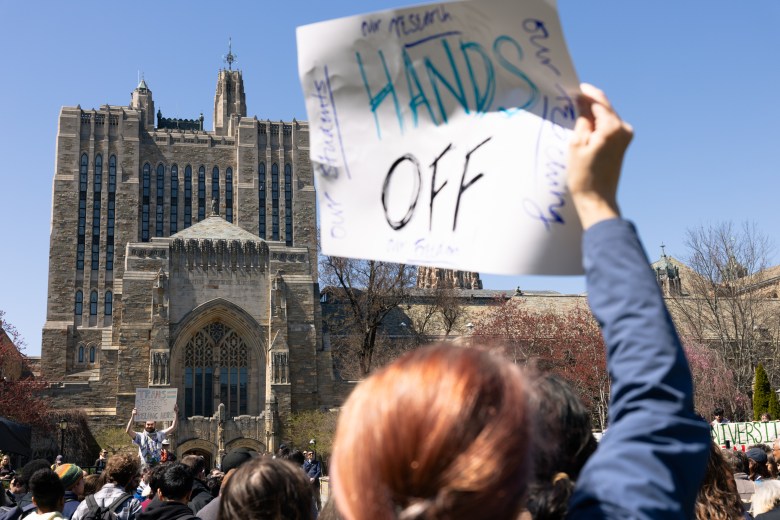
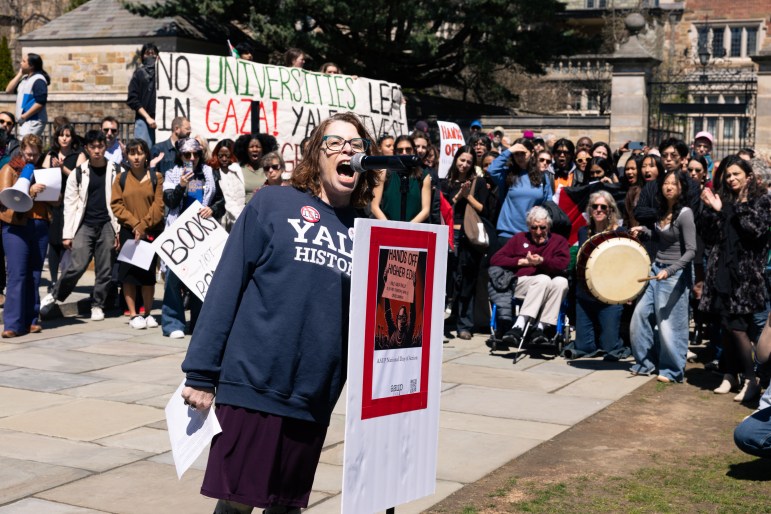
Professors, students and community members rallied on college campuses around Connecticut Thursday to denounce recent actions by President Donald J. Trump and his administration.
Hundreds of protestors at the University of Connecticut and Yale University gathered to oppose what they called an attack on higher education — including recent suspensions of research funding, cancellations of international student visas and what some see as a failure on the part of local officials to respond.
Chants of “Hands off our university!” rung out.
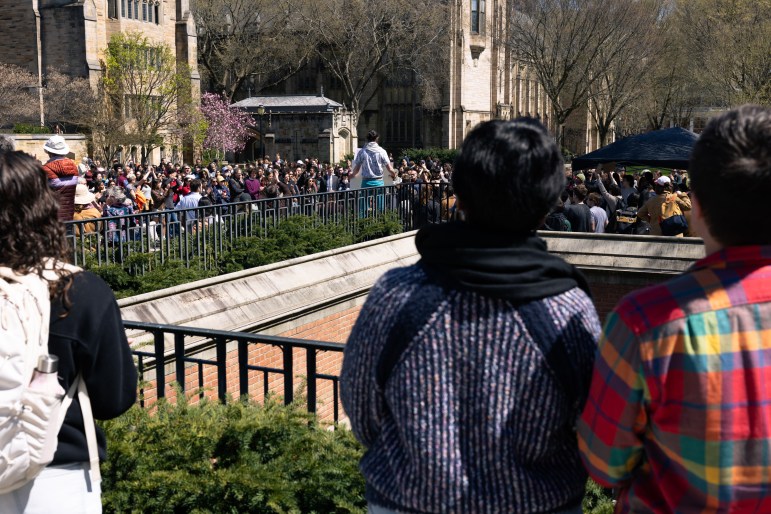
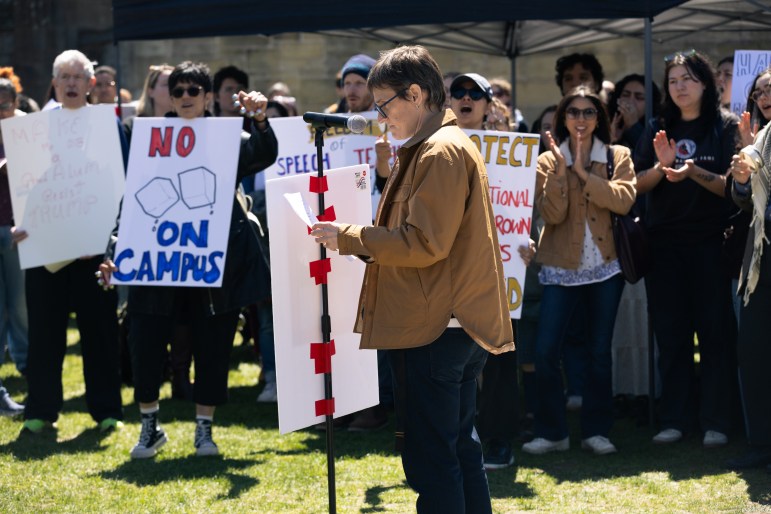
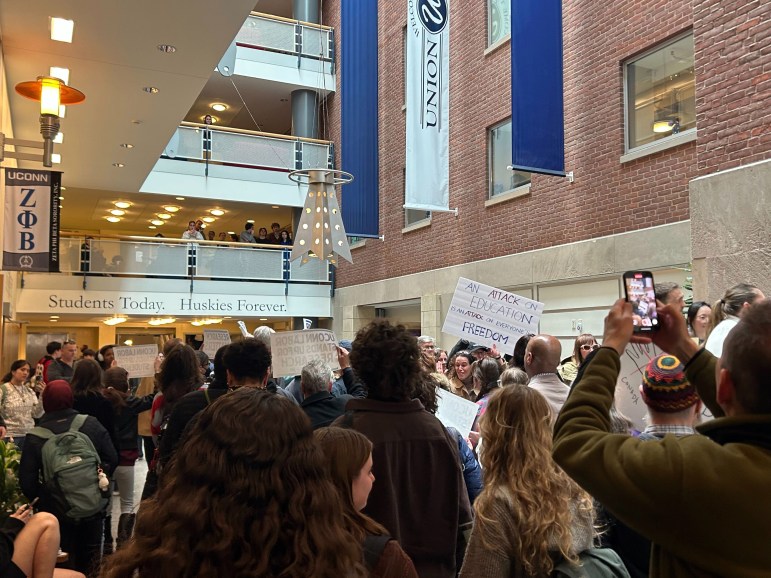
At Yale, roughly 500 faculty, students and community members gathered on the quad known as Cross Campus. Attendees held signs reading “Protect higher ed everywhere” and “Education not deportation.” About 60 miles northeast, more than 200 people at UConn’s Storrs campus participated in a similar effort, part of a national “Day of Action for Higher Ed,” organized locally by chapters of the American Association of University Professors.
According to organizers, the “day of action” included more than 175 gatherings around the country, including at Harvard University which has recently been at the center of standoffs with the Trump administration after threats to end the university’s ability to enroll international students and revoke its tax-exempt status.
“As we see universities across this nation speaking to our shared values, I know more than that ignorance is deadly, but that courage is contagious,” Phillip Atiba Solomon, chair of Yale’s department of African American studies, said while addressing the crowd in New Haven.
In Storrs, Chris Vials, an English professor and union president of UConn-AAUP, said, “We are facing a federal government that wants to do us harm, a federal government that is deporting students from this campus, a federal government that is cutting life saving research, a federal government that hates diversity … and a federal government that’s not even obeying the law.”
The rallies come as details emerge about international students at colleges and universities around the country seeing their visa status terminated by the Trump administration. In Connecticut, more than 50 students have had their visas revoked.
“The truth is students and workers across campus are scared for themselves and their friends, scared to go to class in case they get abducted by ICE, scared to be associated with anything vaguely political, scared to be here today,” said Lily Lou, a UConn political science graduate student.
“How are any of us expected to learn, teach or work in these conditions?” Lou said.
Student visas
Earlier this week, UConn confirmed that 13 students had their visas revoked, including six undergraduates, six graduate students and one person in a post-graduate professional program. The Connecticut Conference of Independent Colleges, which represents 14 higher education institutions, said at least 40 visas had been terminated among students at its member schools — which include Yale University, Trinity College, Quinnipiac University and Wesleyan University.
The revocations are part of a government effort that has left hundreds of students across the country at risk for deportation.
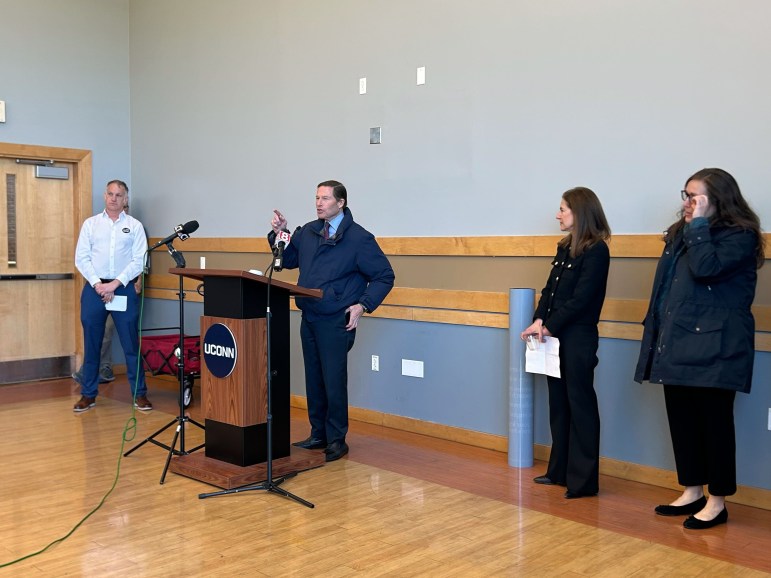
U.S. Sen. Richard Blumenthal, D-Conn., said Thursday he’d sent a letter to the Trump administration demanding details on how many visas had been revoked and guidance on what those students should do next.
“There’s been no due process, no apparent rights of appeal, no disclosure by this administration,” Blumenthal said on Thursday morning during a press conference at New Haven City Hall before heading to UConn to share similar sentiments. “I want the facts and I want the revocations to stop until they come clean with the American people about why these revocations are taking place.”

Later in the day, faculty at Yale described what they see as a “chilling effect” the administration’s actions have had on institutions of higher learning.
“Who is safe in this environment?” Kishwar Rizvi, a professor at the school of architecture, asked the crowd.
At UConn, Alexander Blagojevic, a biomedical engineering graduate student at UConn, echoed sentiments from Blumenthal and Rizvi. “The brightest minds in the world used to dream about coming here and calling this country home because they knew that this was a place you could come to make a difference,” he said.
“Now, all they dream about is jumping ship.”
Sen. Henri Martin, R-Bristol, ranking member of the Connecticut legislature’s Higher Education and Employment Advancement Committee, said Blumenthal “is seeking more information from DHS and the State Department about the revocations. He is right to pursue that clarity and get the facts in order to ensure fairness in the process, as our colleges continue to monitor the situation and provide guidance for students.”
Senate President Pro Tem Martin M. Looney, D-New Haven, and Senate Majority Leader Bob Duff, D-Norwalk, said in a joint statement that they “stand with the UConn and Yale communities and share their outrage at the unprecedented and ongoing Republican attacks on higher education, scientific research, freedom of speech, and human rights.”
“The students and faculty who are protesting in peaceful defiance of these senseless and often cruel actions should be commended for their conviction,” the joint statement read.
Research funding
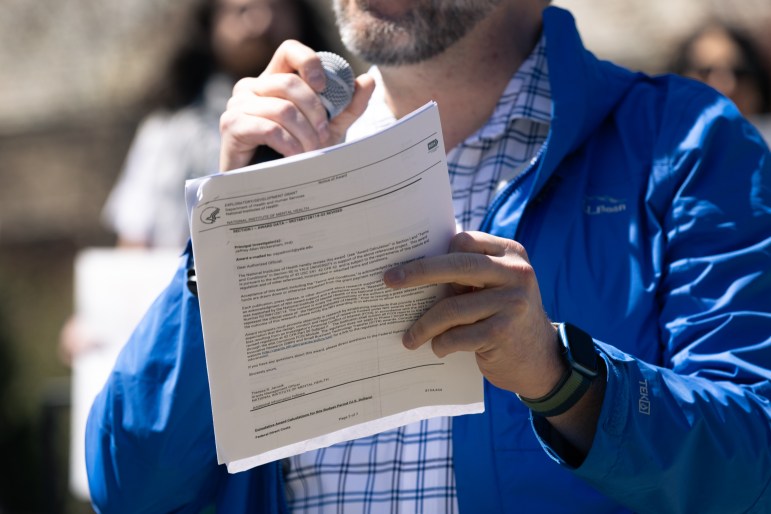
Rally-goes and lawmakers also spoke out about the Trump administration’s cuts to scientific research funding.
The National Institutes of Health has terminated nearly 800 research grants at academic institutions across the country. Last month, NIH announced that the funding it provides to grantees for “indirect costs” — like laboratory, utility and administrative personnel costs — would be limited to 15% of the grant award. Currently, the average indirect cost rate is between 27% and 28%, though some organizations have rates that are much higher, according to the agency.
Connecticut joined 21 other states in filing a lawsuit against the Trump administration shortly after the cuts were announced. In April, a federal judge permanently blocked implementation of the cuts, but the administration is now appealing that decision.
During the Thursday morning press conference in New Haven, Arita Acharya, secretary-treasurer of UNITE HERE Local 33, which represents graduate teachers and researchers at Yale, spoke about the critical role that NIH funding has played in advancing life-saving treatments. “Many illnesses, including aids and breast cancer, kill far fewer Americans now than they did 30 years ago, due to medical advancements developed at our universities. Technological innovations made in engineering labs across the country have grown our economy year after year,” Acharya said.
Jeff Wickersham, a professor of medicine who’s been at Yale for 15 years working on HIV treatment and prevention, told the crowd on the Cross Campus quad that in March of this year he’d received his first ever NIH grant termination notice.
“There is a chokehold on funding right now,” Wickersham said. “Only 50% of the funds that should have been awarded so far this year have been awarded, and we are here today to say: No. Stop this.”
Cuts to medical research also resonated at UConn, where Blagojevic said he feared what it could mean for people like him. As a cancer survivor, he said, “every single drug in my chemo regimen was developed in full or in part by NIH research.”
“So thank God that Republicans didn’t cut NIH 20 years ago because I would be dead right now,” Blagojevic said. “We’re not just talking about numbers on a spreadsheet. We’re not just talking about numbers on a budget report. These are human lives. These are our futures.”
Adam McCready, who works within UConn’s Neag School of Education, said his department is also facing cuts. His team had been working on research regarding the connection between student technology and digital literacy, school intervention and the impact on academic outcomes for middle schoolers, but the work was cut short abruptly and without notice, he said.
“Our work and some of our team members livelihoods are in jeopardy, all because it was deemed wasteful spending,” McCready said before leading a chant.
“No research, no knowledge, no progress,” the crowd shouted.
CT Mirror Reporter Emilia Otte contributed to this story.
Correction:
An earlier version of this story misattributed a comment from Arita Acharya, secretary-treasurer of UNITE HERE Local 33, to Sen. Richard Blumenthal.