



This story has been updated.
For decades, minority-owned businesses in Connecticut have struggled to win contracts to do work for the state — despite a nearly 50-year-old program requiring that a certain percentage of state contracting funds be awarded to businesses owned by people of color, women, veterans or people with disabilities.
In 2021, in response to concerns about underrepresentation of minority businesses and the alleged presence of “front businesses” taking advantage of the system, the legislature commissioned a study examining whether state contracts were being awarded fairly.
Last December, the results of that study were published — and they largely validated the concerns minority contractors have raised for years.
But business owners say lawmakers have thus far failed to take meaningful action in response to the findings.
According to the report, conducted by consultancy Griffin & Strong, about 14% of all construction firms in Connecticut are owned by Black individuals. But between 2017 and 2021, these firms received only 0.57% of state contracts valued at less than $1 million. Of the $544 million spent on these contracts in total, $91 million went to firms owned by women and minorities — or roughly 17%.
The law requires that the state reserve, or “set aside,” 25% of its contracts for small businesses and minority-owned businesses.

Colin Dawkins, chair of the construction committee of the Greater Hartford African American Alliance and vice president of MCM Acoustics in Hartford, said the study didn’t capture the full scale of the challenge minority contractors face, since it did not factor in work at the University of Connecticut, Connecticut State Colleges and Universities or any of the quasi-public state agencies.
Aside from the state not meeting its mandate on contracts, minority subcontractors describe barriers across all aspects of the business: from seeking a line of credit from banks, to paying higher prices for materials and experiencing poor treatment by lead contractors on projects, including delayed payments.
“I just think that if it doesn’t get fixed now, we might have to wait until another 15 years for them to do another disparity study in order to fix what needs to be done,” said Dawkins.
In the wake of the Griffin & Strong report, lawmakers drafted legislation this year that was intended to ease some of the barriers faced by business owners.
The bill removes the 25% set-aside requirement, and instead assigns the state’s Commission of Human Rights and Opportunities to annually “establish goals for including small contractors and [minority business enterprises] on all public works contracts to attain parity with the availability of contractors required for the specific contract according to their industry and the relevant geographic area,” according to a nonpartisan analysis of the bill. CHRO would also be given a greater ability to penalize lead contractors who do not treat minority subcontractors fairly.
CHRO, which currently oversees the set-aside program and played a large role in drafting the legislation, said it’s meant to give the agency a greater ability to hold large contractors accountable for their treatment of minority subcontractors.
“This bill represents an important opportunity for Connecticut to address continuing disparities within state contracting while improving a program that aims to keep state contracting dollars within the state and giving all businesses, including small contractors and [minority and woman-owned business enterprises], an equal chance to compete for those dollars,” Tanya Hughes, executive director of the CHRO, wrote in testimony.
But owners of minority construction businesses who spoke with the Connecticut Mirror said the legislation won’t address the real barriers that keep small contractors like them locked out of state projects.
“ It’s clear that the author and the architect [of the bill] have little understanding of the plight that minority businesses are facing contracting. They’re the ones who are supposed to know what we’re facing,” Bernard Thomas, the owner of Global Construction Services LLC and Vice President of the Minority Construction Council, said. “If not, ask. Don’t write up [a bill] and assume that … what you’re writing is good enough for the minority contractors.”
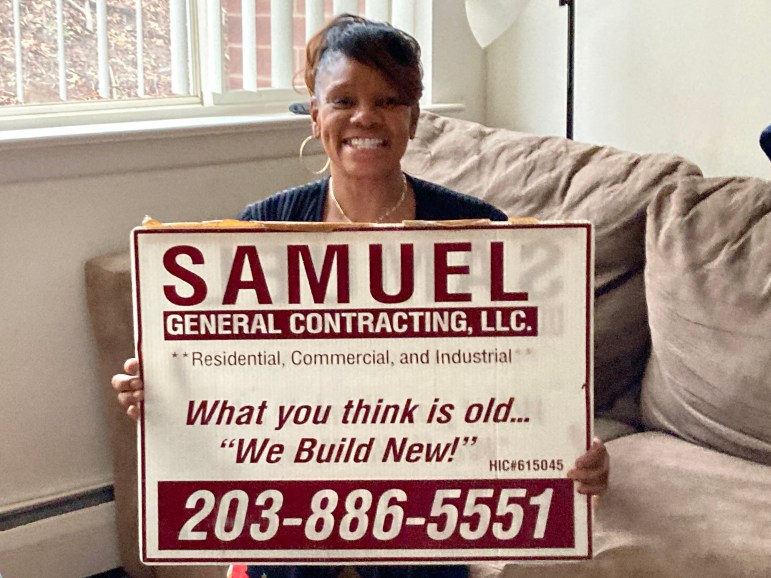
Gwen Samuel, former owner of Samuel General Contracting, said it didn’t make sense for CHRO to continue to oversee the set-aside program when it was under that agency’s watch that the disparities found in the study were allowed to propagate.
“ My concern with this whole [bill], it still doesn’t hold Connecticut accountable to fair practices,” Samuel said.
An ‘aspirational’ program
In 1976, the state created a voluntary set-aside program for small businesses. A senator who spoke during a debate at the state Capitol at the time said the program was designed to keep a few large contractors from overtaking all the state contracts. The next year, the legislature made the program mandatory, and in 1982 it expanded the program to include mandatory set-asides for minority-owned businesses.
Lawmakers in office at the time the minority-owned set-asides were created said they were intended to help minority businesses during a difficult economic period and create jobs in communities with high unemployment. At the time, a representative of the CHRO also noted that only a small number of minority-owned businesses were accessing state contracts.
Subsequent changes to the law expanded the program to cover all state agencies and quasi-public agencies and increased the percentage of contracts that needed to be reserved for small and minority businesses.
The current set-aside program requires that the state reserve 25% of its contracts for small businesses and minority-owned businesses. A quarter of that — 6.25% of contracts overall — must be granted to businesses owned by people of color, women, veterans or people with disabilities.
In testimony to lawmakers in 2021, when the legislature was considering a disparity study, Hughes of CHRO pointed out that the last time the state studied the program was 1992. “The diversity and economy of Connecticut has changed substantially in almost 30 years,” she wrote, adding that a more “accurate picture” of the challenges facing minority contractors, “ensure equity and equality in state contracting by affirmatively addressing underutilization.”
Ultimately, last year’s Griffin & Strong disparity study characterized the program as “aspirational” rather than setting solid requirements for contracting, and it concluded that the state has failed to meet those goals in multiple categories of contracting for nearly every minority.
A range of problems to solve
This year’s proposed law, which advanced out of the legislature’s Government Administration and Elections Committee in late March, incorporates a recommendation from the disparity study to shift from having overarching set-aside goals to having the CHRO decide on a project-by-project basis what percentage of the work should be reserved for minority businesses.
Attorney Spencer Hill for the CHRO told CT Mirror that this was to ensure that what they were doing was legal, since the state constitution only allows race to be used narrowly as a criteria in government programs.
“You want to be very narrowly tailored and have a focused approach, to ensure that you’re being as effective as possible and not being overly broad and relying on race in any way that’s inappropriate,” Hill said.
Still, contractors said there were other problems with the set-aside program that the legislation failed to address.
For one, Colin Dawkins said, he believes the definition of “small” business is too large. Under federal guidelines, a masonry, framing, poured concrete or roofing contractor can make up to $19 million annually and still be considered a small business.
Furthermore, the study referenced concerns from state staffers about “fronts” — situations where firms owned by men were registered in a woman’s name to make the business appear to be female-owned. According to the study, about one-third of business owners Griffin & Strong surveyed were under the impression that non-minority or woman-owned companies were misrepresenting themselves in order to circumvent certification requirements.
Data from the disparity study shows that in construction, Black-owned businesses earned only 0.3% of the total amount of money the state paid out directly to contractors between 2017 and 2021. Non-minority woman-owned businesses earned 7.22% of the money during the same time period.
Leigh Appleby, spokesperson for the state’s Department of Administrative Services — which administers state contracts — said in an email to CT Mirror that while the department has heard anecdotes about this for years, it “employs a rigorous review to prevent such things from happening.” He said DAS conducts random site visits, and that falsely placing a male-owned business under a woman’s name can be punished by fines or disqualification.
“DAS procurement has never disqualified a business based solely on a false representation of minority ownership,” Appleby said in a follow-up email. “In some cases, it has been determined that the certification as a small business is justified, while the certification as a minority-owned business is not.”
One woman quoted in the study, a construction firm owner, also said the state had begun to crack down on those “fronts” by interviewing companies to confirm ownership.
Along with changing the set-aside program, CHRO attorney Hill said, the bill was also designed to increase the CHRO’s ability to oversee construction projects in real time and penalize contractors who do not follow through on efforts to engage minority businesses.
Hill said the agency typically receives “a handful” of complaints each year from minority contractors. Most come from contractors who say they believed they were selected by a lead contractor to be part of a project solely in order to meet state requirements for minority contracting, and were later dropped from the project.
“Small and minority contractors deserve the chance to compete in a level, fair marketplace.”
Bernard Thomas, Global Construction Services LLC
He said that new reporting requirements outlined in the bill would allow the commission to catch any problems in the contracting process early on, rather than in a review period at the end of the project.
Additionally, the commission would withhold 2% of the contract cost until their review was completed.
But Bernard Thomas of Global Construction Services said in testimony to the legislature that the bill did not address inequities in the state’s contracting procedures “by any stretch of the imagination.”
Thomas said he believed there was no way to hold towns or state agencies accountable when they fail to bid the project properly, and he said a $10,000 fine for violations of the law was “laughably low,” especially for out-of-state companies or contractors who only do business with the state on occasion.
“Small and minority contractors deserve the chance to compete in a level, fair marketplace,” he wrote.
Several state agencies also raised concerns about the bill’s intent to set project-by-project goals, saying they felt it would delay projects.
Office of Policy and Management Secretary Jeff Beckham said the state needed better data collection in order to comply with the bill’s requirements, and DAS Commissioner Michelle Gilman questioned what would happen if available contractors did not bid on the contracts. Gilman also noted that requiring CHRO to set goals for each project without a clear timeline could stall projects.
Hill said he believed that the new requirements would not cause the delays that the state agencies feared. “We hear their concerns about efficiency. We don’t want to be holding anything up. But I don’t think that the processes are as labor intensive as they’re kind of painting it as,” he said.
Even if there are some delays, he said, making sure tax dollars are properly spent is critical.
“It would be very efficient to not have oversight and just give out tax dollars without anyone scrutinizing where they’re going or why. But as the state of Connecticut is saying, we need to be better than that,” Hill said. “If there is oversight that needs to happen, we’re not going to sacrifice that just for the sake of business expediency.”
‘Bigger, better breaks‘
Minority contractors say they operate within a system that favors larger, established firms over theirs. That disadvantage is present in every step of the process, from bidding to purchasing materials, they say.
Michele Clark Jenkins, Director of Research and Methodology for Griffin & Strong, told attendees at an informational session that more than half the firms they spoke with for the disparity study described an “informal network” that they said was “monopolizing public contracting with the state.”
Clark Jenkins also made recommendations around CHRO’s accommodations of lead contractors’ “good faith efforts” — a concept that minority subcontractors have criticized. Under current policy, lead contractors who have made “good faith efforts” to reach out to minority businesses can be exempt from the set-aside requirements. But Clark Jenkins said their research showed that contracts were being awarded whether or not that “good faith effort” was made.
CHRO Executive Director Hughes said in an email that the new bill would improve the agency’s ability to assess good faith efforts from the start of a project.
In response to comments about an “informal” or “old boys” network, Appleby said DAS “follows all statutory guidelines concerning procurement,” limits how many contracts one business can have at a time, and has “worked to expand the breadth of our outreach when advertising to reach a wide swath of potential bidders.”
There are other roadblocks within state requirements, business owners told CT Mirror.
State rules require that contractors provide 10% of the total amount of the bid for any project over $50,000 up front. This is known as a “bid bond,” which acts as a kind of security deposit proving that the contractor will complete the project.
Dawkins said many minority contractors aren’t able to access bid bonds at a level that would allow them to compete for multiple large contracts at once. They don’t have a large amount of assets, and any hits they take on credit can detract from their ability to get a bond.
Both Dawkins and Rollo Jones, the owner of Capital Masonry LLC in Hartford, said getting a bank or insurer to sign off on a bond was about relationships. Larger construction companies, they said, have established credit lines they can draw on.
In addition, minority companies often pay more for materials like sheetrock and drywall. Larger firms are able to purchase in bulk, Dawkins said, meaning they often get a better per-unit price.
“The big guys, they get bigger, better breaks. They get better deals, they get better contracts,” Rollo Jones told lawmakers.
With higher material costs, minority business owners say they can’t always complete a project at a low price comparable to what larger firms can offer.
Dawkins suggested the state could eliminate the requirement for bonding for minority contractors for any bids of $500,000 or less. This way, he said, smaller businesses that couldn’t afford a bid bond would have a chance at getting a contract.
But Appleby said bonding protects taxpayer money if a contractor fails to complete their contract, and that it also protects workers and subcontractors if the contractor who hired them ends up unable to pay them for labor or materials. He said having a bond provides evidence that a contractor is financially stable.
Another problem businesses cited was the sometimes lengthy periods they wait to get paid for their work. Although the state requires minority contractors to be paid within 25 days, about 45% of the contractors surveyed in Griffin & Strong’s disparity study said it took at least a month and a half to receive payments from the state.
For about 10%, it took three months or longer.
‘A domino effect’
Rollo Jones and his wife Rochelle say they’ve experienced many challenges with their business, Capital Masonry, in the 30 years it’s been operating.
In one case, the company was contracting in Hartford for a project with the state Department of Transportation. Rochelle said they completed the job in September 2023 but didn’t receive their last check until December 2024.
“I’ve never seen anyone who worked so hard to do a job and yet does not get paid on time,” Rochelle said of Rollo. “We have a contract we write up, [it’s] supposed to be recognized, but it’s never recognized.”
Department of Transportation Communications Director John Morgan told CT Mirror in an email that the department “has frequent communication and dialogue with Prime Contractors” about payments, and that the department is rolling out a new system that will monitor payments and give subcontractors more access to the department.
Morgan said the primary contractors who receive payment directly from the department can delay payments to subcontractors “based on quality assurance and quality control of the work that was performed.”
“If you don’t pay me on time, then I can’t pay my vendors, I can’t pay my taxes … It’s a domino effect.”
Rollo Jones, Capital Masonry LLC
But such delays can put small contractors in a tough position, particularly if they need to make payroll and they don’t have much in savings to draw on. It can also prevent them from taking on additional jobs, and it can hurt their credit.
In October 2019, Rollo filed a complaint with CHRO against a lead contractor, Viking Construction, whom he alleged had refused to pay Jones the full amount for the work they did and treated him “unprofessionally overall.”
CHRO ultimately ruled, in May 2022, that there was “reasonable cause” to believe that Jones had been discriminated against based on race. But Rochelle told CT Mirror that even with the CHRO finding, Capital Masonry was paid only a fraction of the amount they were owed.
(Viking Construction attorney Jeffrey Mirman told CT Mirror in an email that Jones entered into a confidential agreement, withdrew his complaint from the CHRO and that Jones later signed a document in which it stated that he had been “paid in full.”)
Rochelle said she felt the CHRO didn’t support them during hearings after the finding of probable cause, instead encouraging them to come to an agreement with Viking. In the midst of difficulties with her own lawyer, she said, she felt pressured to acquiesce.
Hill declined to comment on specific cases, but said the CHRO does not represent any one party in proceedings.
“If you don’t pay me on time, then I can’t pay my vendors, I can’t pay my taxes, you can’t pay your guys, it’s a domino effect,” Rollo Jones said. “That destroys you. You can’t go to a lender. You can’t go to a bank. You can’t get any material. You can’t get anything. It really destroys you.”
‘We should be embarrassed‘
Thomas, Dawkins and the Joneses asked members of the legislature to place woman-owned businesses in a separate category from ethnic minority-owned businesses, and they asked for the state to require subcontractors be paid on time. Dawkins also recommended eliminating bonding requirements for minority contractors taking on smaller contracts.
Lawmakers who heard the contractors lay out the minefields they faced said they agreed the legislature needs to address the long-running problems.
“That level of disparity is just a shame. And to be perfectly honest, I agree with you,” Rep. Joshua Hall, D-Hartford, told Jones at the hearing. “We should be embarrassed as representatives of our community that we’ve allowed this to transpire.”
Earlier in the session, Hall proposed his own bill that would have eliminated the bonding requirement for all contracts of less than $1 million. The bill failed to receive a public hearing.
“Our legislative people do not push on these issues,” Thomas told CT Mirror. Thomas said he felt the bill had been drafted “behind closed doors,” without necessary input from the contractors.
CHRO Executive Director Hughes said in an email to CT Mirror that the agency had been in contact with the Minority Construction Council and had updated the council throughout the process about their plans to address what was laid out in the disparity study.
Jennifer Little-Greer, president of the Minority Construction Council, declined to comment for this article.
Rep. Derell Wilson, D-Norwich, vice chair of the Black and Puerto Rican Caucus, told CT Mirror that the bill was still being negotiated. He said while caucus members took the disparity study’s findings seriously, they’re still working to find the right way to help the minority contractors while staying within constitutional boundaries.
“ We are all-in about this. I think that’s a no-brainer. I think for us [it’s] making sure we create something that’s, one, going to last [and] two, going to be beneficial and helpful. And we know that that’s not something that’s going to happen overnight,” Wilson told CT Mirror.
Black and Puerto Rican Caucus Chair Antonio Felipe, D-Bridgeport, confirmed to CT Mirror Thursday that negotiations were ongoing. He said they were discussing ways to ensure prompt payment to contractors and to verify that major contractors made “good faith efforts” to reach out to minority businesses.
Felipe said lawmakers likely wouldn’t be able to include everything the minority contractors requested, but he said he hoped they could fill some of their requests this year and build on that work next year.
‘This is about fairness’
The contractors said that having minority business owners flourish does more than add diversity to an industry — it provides jobs in communities where people are in need of work. These contractors often train and employ residents of areas with high rates of poverty and unemployment.
Gwen Samuel, the former co-owner of Samuel General Contracting, said she wants to restart the business this summer with a specific goal: training young people in construction.
“They may not be skilled in engineering and plumbing,” she said. “But you can get a basic entry job and make a livable wage in construction.”
At a public hearing, Samuel urged lawmakers to invest in minority companies, calling it a “fiscally sound decision.”
Dawkins used to run a program teaching incarcerated people at Cheshire Correctional Institute about construction and helping them get certified, before COVID shut it down. He also crafted a proposal years ago to train young people in construction and then have them fix up blighted houses. “ It’s been a passion of mine,” he said.
And the Joneses have been offering classes for decades to people coming out of prison who want to learn a trade. They offer six to eight week classes in things like concrete, carpentry and electrical work. They help them get an OSHA card and a driver’s license.
Samuel said minority contractors aren’t looking for “help” — what they want is a system that they can operate in.
“This is about fairness,” said Samuel. “We could help ourselves if we have fair access to the opportunity.”
Corrections and clarifications:
An earlier version of this story misstated Colin Dawkins’ roles with the Greater Hartford African American Alliance and MCM Acoustics. He is chair of the alliance and vice president of MCM Acoustics.
The earlier version of the story also misreported that the Griffin & Strong report exclusively studied school construction projects. The report examined contracts executed by a range of state agencies, not including public higher education institutions and quasi-public agencies.