


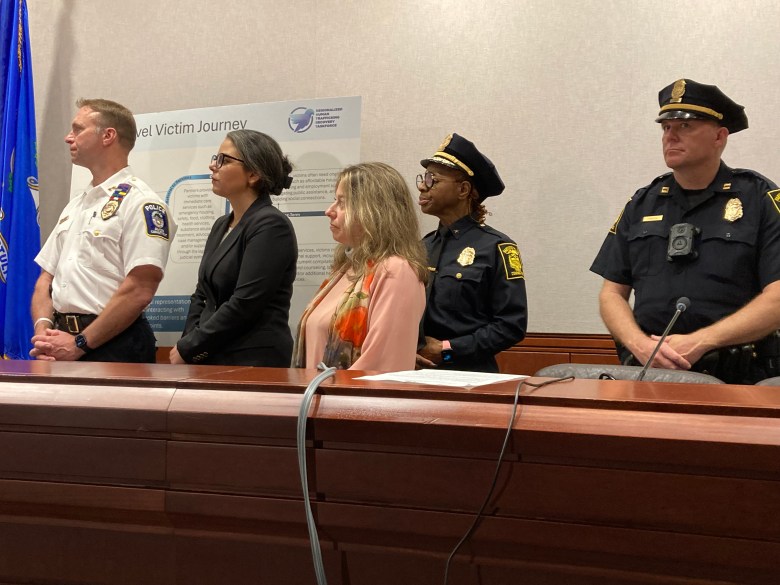
Police officers, nonprofits and state agencies are seeking better ways to help human trafficking victims in the wake of a new report detailing the weaknesses in Connecticut’s judicial system, law enforcement, child welfare agency and human services organizations.
The report, released Tuesday by the Regionalized Human Trafficking Recovery Taskforce of the Greater Hartford Region, listed several major findings. Community services are backlogged. The system is disconnected across the state. Specialized training for professionals is limited. Victims hesitate to trust and collaborate with law enforcement. And the criminal justice system and court cases against perpetrators can drag on for extended periods of time.
Erin Williamson, the chief programs and strategy officer of Love146, which serves children across the state who have been trafficked, said victims need specialized help from professionals who have been trained in helping people who have gone through this type of trauma.
“This is such a complex victimization,” Williamson said, speaking at a press conference Tuesday. “It really is where your body is commodified. We have had children who have been sold for different amounts based on their race. Their understanding of their value and their worth is embedded in their victimization,” she said.
Between 2022 and 2024, the Greater Hartford task force supported 27 children and 22 adults who were human trafficking victims, 94% female and nearly three-quarters victims of sex trafficking. According to the report, the number of investigations in the greater Hartford region has risen 200% during that time period.
The report looked at a variety of ways that children and adults can be identified and receive services — through law enforcement, through the state Department of Children and Families, the Children’s Advocacy Center, the courts or community providers. It identified the major barriers that victims face at each stage and made recommendations for how the state can improve its practices.
Williamson said her organization has had wait lists for long-term services for children since 2019. Currently, she said, they have 35 children on their waitlist.
Since the pandemic, the needs of the children Love146 serves — who fall mostly between the ages of 13 and 17 — have increased, Williamson said. The organization now works with them for longer periods of time, from nine to 18 months, and they’re increasingly housing insecure, food insecure, and have mental health needs. Every time Love146 has expanded services, they’ve reached capacity in a matter of months, Williamson said.
The increased need for help comes amid rising uncertainty around funding. Williamson said Love146 hasn’t experienced funding cuts but she’s worried about the future of funding under the federal Victim of Crimes Act, which makes up about half of the organization’s budget.
With the expiration of federal COVID-19 relief funds, the amount of money Connecticut can distribute to agencies serving victims is expected to drop 29% next year, according to Marc Pelka, deputy director of the Judicial Branch’s Office of Victim Services.
A particularly vulnerable population
Police officers said working on human trafficking cases presents myriad challenges.
For one, Avon Police Chief Paul Melanson said, it can be hard to identify. An officer might arrest someone for prostitution without realizing that person is being trafficked.
And Melanson said perpetrators take advantage of individuals in circumstances where they’re afraid to seek help from law enforcement. He said partnering with nonprofits that provide services to victims helps increase that trust.
Captain Jeffrey Rousseau of the Hartford Police Department said human trafficking is highly underreported. He estimated that the number of actual victims could be eight to 10 times higher than the number recorded by the state.
Officers said young teenagers, in a desire for independence or for attention, might be taken in by traffickers. “They appeal to all your insecurities,” said Hartford Deputy Chief Sonia Watson.
While there are wait lists for children’s services, the report noted that adult services are especially scarce. Over half of adult victims were under the age of 23, the report found.
Teams of trained professionals who work with trafficking victims — known as Multi Disciplinary Teams, or MDTs — exist around the state for child victims, but are present only in Hartford for adults. And unlike for children, no one is mandated to report suspected abuse for adults.
Williamson said she was particularly concerned about the adults between the ages of 18 to 25. “That is such a critical period in starting on the right trajectory for positive outcomes, both in terms of economic and mental health and physical health,” she said.
“Sometimes it can feel for these victims like there’s a cliff,” Williamson said. “They hit 18 and then all the systems change.”
The task force report recommended that the state improve its data tracking, look for more funding sources for victim services and find ways to address labor trafficking. It also recommended creating human trafficking task forces for regions across Connecticut as well as a statewide task force or agency.
The report will be presented to the state’s Trafficking in Persons Council on May 15. The task force will then form a group to make recommendations to address problems that the current system faces.