



|
Getting your Trinity Audio player ready...
|
Editor’s note: We are now offering an audio version of our Sunday features. To access, click on the player above.
When the Neighborhood Health workers first met this homeless man in Hartford, they weren’t sure he would be able to get around on his own again, or even if he’d survive. The flesh was rotting off his feet, and his tendons were exposed from frostbite.
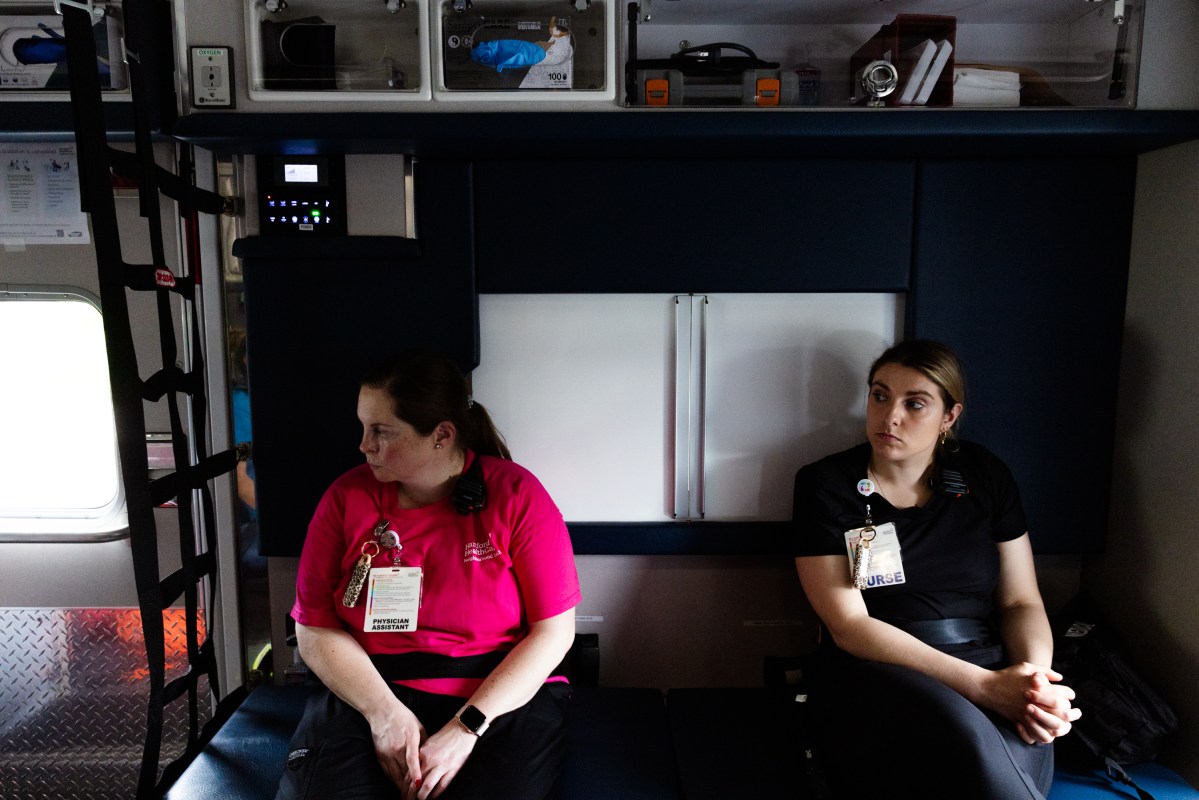
But last week, squeezed into the back of the former ambulance they use to get around the city, they were watching a video of the man taking some of his first steps on new prosthetic legs. They craned their necks to see their colleague’s phone.
They could see the patient smiling, hesitantly pushing a walker as he meandered down a hallway.
The man had been living on the streets of Hartford over the winter and couldn’t get into a shelter. As the homeless population has risen, shelter space has become more scarce and scenarios like his more common.
The Neighborhood Health workers, employees of Hartford HealthCare, cheered when they saw him walking with the prosthetics. Then they climbed out of the ambulance, grabbing gloves on the way. They had more patients to help, more people with complex health care issues like his.
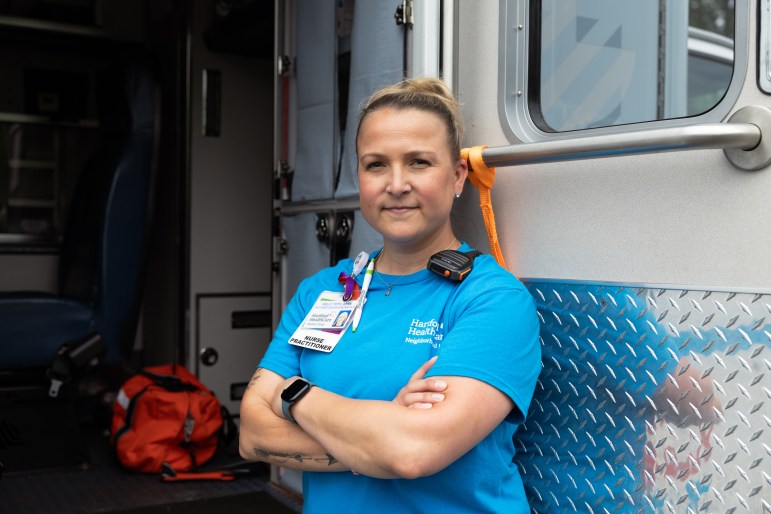
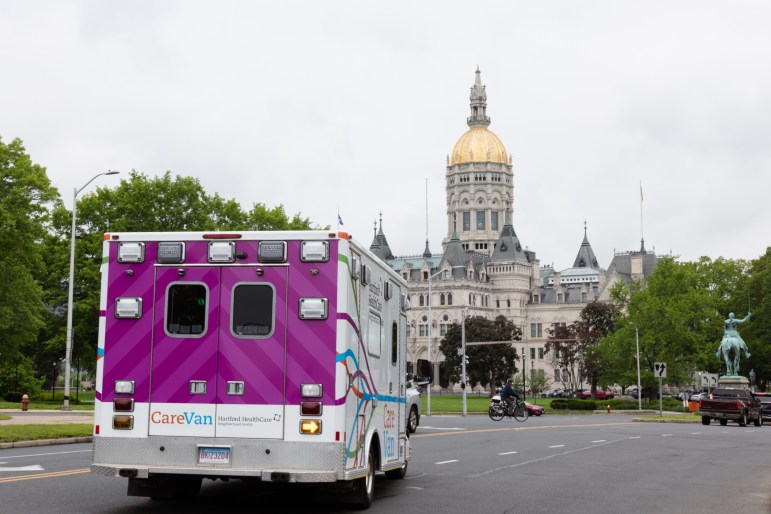
Launched in 2021, the team drives a refurbished ambulance to shelters or encampments, then provides health care on-site for people experiencing homelessness. They’re out nearly every day.
In recent months, as more people, particularly seniors, have lost their housing, health workers are finding that the cases they handle are more complicated. People often have multiple diagnoses, and with older age groups, there are often health complications that make the illnesses or injuries harder to treat. Sometimes, conversations are veering to end-of-life care.
These conversations between health care professionals and patients are poignant as state lawmakers debate funding for the systems that offer shelter and other services for the unhoused population. The providers that would benefit from the state support — none affiliated with Hartford Healthcare — could help prevent many of the injuries the nurses see in the first place, health care workers said.
Homelessness in Connecticut increased by about 13% from 2023 to 2024. Recent data from the state’s response system shows that nearly 6,000 people are experiencing homelessness, and nearly 1,000 are living outside instead of in shelters. Providers have asked for $33.5 million for homelessness services to help with the increased population, but most budget proposals so far have suggested they’ll get only a fraction of that money.
“When you think about the fact that the average life expectancy of an unhoused individual is about 50 years, a 60-year-old is like dealing with a 90-year-old that’s housed, so these individuals are really sick and complex,” said Kelly Toth, system director of the Neighborhood Health Operations.

In the case of the older man with frostbite, workers did the best they could for him, bandaging and cleaning his wounds. But within days, his legs had to be amputated in the hospital. Soon after, another problem presented itself.
“They finished the acute stuff, but there was nowhere to send him, because no nursing home wanted to take him, because he’s homeless” and unable to pay, Toth said. “So they were going to discharge him to the street with no legs.”
It took 24 hours and more than a dozen health care workers, but Toth and her team helped find a place for him in a rehabilitation facility. He’s doing physical therapy while he learns to use his new legs.
The Neighborhood Health program started in 2021 with funding from Hartford HealthCare, grants from organizations such as the Connecticut Health and Educational Facilities Authority, Farmington Bank Community Foundation and TD Bank Charitable Foundation, as well as private donations.
The team works out of an ambulance that’s been retrofitted to allow for more seating and storage. The team offers a range of medical aid, from eye care to wound care and overdose prevention and treatment. Part of their goal is to keep health problems from getting worse — and even harder to treat — down the road.
Earlier this month, they gathered in a circle at the Hartford office to talk about the day ahead before clambering aboard the rig.
“We’re going to go to Pope Park first. There’s someone who got a gunshot wound in November and never followed up,” Toth said.
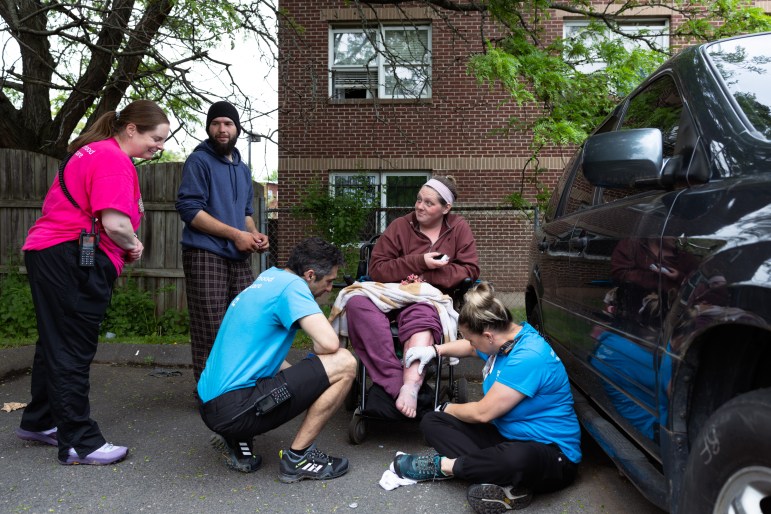
David Mingolelli, a physician’s assistant and street medicine lead, said they might see a patient there who has been getting treatment for an opioid use disorder. They have high hopes that he’ll get clean and plan to bring him another regiment of medication for the addiction.
Another nurse told the group that a service provider at Hands on Hartford, a nonprofit that offers housing and support services, told her they had a lot of folks who needed wound care, and everyone nodded as they packed up the ambulance to head out into the field for the day.
Throughout the day, the staff recalled the stories of different people they’ve treated: cuts on a man who was living in a dumpster and was accidentally picked up by a dump truck, a man on dialysis who needed help getting follow-up appointments, a woman who had leg surgery months ago and never got her stitches out.
Toth spent hours removing that woman’s stitches and staples while sitting on a milk crate in a public park. She fears the woman will get an infection.
“I told her, ‘Not only could you lose your leg, you could lose your life,’” Toth said.
End-of-life care
Two months ago, the team started working with inpatient referrals — meeting with people who come into the hospital for treatment but don’t have a place to go after. Sometimes, like in the case of the man who lost both legs, they try to find a short-term rehabilitation or nursing facility that can admit them. In other cases, they just make sure to follow up with them at their encampments or shelters.
In the coming months, they hope to expand to provide mobile medicine in the eastern part of the state.
Many of the people they treat don’t have watches or phones, Toth said. They don’t know what day it is or what time, and even if they did, transportation to get to follow-up appointments is a challenge.
They’re seeing more seniors, Toth added. The latest state data shows that more than 1,300 unhoused people were over 55, up from 800 last year.
It’s been a concern for the past couple of years as rents have risen and people on fixed incomes struggle to keep up. Toth said many of their patients also struggle to access shelters or warming centers in the winter because of mobility issues.
One warming center in Hartford is on the second floor of a building with no accessible entrance, she said. And sometimes, shelters only have top bunks available.
“It’s hard. Sometimes you feel like you’re trying to boil the ocean, but you just take it one visit and one patient at a time,” she said.
The growing number of seniors also means she’s having more conversations about end-of-life care. In one case, a patient with HIV was in and out of the hospital every couple of days. In another, an older man broke his femur and got an infection that could only be treated with IV antibiotics. The patients weren’t sure about entering the hospital full time, which is what their care required, Toth said.
“We need to figure out how we can support him out here the way he wants and have him still have control, do it his way, have dignity,” she said.
She said she’s asking questions she hasn’t had to in the past, such as: If we find you unconscious, do you want CPR? Do you want us to put a tube down your throat to breathe for you? Where do you want to be when you die?
“Within the last month, we’ve had multiple conversations popping up,” Toth said. “They don’t want to be in the hospital for six weeks for IV antibiotics, or they don’t want to undergo surgery. That’s OK, and I respect that, but it’s thinking about how we support them out here and make sure they’re comfortable.
“They can die with dignity and they can die where they feel safe, and if safe is a park bench that’s your home, that’s your spot. So it’s a crappy realization, but I think this is going to be something we are seeing more and more now that the population is getting older and sicker.”
Sarah Fox, chief executive of the Connecticut Coalition to End Homelessness, said her organization is focused on helping people get housed and increasing funding for the homeless response system. For years, providers have said they don’t have enough resources to meet the need.
“For people who are outside, you know, their mortality is increased exponentially,” Fox said. “People age so much faster because it is so stressful to be outside and to be unhoused.”
The budget request
As homelessness has increased over the past few years in Connecticut, more people are also living outside.
Homeless service providers, such as overnight shelters, this legislative session asked the state for $33.5 million.
The providers’ request includes $7.8 million for prevention, including legal and social services for people facing eviction, and flexible funding for things like rent aid, utility bills or other expenses that could help keep people housed.
It also seeks $19.5 million in crisis response, which includes annual funding for cold weather emergencies, and $6.2 million to increase the number of people getting housing vouchers through the state’s Rental Assistance program.
Gov. Ned Lamont’s budget proposal would have added rental assistance vouchers for senior citizens and people with disabilities, as well as a $5 million allocation for eviction prevention and additional funding for the homeless system’s response to cold weather.
But that $5 million was set to come from the Connecticut Opioid Settlement Advisory Committee budget. The proposal has been controversial among lawmakers and advocates who say the state shouldn’t dip into that money for anything other than its intended purpose.
Speaker of the House Matt Ritter, D-Hartford, said during a press briefing last week that the details of the budget are still being worked out. But the legislature and governor are faced with difficult funding choices, as many programs say they need more money.
Lamont has favored a fiscally conservative approach to pay down debt. But that’s become more difficult to maintain as state officials grapple with federal budget cuts and which holes the state will fill.
The Appropriations Committee proposed spending less than Lamont did: $3.5 million for cold weather services.
Fox said that simply isn’t enough.
“We asked for $33.5 million to prevent homelessness, to respond to homelessness when it arises, and then to house individuals and ensure that they’re stable,” Fox said. “And it’s exactly still what we need. We need every dollar. And when we look at people with complex medical needs, or people who are literally losing their limbs because they aren’t able to get into a warming center, those are our neighbors, and that’s the lens that we look at this from.”
Earlier this year, lawmakers announced the launch of the Homelessness Caucus, a bipartisan group of lawmakers focused on improving services for the unhoused population. Caucus chair Rep. Kadeem Roberts, D-Norwalk, said he’s still talking to other lawmakers, trying to get them more money.
“We’ve just been trying to spread the word, putting a lot of pressure, not just on the governor’s office, but each one of these reps — you guys represent a population that is homeless in your communities,” Roberts said.
Housing Committee ranking member and Homelessness Caucus member Rep. Tony Scott, R-Monroe, called into question the state’s priorities. It’s been hard to get enough funding for homeless services, he said, and he thinks the state wastes money on other programs.
“These are the people that are the most vulnerable people in the entire state,” Scott said. “If we’re not here to help those folks, what are we doing here?”
Fox added that putting people in shelters and preventing some of these medical needs will likely save the state money in the long-term by keeping them out of emergency rooms or urgent care.
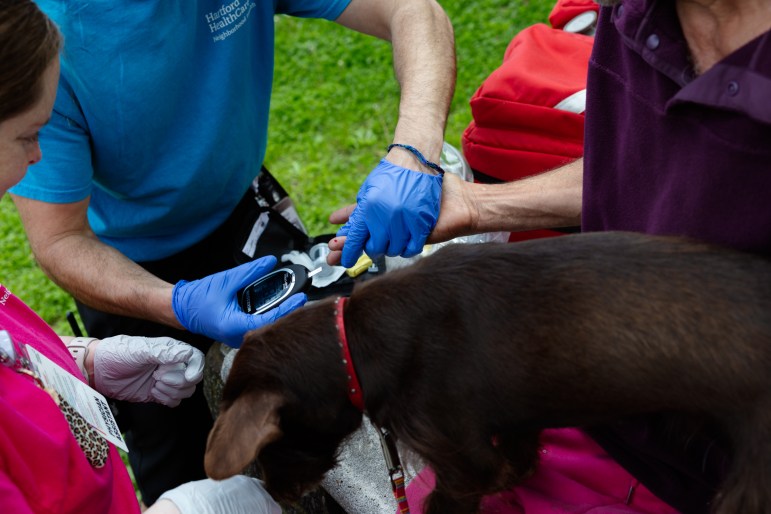
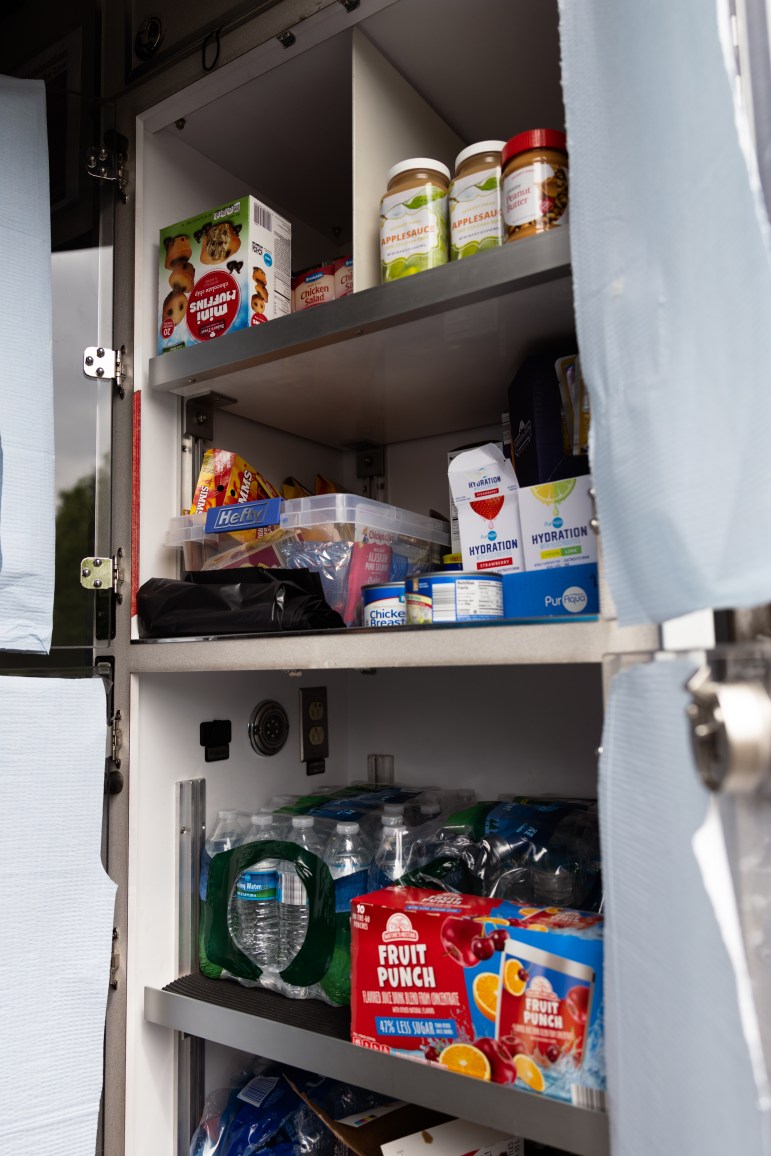
That’s one of the goals of the Hartford HealthCare team as well. In addition to medical care, they carry supplies to take care of people’s basic needs. They keep Slim Jims and mini muffins in the ambulance, as well as a couple of stuffed animals in case they come across any children.
During the recent trip earlier this month, Talia Neves, a nurse with the Hartford Neighborhood Health team, examined one man’s tent and sleeping bag. They were wearing out, and she helped him make plans to get new supplies.
Two people with tents facing one another, and a clothesline stretched between two trees, needed new prescriptions for medication as well as treatment for a wound.

“I was going to wait a couple of days and go to urgent care,” one man told the nurse. “But I guess you could take a look now.”