



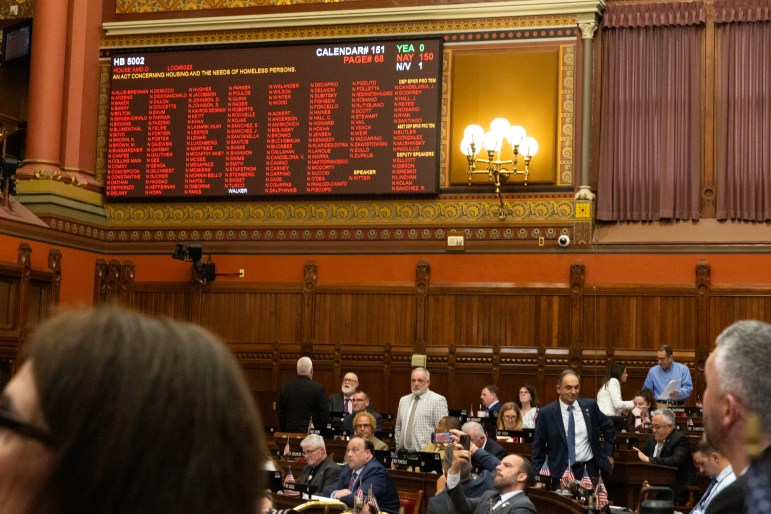
After a debate marked by an unconventional political strategy, the House of Representatives narrowly passed what is likely the most consequential housing bill that’s been considered in the Connecticut legislature in years.
House Bill 5002, which passed 84-67, is an expansive bill tackling issues including zoning, transit-oriented development, parking, homelessness and fair rent commissions. It combines Democratic priorities from across a few legislative committees and aims to address the impact of the severe lack of housing, particularly affordable housing, in Connecticut.
“You can’t solve this crisis one step at a time,” said Housing Committee co-chair Rep. Antonio Felipe, D-Bridgeport. “We need a big move that makes progress, and I think this bill does that.”
Housing costs have been rising for the past few years, and more people have felt the impact of those increases. Homelessness has increased. Studies say Connecticut lacks tens of thousands of units of housing that are affordable to its lowest-income residents, and that the state has the most constrained housing market in the country.
Democrats said they’d bring the bill to the floor late last week, but delayed the vote under threats of a filibuster. Over the weekend, leadership met and made what House Majority Leader Jason Rojas, D-East Hartford, said were clarifications and compromises to get the bill through.
“I think the marketplace is going to determine whether a big apartment building gets built or not,” Rojas said. “So a lot of it [the opposition], I think, is just fear of this unknown, or fear or concerns about change.”
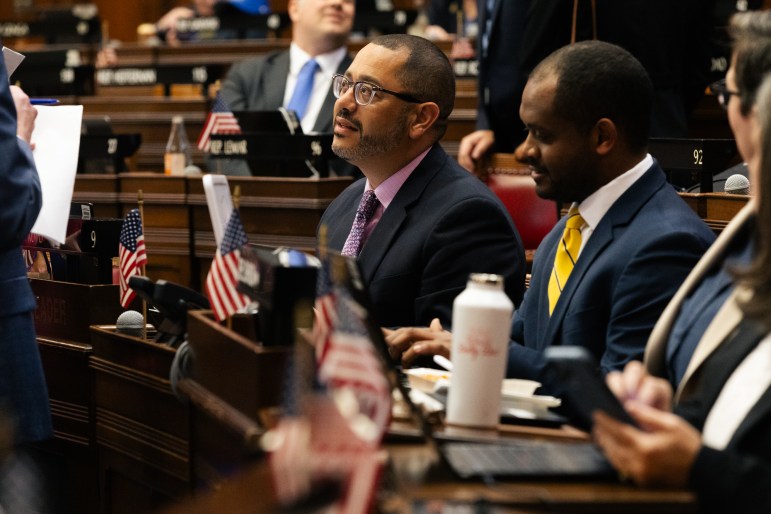
Rojas said he thinks the sections on parking and those that encourage more middle housing, or housing such as duplexes, triplexes and townhomes, will help the state’s economy.
The clarifications made over the weekend were largely centered around a zoning policy that requires towns to plan and zone for a set number of units of housing. These included making sure it was clear that litigation couldn’t be used as an enforcement tool and adding in a process for towns to contest their assigned numbers.
Lawmakers also removed commercial properties from the reforms to parking policy. And they set a new, lower population limit for towns required to establish fair rent commissions — thereby expanding the number required to have one — rather than mandating that all towns create commissions.
Still, the bill drew ire Tuesday.
Republicans took particular issue with the policies around zoning and parking. Debate stretched across nearly 12 hours, and centered largely on local control, what members called one-size-fits all solutions and concerns that towns don’t have the infrastructure to support more housing.
During this portion of the legislative session, the minority party’s power increases because the session ends next week. Republicans can talk for longer, spend more time on bills and limit Democrats’ ability to pass legislation.
“It will change your district. It will change your municipality. It will change your town or city,” said Housing Committee ranking member Rep. Tony Scott, R-Monroe, of the bill, who spoke for about four hours.
Much of the discussion Tuesday centered around a policy known this session as “Towns Take the Lead.” The proposal analyzes the regional housing need, then divides that need up among towns and assigns each a set number of units. Towns would have to include how they’d plan and zone for those units in their 8-30j plans, which are due every five years.
It’s similar to fair share policies proposed in past sessions, and uses the methodology from a fair share policy to determine how many units of affordable housing towns would need to plan and zone for, with a general goal to increase housing stock and cut down on segregation. The bill contains some other specifications for the housing, including requirements to build units for families and for certain income levels.
Under the bill language, towns would be able to contest their assigned numbers and tell the legislature how many units they think they can accommodate, and lawmakers will approve or deny the towns’ proposals.
Opponents have said the proposal dilutes local control and imposes cookie-cutter solutions on towns. Scott, whose hometown of Monroe would have to plan for 326 units, called the numbers “astronomical,” “unrealistic,” and “comical.”
Political strategy
Republicans charted a peculiar political course Tuesday by introducing an amendment that bill proponent Rep. Joe Zullo, R-East Haven, asked his GOP colleagues to vote against. Zullo, the Planning and Development Committee ranking member, said those in favor of the legislation should support his amendment because it added a list explicitly stating the number of units that towns should plan and zone for, rather than the formulas and references to studies in the bill.
“This is a really odd position to be in today because what I’m actually saying to my colleagues on this side of the aisle,” Zullo said, gesturing to his Republican colleagues, “is ‘if you’re like me and you don’t believe that your town should have to build this share of housing, you should vote no.’ I’m proposing an amendment where you should stand up and say ‘I don’t want this number.’”
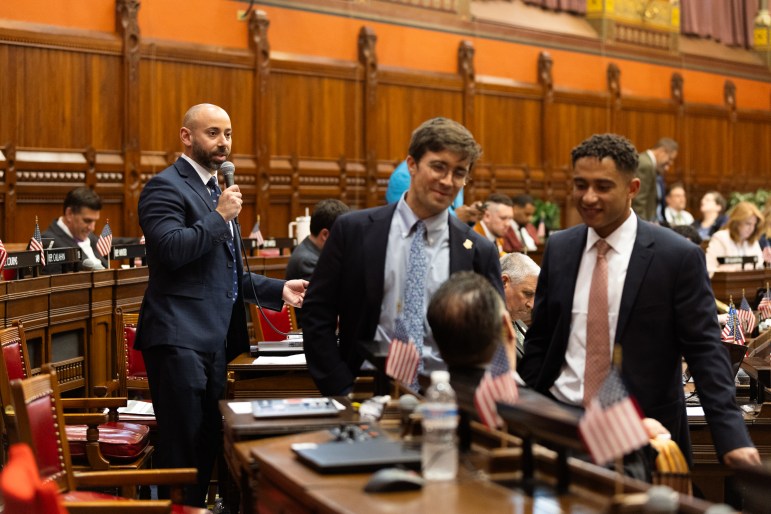
Then, Zullo directed his attention to Democrats, saying they should “unabashedly,” support the numbers.
“On the other side of the aisle, it’s interesting. If you’re going to vote yes for this bill, well then you should be voting yes for this amendment.”
Part of the confusion stemmed from the numbers themselves, which weren’t true to the bill language. The housing allocations in Zullo’s amendment were quadruple what the bill proposes. For his town of East Haven, the bill says they would need to zone for 251. Zullo’s amendment said it would need 1,005.
The housing bill language says towns would only have to build a quarter of the number of units assigned for each town in a recent state commissioned study about the housing need. But Zullo put 100% of the numbers listed in the study, saying that because the language calls for affordable housing, towns would need to add more market-rate units as well.
“I think it needs to be made abundantly clear that in the bill, we’re asking for 25% of that number,” in Zullo’s amendment, said Planning and Development Committee co-chair Rep. Eleni Kavros DeGraw, D-Avon. “There is absolutely no enforcement if you are unable to build those and what you would say is, you would come back with reasons why you weren’t able to build that 25%.”
The measure was unanimously voted down, an unheard of event in recent memory at the House of Representatives.
“We are all on the RMS Titanic, and I am standing here shouting to you all ‘Iceberg right ahead,’ and a lot of you are going to ignore me and this ship is going to sink just like that ship sank because these proposals are dangerous,” Zullo said as he concluded his remarks on the bill.
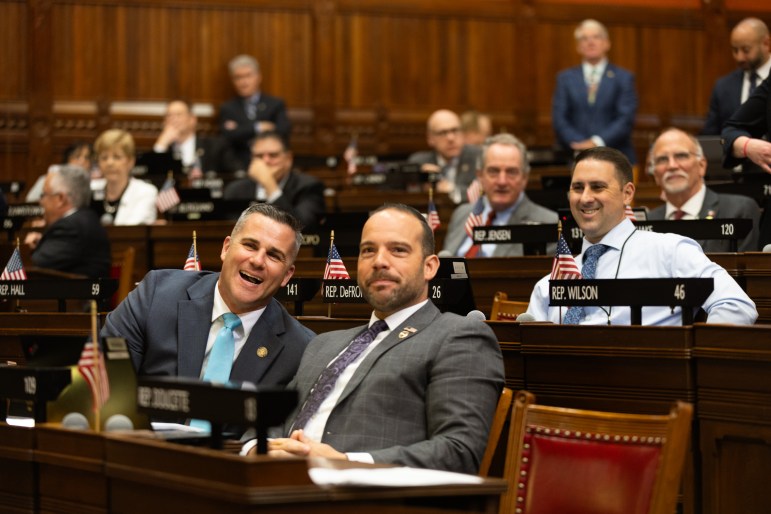
Some moderate Democrats voted against the bill. Rep. Minnie Gonzalez, D-Hartford, called it a “monstrosity,” and urged her fellow urban lawmakers to vote against the measure. She said it would result in a loss of local control.
Rep. Geoff Luxenberg, D-Manchester, gave an impassioned speech Tuesday night, pointing to the circumstances under which the federal Fair Housing Act was passed in the wake of Martin Luther King, Jr.’s assassination. That bill had bipartisan support, he said. Luxenberg questioned why loss of local control and cost to towns was the center of the conversation.
“The cost of inaction, the cost of stagnation, the cost of looking the victims of this housing crisis in the eye and saying, ‘Sorry, we’re not going to build one more house. Sorry, you can’t get into that high opportunity neighborhood. There’s a wall that keeps you out,'” Luxenberg said, “Mr. Speaker, that cost is far too high.”
Zoning, parking
The legislation also includes a proposal from Gov. Ned Lamont’s office that would offer towns easier pathways to moratoriums under 8-30g. The decades-old housing law offers developers court remedies if their affordable housing proposals are denied, unless it’s for a reason of health or safety.
Towns can get moratoriums under the law by showing they’re making progress toward increasing their percentage of designated affordable housing and are exempt from the law if at least 10% of their housing stock is designated affordable.
Lamont’s proposal would allow municipalities to establish a “priority housing development zone” that would set a minimum density of four units per acre for single-family housing, six for duplexes or townhouses and 10 for multi-family housing.
The zones would allow this type of development “as of right,” or without a special hearing before the local planning and zoning commission. Towns that adopt these zones would have easier pathways to moratoriums under 8-30g.
It’s a controversial proposal among housing advocates who object to changes to 8-30g and say too many adjustments could render the law ineffective.
The bill also aims to get towns to increase residential density near train and bus stations by prioritizing certain infrastructure funding for towns that establish “transit-oriented districts,” where certain development is allowed without special hearings before the planning and zoning commission.
The bill, known as Work, Live, Ride, aims to increase the housing stock and encourage people to use public transportation, which advocates say would be a boon to the environment.
Opponents say the prioritization of funding effectively means that towns that don’t participate in the program would be deprioritized and could risk losing funding.
It also includes a measure that would ban minimum off-street parking requirements for residential developments. This would mean developers can cut down on costs of building housing by not adding as many parking spaces. The legislation had originally included a ban for commercial properties as well, but that was removed as part of the compromise over the weekend.
Rojas in particular has advocated for this measure, saying it would increase housing and allow more development in areas that may already have sufficient street parking or are close to public transportation.
Meanwhile, opponents say it would weaken local control and run the risk that developers would ignore parking needs.
The bill would require towns to allow developers to convert commercial buildings to residential with nine or fewer units without a special hearing before the planning and zoning committee.
The proposal is a favorite of Planning and Development Committee co-chair Sen. MD Rahman, D-Manchester. He’s said it would utilize office space and other commercial areas that have been vacant since the COVID-19 pandemic. Opponents say it would usurp local control.
Homelessness, fair rent
H.B. 5002 also includes a couple of measures to help the unhoused population. It would ban towns from using so-called “hostile architecture” on public property. Hostile architecture is an urban design architecture in which certain public structures are designed to discourage behaviors such as sleeping or lying down in public. It often comes in the form of spiked surfaces under bridges, narrow benches or rocks strewn across grassy areas.
Under the bill, the state Department of Social Services would also be asked to create a program to offer portable showers and laundry services to people experiencing homelessness, as funds allow. The Office of Fiscal Analysis estimated it would cost between $200,000 and $300,000 annually.
The bill would also expand the number of fair rent commissions in Connecticut, mandating that any town with a population of 15,000 or more establish a commission, which are local bodies empowered to hear and make legally binding rulings on landlord-tenant issues such as complaints about unfair rent increases.

This year’s bill would require an additional 32 towns to have fair rent commissions and allow towns to establish regionalized commissions through their local councils of government, according to 2023 population estimates.
In 2022, the state legislature passed a law that required municipalities with populations of 25,000 or more to have such commissions. The 2022 law required 27 additional towns to create these boards. Before the law passed, 25 towns had commissions.
Supporters say the commissions help oversee rent increases and make sure they aren’t excessive as housing costs rise across the state. Opponents fear the measure interferes in local control and that small towns may struggle to find people to volunteer to be members of the commissions.
Rojas closed debate late Tuesday night with a statement about the importance of passing housing policy in Connecticut.
“There is a lot that we can’t control when it comes to housing,” Rojas said. “We can’t produce more land. We can’t control the cost of lumber. We don’t control interest rates. But there are many things we can do if we have the political will to act. This bill is but a step in the direction that is needed to adequately address what has long been a running crisis.
“As I have feared for some time, if we continue to do nothing today, 10 years from now, our communities and the people we represent will be in a far more precarious position if we do nothing.”
The bill next heads to the Senate for a vote.