


Governor Ned Lamont denied Wednesday that he threatened to veto Senate Bill 7, a public health omnibus bill, over a measure that allows for the establishment of safe injection sites in Connecticut, despite reports from House Speaker Matt Ritter that he had.
Whatever the truth was, confusion over the governor’s intentions led lawmakers to strip the provision from the bill to ensure passage of the broader legislation later this week.
Safe injection sites, also known as safe consumption sites or overdose prevention centers, are facilities where people can bring illegal substances to use under the supervision of trained staff in a clean environment with access to safety supplies, like clean needles and naloxone, a medication used to reverse opioid overdoses. The bill refers to “overdose prevention centers,” which is a term used by advocates to reflect the broader services offered, including medical referrals and other social services.
Last week, a measure passed as part of a broader bill in the Senate allowing Connecticut to set up safe injection sites, though it prevented the use of public funds for the effort. The bill was slated for a House vote this week, but didn’t go to the floor Wednesday amidst reports of Lamont’s opposition.
During a press conference at the state Capitol that afternoon, Lamont denied having made a decision regarding a veto, though he acknowledged he had concerns about bringing such facilities to Connecticut.
“I do have some worry about the perception of safe injection sites in our major municipalities, but I haven’t made a call on that yet,” Lamont said.
Ritter said he had heard the exact opposite from the governor’s staff, so he had encouraged legislators to amend the bill to remove the measure ahead of a House vote slated for this week in the interest of preserving the broader legislation.
“The Governor’s chief of staff told us the Governor would veto the bill as it is currently written,” Ritter said in an emailed statement. “I always urge chairs to explore all options to get legislation across the finish line. It would be a shame to lose the legislation to a veto if there are some changes that would protect most of the important health care policies that the chairs and advocates have been working on for months.”
Rep. Cristin McCarthy Vahey, D-Fairfield, co-chair of the Public Health Committee, confirmed Wednesday evening that, despite supporting safe injection sites, she approved an amendment to remove the measure from the bill and hopes it will go to the House floor for a vote tomorrow.
“The more I learned about this way of saving people’s lives, the more I believed in it,” McCarthy Vahey said. “That policy desire bumps up against the practicality and also the clear communication from the governor that he is planning to veto the bill if it were to pass.”
McCarthy Vahey clarified that she did not speak directly with the governor and had only heard about his comments from others.
Supporters of safe injection sites point to research that they decrease overdose deaths, disease transmission and public disorder. Despite the body of research establishing their public health benefits, the sites remain controversial. Critics say they encourage illegal drug use and express concerns about the impact of the facilities on surrounding communities.
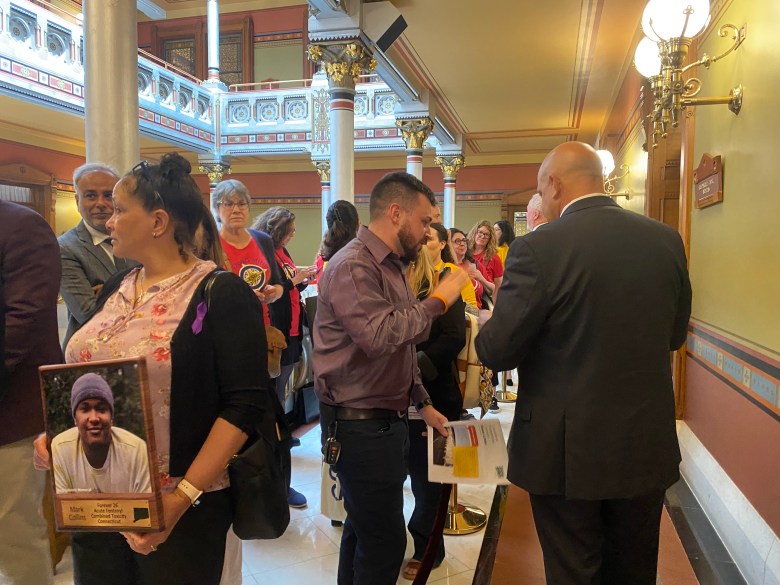
Overdose prevention advocates, awaiting full passage in the House this week, gathered at the state Capitol on Wednesday morning to express support for the safe injection sites and denounce the reported efforts by Lamont to kill the effort.
“I’m just tired of watching my friends die,” said Cameron Breen, an overdose survivor who now works in overdose response. Breen pushed back against the connotation he says some people have of safe injection sites as “sanctioned drug dens.”
“The reality is it’s a quiet, clean, safe space for people to come with the only role of making sure that when they use they do not die. Currently, they’re dying in cars, they’re dying in bedrooms. They’re dying in public bathrooms,” Breen said.
Sen. Saud Anwar, D-South Windsor, Senate co-chair of the Public Health Committee and a physician, expressed disappointment that the measure was being removed, and said it made clear that the governor was not forthcoming about his intentions.
“I’m disappointed that the governor was not forthcoming with the media. For the House to hear him directly saying to the media that he’s not going to veto it and then still remove the measure should be very confusing,” Anwar said.
McCarthy Vahey said she still looks forward to the measure passing in the near future, and wants to start that work immediately.
“We have to be thinking about, if we can’t get this passed now, how do we start that conversation today so that we can do this bill next year? So that the governor’s on board, so that some of my colleagues on the other side of the aisle are on board,” McCarthy Vahey said.