



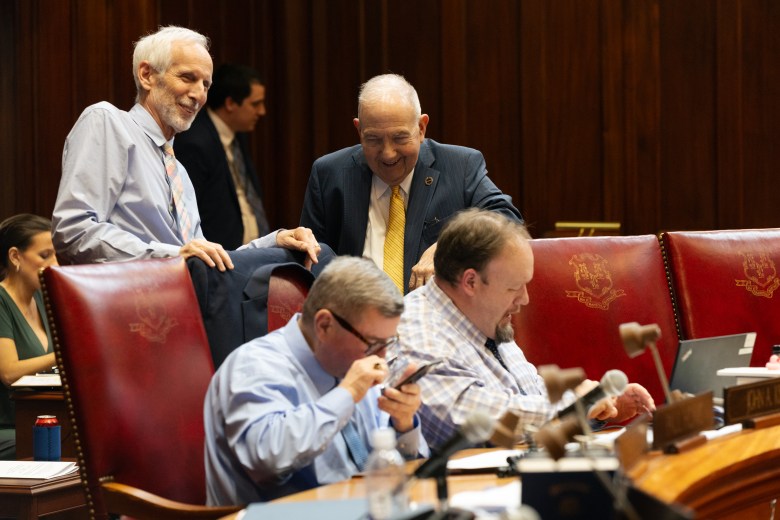
On May 1, the Connecticut house of representatives voted 98 to 47 to pass HB 5004, the main climate mitigation bill introduced this session.
HB 5004 is a package of climate legislation ranging from a study on heat pumps to transitioning the workforce to green jobs. To see it pass the house this quickly is a victory for advocates and Connecticut residents alike. Still, the bill focused largely on studies instead of direct action. Climate and environmental justice advocates agree, HB 5004 could have been much stronger.
I’m a 17-year-old climate activist, and for the past three years, I’ve been coming to Hartford and witnessing a frustrating pattern: bold climate legislation repeatedly stalling due to the legislature’s political culture.
The version of HB 5004 last year was significantly weakened with amendments before it passed the House in May 2024. The bill was never brought up for a vote in the Senate. This year, some of the bill’s strongest language was removed before passing the House. The House-passed HB 5004 bill failed to include a Future of Gas docket, which aims to align gas system planning with state climate policy while balancing ratepayer impacts. Legislators also cut out programs for Thermal Energy Networks and active demand response. Thermal Energy Networks are six times more efficient than air source heating, and active demand response would reduce electric demand at times when it is highest – in order to strain the grid less, and reduce energy prices.
Last year’s disappointment and this year’s weakened bill reflect the overall culture in the legislature, a culture which has indefinitely stalled and weakened important bills, preventing any climate action for the past two years.
Despite having a supermajority in both the House and Senate, Democratic leaders insist on bipartisan compromise and a strict tradition of unlimited debate. But this poses an issue: because the legislative session is only three to five months long, there is limited time for bills to be passed. Therefore, leadership usually only brings bills up for a vote after they have been compromised enough, behind closed doors, to easily pass with little debate. This is why legislators don’t move forward with stronger legislation, opting instead for less controversial study-focused bills like HB 5004.
HB 6280, the climate superfund bill introduced this year, is another example of stalled and watered-down legislation. The bill would have held polluting companies accountable by making corporations pay an amount of money proportionate to their share of emissions, and the impact of those emissions on Connecticut. The payments would have gone into a fund used for climate adaptation. The bill didn’t even make it out of committee because legislators assumed it was too progressive to pass.
The environmental rights amendment, SJ 36, is another bill sabotaged by a need to compromise. The bill would have codified the right to clean air, water, soil, environment, and a safe and stable climate into the state constitution. It was meant to be an umbrella of protection, filling in any gaps in existing law. However, the bill was amended to include the modifiers “reasonable” and “unreasonable.” While seemingly harmless, legal experts point out that based on legal precedent, “reasonable” is interpreted as referring to existing law (City of Waterbury v. Town of Washington 260 Conn 506 [2002]). The compromised language defeats the bill’s purpose of filling gaps in existing law and providing overarching protection.
SB 9, the climate resilience bill, also fell victim to compromise. Part of the bill is meant to ban the use of neonicotinoids (toxic insecticides) for many uses. However, the legislators yielded to the chemical industry’s demands. The bill was amended to exempt the use of neonicotinoids on ornamentals from the ban, and to delay the ban one year. There was even talk of adding an amendment that would partially roll back a 2010 ban on pesticide use on K-8 school grounds, which fortunately was rejected.
This is why Connecticut is falling behind not only on climate policy, but any policy that will actually do something real to improve Connecticut for its residents. Compromise and unlimited debate is killing necessary progress-– and Connecticut residents are the ones suffering the costs of high energy bills, climate disasters, and every other issue the legislature has bent to opposition on.
Who are we really compromising with? The only winners from a lack of climate action are oil and gas companies. “Compromise” ends up being a very slippery slope toward allowing monied interests to infinitely water down the bills that get passed in our state. Our future is being compromised for their profit.
Back to HB 5004. Some of the removed language can be added to SB 4, a priority energy bill, which already includes language on thermal energy networks and demand response. I encourage anyone reading this to ask your legislators to advocate for all of these provisions to be voted on through SB 4.
Though the legislature may insist on compromising our future for polluter profit, we will continue to fight to protect it.
Ashen Harper is a youth climate activist with Sierra Club Connecticut and Fridays for Future Stamford.