



A lighthouse does not decide which ships deserve guidance, it simply shines, ensuring that those navigating rough waters can see the truth. However, what happens when those in power find the light disruptive? Can they turn it off, leaving the water dark?
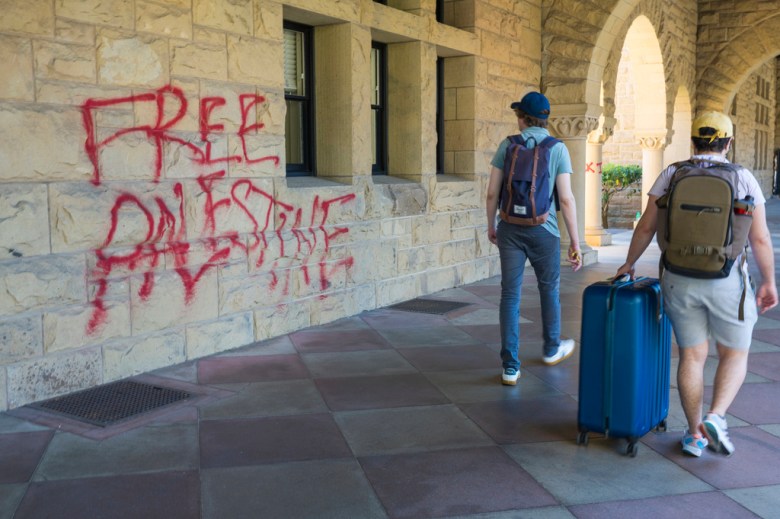
This question proves central to the case of Dilan Gohill, a student journalist at Stanford University. In 2024, Gohill entered a building to report on the pro-Palestinian protest. He did not chant slogans, vandalize property, or resist authorities. Yet, when police arrived, they arrested him along with the protesters.

In determining the validity of Gohill’s arrest, one must address three key questions:
- Do journalists deserve special legal protection?
- Does intent matter?
- Would criminalizing Gohill set a precedent that endangers press freedom?
No one, not police officers, politicians, or journalists, is above the law; however, certain roles sometimes require special legal protection. For example, police possess “qualified immunity to enforce laws” (NCSL). Journalists, tasked with holding power accountable, must be protected not with immunity, but from laws used to suppress reporting.
In Houchins v. KQED (1978), the Supreme U.S. Court ruled that the press has no special right to restricted areas. Stanford may argue this precedent justifies Gohill’s arrest. However, Houchins does not state that reporting from within a restricted area, strips journalists of First Amendment protections when it relates to a public concern.
- Does intent matter?
Yes, in Bartnicki v. Vopper (2001), the court ruled that journalists could publish illegally obtained recordings. This decision was a result of the court reasoning that the public’s right to know outweighs concerns about how information was acquired. Similarly, Gohill did not break in; he intended to report, not to participate. This strengthened his case, and importantly, the protest addressed both a matter of public concern and public significance.
- Would criminalizing Gohill set a precedent that endangers press freedom?
Yes, governments have long used laws to suppress uncomfortable truths. In Jean v. Massachusetts State Police (2005), a journalist filmed police brutality, only for officers to raid her home and seize her footage.
The Court ruled in her favor, recognizing that punishing journalists for exposing the truth threatens democracy. The First Amendment guarantees freedom of the press, and history has shown that when journalists uncover uncomfortable truths, those in power often find ways to suppress them.
From the early days of the republic to landmark cases, such as New York Times Co. v. United States (1971), the press has repeatedly clashed with the government over its right to report without retaliation. If Gohill’s conviction stands, it sends a clear message. Journalists covering protests risk arrest simply for being present.
In Bursey v. United States (1972), the Court ruled that press independence must be protected from government interference. If laws can erase the difference between reporting and activism, then journalists will self-censor out of fear, and the public will suffer. Individuals argue that granting journalist protection creates loopholes, and what stops activists from claiming to be reporters?
Journalism is not simply holding a press badge, it means gathering information in the public’s interest.
A lighthouse does not take sides, it reveals the dangers. Punishing Gohill’s reporting will deter journalists from covering protests, government misconduct, and abuse. Journalists are not above the law, but neither are police. Just as officers have immunity to enforce laws, journalists must be able to report without fear of suppression.
If society allows the lighthouse to be shut down, the water will grow dark, not just for the journalists but for all of the public.
Ehsanullah Hadi is a student at West Haven High School. This essay was awarded first-place in the 2025 Forrest Palmer High School Essay Contest, run by the Connecticut Foundation for Open Government to foster debate on First Amendment issues. Prosecutors have since dropped the charges against the Stanford student described in Ehsanullah’s essay.