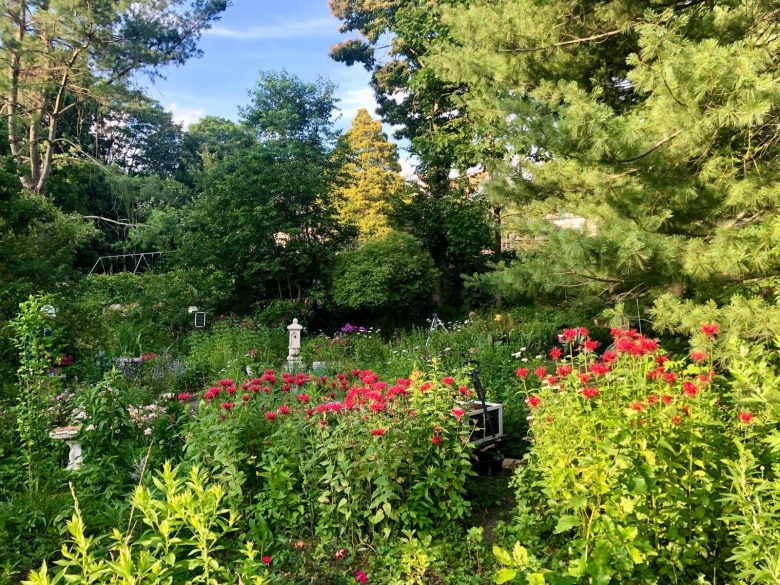
The word “lawn” comes from the Welsh llan, which originally meant “barren land:” how fitting that word is for what most American homeowners have!
European aristocrats displayed their wealth in part through lawns: only they could afford to have their land be wholly unproductive. Eager to emulate aristocrats, the American middle class created machines and chemicals to make such land less expensive to maintain. We denuded the very land that could nourish us, drove away the insects and birds, and sterilized the soil. But true affluence today lies in authenticity, not imitation; it lies in fostering nature. The meadow is no longer wild: it is curated.

The U.S. has over 63,000 square miles of turf grass, an area larger than the state of Georgia. Twenty percent of Connecticut is lawn. Only 19 percent of American homeowners do not have yards or grass. The rub: lawns are exceedingly harmful to the environment.
For instance:
- A recent toxicology analysis found that half of the weed killers sold at the largest home and garden stores, Home Depot and Lowe’s, include chemicals classified as “highly hazardous pesticides” that are linked to detrimental health effects on humans. The ingredients in commonly used herbicides, such as 2,4-D — a chemical from the Vietnam War defoliant Agent Orange — are associated with neurotoxicity, reproductive issues, and cancer.
- To attain lush green lawns, homeowners use three million tons a year of nitrogen-based fertilizers. For every ton of nitrogen created to make this fertilizer, four to six tons of carbon are added to the atmosphere. Further, a lawn neither needs nor can hold the amount of nitrogen in the fertilizer: soil microbes turn the additional nitrogen into nitrous-oxide gas, a greenhouse gas that, unit for unit, traps 300 times as much heat as CO2.
- Lawns intensify droughts. Americans use 20 trillion gallons of water on their lawns each year. By way of comparison, 30 trillion gallons of water are used to irrigate crops in the U.S. The critical point: this is drinking water. Further, water is often woefully underpriced, leading to overuse.
- Lawn maintenance emits five to six times more CO2 than the grass absorbs. Gas-powered lawn mowers make up five percent of the total air pollution in the U.S. — and even more than five percent in urban areas. While four-stroke engines are slightly more environmentally efficient than two-stroke engines, a four-stroke lawnmower operating for one hour releases as much CO2 as the average car traveling 500 miles.
Now imagine if these lawns were meadows instead. Pennsylvania has a model program, the Lawn Conversion Program, that encourages homeowners to convert their lawn into a meadow. Seth Cassell, the Director of the Program, has been delighted by “the tremendous response we’ve seen to our program to convert mowed lawn areas to native meadows. By restoring habitat on some of the millions of acres of grass in Pennsylvania alone we are addressing and offsetting some of the damages of climate change, helping pollinators and wildlife, and connecting more people to nature.”
Unlike lawns, meadows require very little upkeep — no irrigation, fertilizers, mowing, or maintenance. Meadows require little to no irrigation, helping to alleviate water shortages and reducing household water bills. And they certainly do not require pesticides and herbicides.
The science is clear: meadows are ecological powerhouses hiding in plain sight. Thanks to their deep, dense root systems — some of which reach to 12 feet — they can reduce peak stormwater flows by up to 96 percent, filtering pollutants before they reach our rivers. Meadows also cool the environment far better than do lawns. At a time of climate change, biodiversity loss, and extreme weather, choosing a meadow is no longer just an aesthetic decision — it is an act of climate resilience. Further, a lawn can be up to 22 times more expensive to maintain than a native meadow: maintaining a lawn costs approximately $637 to $1,206 an acre each year, whereas maintaining a meadow costs only $54 to $167 an acre.
“We’ve had huge interest in the Lawn-to-Habitat Program since it launched in 2020. Over 3,000 Pennsylvanians have expressed interest in replacing portions of their lawns with native plants. So far, we have supported over 470 acres of lawn-to-meadow plantings through our funding programs. It doesn’t matter whether you own a small lot in town or several acres in the country, anyone can swap a little lawn for native meadow.” —Kelsey Mummert, Lawn-to-Habitat Program Coordinator.
Convinced that homeowners should convert their lawns into native meadows, I began to advocate for the creation of legislation to offer homeowners in Connecticut multi-purpose credits for doing so. I formed an advisory council of 20 experts to advise me on this legislation. Sen. Richard Blumenthal met with me to discuss the legislation; he recommended that I reach out to Connecticut Senate Majority Leader Bob Duff and State Rep. Tom O’Dea. Both Duff and O’Dea were exceedingly helpful; indeed, O’Dea shared my research with a legislative committee — and my legislation became Proposed House Bill No. 6271!
“This legislation is more than just a policy — it is a signal that Connecticut is serious about turning environmental ambition into tangible action. By recognizing the power of every backyard, we are weaving resilience, beauty, and sustainability into the very fabric of our communities,” Duff said.
In the not-too-distant future, native meadows will emerge as a signature of thoughtful design and lasting value — just as chef ’s kitchens and walk-in closets became staples of the discerning homebuyer. Buyers will ask: Does this property support pollinators? Does it bloom across the seasons? Does the landscape regenerate itself — or does it demand constant input and expense?
A meadow is more than an ecosystem: it is a statement, a living emblem of modern wealth, one that signals intelligence, taste, and freedom. In a country built on personal liberty, why settle for conformity? Meadows offer freedom from maintenance, freedom from cost, and freedom to express a new kind of American elegance. More than just beautiful, they become a conversation starter, a point of pride.
William Sweet lives in New Canaan.