


Before it became a flash point in a viral debate over the use of herbicides on the Connecticut River, the chemical diquat was widely used for years to treat lakes and ponds across the state, public records show.
The vocal criticism of diquat dibromide began earlier this summer when the U.S. Army Corps of Engineers announced plans to renew and expand its studies using the herbicide at several points along the river to combat the invasive weed hydrilla, which has alarmed both officials and environmental advocates with its rapid spread throughout the river’s watershed.
Those plans quickly became the subject of social media posts accusing public officials of planning to “poison” the river and acting in secrecy to avoid public scrutiny. Many critics noted that diquat is banned in the European Union and the United Kingdom, and questioned why it appeared to be suddenly under consideration for use in Connecticut.
But a review of hundreds of permits issued by the Department of Energy and Environmental Protection in recent years shows that diquat is among the most common herbicides used to treat lakes and ponds for invasive species such as hydrilla, water chestnut and Eurasian watermilfoil.
This year alone, the state agency has issued 188 permits authorizing the use of diquat, the records show. That amounted to roughly two-thirds of all permits issued by the agency this year for aquatic herbicide treatments. Over the previous three years, more than 765 permits were issued.
In addition, diquat is commercially available as an ingredient in several household landscaping products, including Roundup.
In statement this week, DEEP said the permits “reflect common, permitted, regulated aquatic vegetation management practices, performed by licensed third parties.”
“DEEP evaluates each application based on site-specific ecological and public health considerations, ensuring that permitted treatments align with best practices for protecting water quality, aquatic ecosystems, wildlife, and human health,” the statement read.
The chemical’s widespread use, however, hasn’t tempered the blowback aimed at the Army Corps of Engineers and other public agencies over planned treatments on the Connecticut River. Chris Webby, a self-described conspiracy theorist and rapper from Norwalk, roused much of the current opposition by sharing videos about the plans with his more than 100,000 followers.
In response, multiple officials this week described being inundated with angry phone calls, emails and voicemails from people demanding a halt to the use of diquat — as well more threatening messages.
“The vast majority are people letting us know they saw this online, mostly from social media posts, and they’re angry,” said one recipient of the messages, who did not want to be identified for fear drawing more hostility. “A few are using more direct language that has crossed some lines.”
Webby did not immediately respond to a request for comment on Friday.

In a previous interview with the Connecticut Mirror, Webby acknowledged his own lack of expertise on the subject but said he became passionate about the issue after watching videos on social media purporting to show the harmful effects of diquat spraying on a lake in Texas. Others critics have pointed to recently published research suggesting that exposure to diquat can damage the digestive system, particularly from consuming food grown using the herbicide.
Longtime environmental advocates who are supportive of the Army Corps’ efforts along the Connecticut River say they, too, share a skepticism over the use of herbicides in many instances. But, they said, the Army Corps leaders assuaged their concerns through a careful study of the river and the methods used to deploy the chemicals.
“Concerns about diquat are valid,” Alicea Charamut, executive director of the Rivers Alliance of Connecticut, said. “It’s a powerful chemical, but like most chemicals, the way it’s used makes all the difference, especially when comparing its use in agriculture to aquatic settings.”
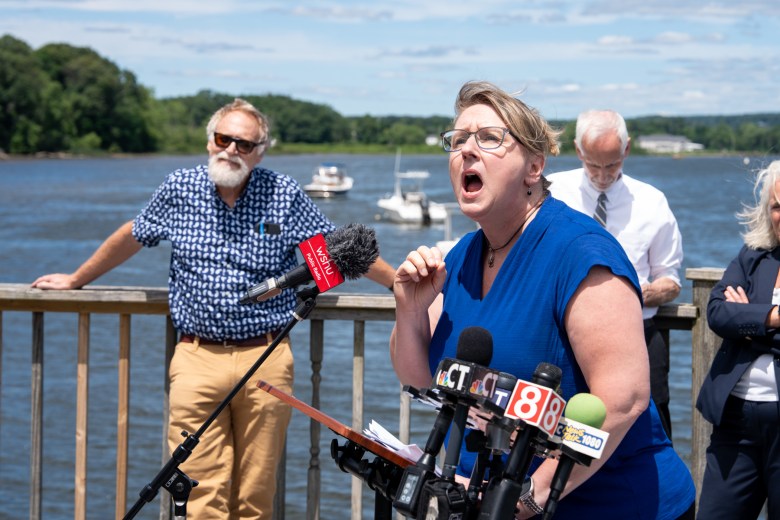
Charamut attempted to alleviate some of the public’s concerns about the specific use of diquat to combat hydrilla in the river at a press conference hosted by state and federal officials in Deep River on Friday. She was joined by U.S. Sen. Richard Blumenthal — who helped secure $5 million in federal funding for the Army Corps’ project last year.
“I welcome different points of view on this topic, but right now we are deluged with a lot of misinformation from people who have suspicions and doubts,” Blumenthal said. “We’re here to dispel those doubts and say we must stop hydrilla before it kills other wildlife, habitat, environmental and ecological life.”
After hearing from all the speakers, several protesters began to shout questions and insults at Blumenthal and other officials, accusing them of ignoring studies on the health effects of diquat. Others said they wanted to hear directly from the Army Corps, which was not present at the press conference.
One woman, who gave her name only as Katherine M., pushed around a toddler in a stroller as she asked whether it would be safe for the child to swim in water that had been treated with diquat.
Mason Trumble, deputy commissioner of environmental conservation at DEEP, responded that the agency requires any users of aquatic herbicides to post signs nearby letting people know when it is safe to swim, fish or use the water for irrigation purposes.
“They don’t really know exactly how unsafe it is,” the woman told reporters afterward. “If you read the studies and you look at the information out there, it’s not secret.”
Prior to the press conference, the Army Corps of Engineers announced that it had no immediate plans to resume its studies using diquat in the river despite having permits in place to do so at three locations. A spokeswoman, Beth Gosselin, said the agency would wait until the end of an extended public comment period in mid-August to determine its next steps and would provide additional public notice before beginning any herbicide treatments.
“We remain committed to transparency and will continue to proactively engage with the public and our stakeholders,” Gosselin said in statement.
While the Army Corps’ project is on hold, many Connecticut communities and property owners are still able to deploy the herbicide — with permits from DEEP, which require periodic reapplication.
Sightings of those treatments, however, may have spurred some of the recent backlash.
Earlier this week, Webby and others shared a video of two men in a fanboat spraying chemicals across a small pond. Webby said the video was taken in the town of Berlin, and he used it to accuse officials of lying about about their plans to delay the use of herbicides.
The Corps’ publicly-available plans, however, make no mention of any treatments in Berlin, which is not located along the river. In addition, officials have said the Corps’ methods involve injecting liquid diquat underneath the water, rather than spraying it above the surface.
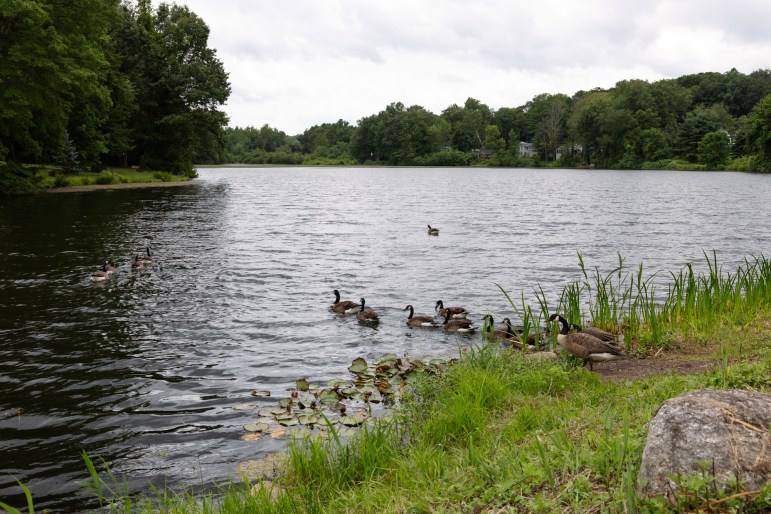
An analysis of the video by CT Mirror determined that it was filmed in Berlin at Paper Goods Pond, one of two areas where the town had previously notified residents of its plans to spray diquat and other herbicides.
The treatment, which was permitted by DEEP, took place on July 11 and was not associated with the Army Corps’ studies.
Officials in Berlin did not respond to a request for comment this week, but in a subsequent Facebook post responding to “recent comments and concern,” town officials provided more information about the project, which began several years ago following surveys, water tests and research into different treatment options.
“The project has been ongoing for several years and conditions are improving,” the post said. “An increase in fish and wildlife has been documented as a result of the management program… We are aware that false and out of context information is being shared online, but is important to rely on factual information, data collection, state and federal agencies, and expert scientists.”
At Paper Goods Pond on Thursday, Berlin resident Bill Grem III said he’d been fishing at that spot for years with his grandson. He said he’d noticed crews in the past spraying herbicides, and he’d seen posted signs stating when it was safe to resume fishing. He said he trusted the public advisories, and had not noticed any adverse ecological effects.
As if to prove the point, he showed off a photo of his grandson proudly holding a large bass he had caught from the same pond.
“The fish aren’t dying,” he said. “It’s just something they have to do.”
CT Mirror photojournalist Shahrzad Rasekh and CT Mirror reporter Dave Altimari contributed to this article.