



|
Getting your Trinity Audio player ready...
|
Editor’s note: We are now offering an audio version of our Sunday features. To access, click on the player above.
On its surface, the Connecticut River can be deceptive. On a sultry, partly overcast afternoon in early July, the river appeared to be in no rush to complete its meandering 410-mile journey to Long Island Sound.
Under the water, however, forces were at work that grabbed the attention of ferry Captain Blaise Clemente.
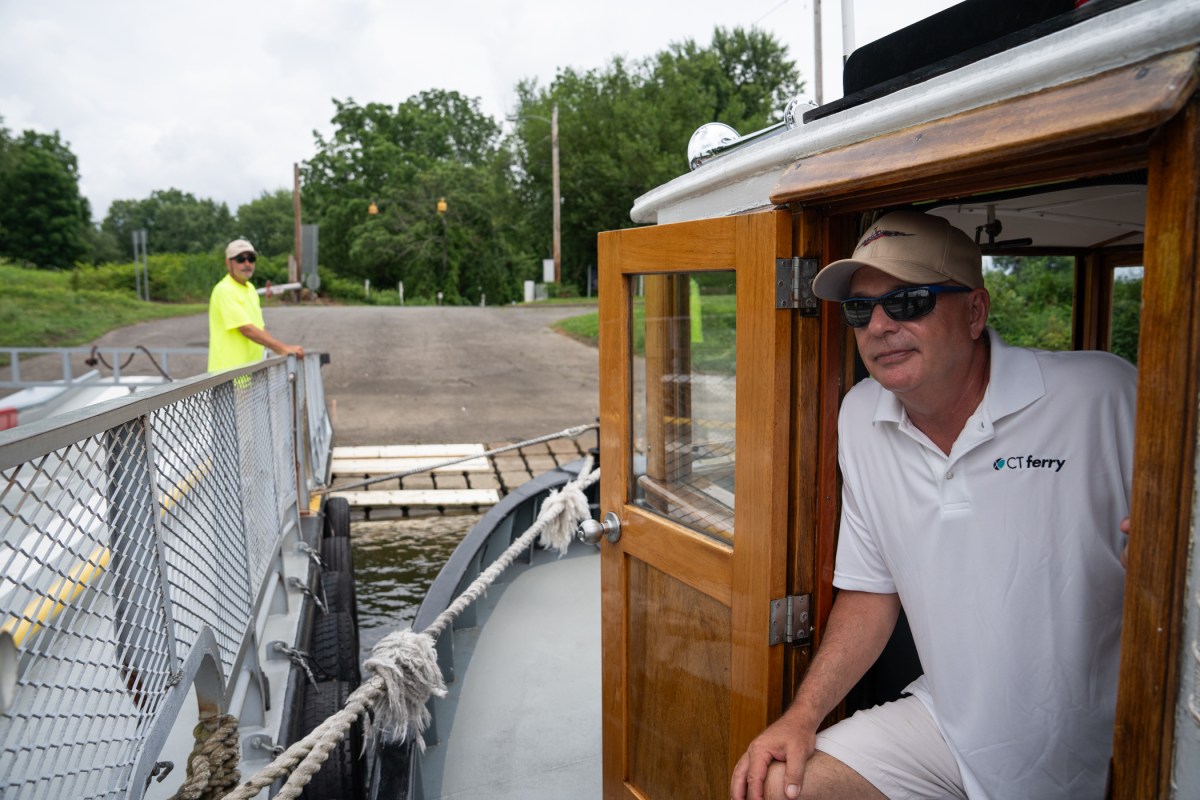
“This current’s unbelievable today. Sorry, Sal,” Clemente called out to his first mate as the two worked in tandem to turn their tug, the “Cumberland,” so that it faced into the river for the next crossing to Glastonbury. The mate, Sal Carta, stood alongside on a barge handling the ropes while Clemente got a feel for the tides, which can shift up to 2 feet even 50 miles inland.
Each trip across the river takes Clemente about four minutes. It’s one he’s made hundreds of times a week for the last two decades since he joined the crew of the nation’s oldest continuously operated ferry service.
“You do anything 300,000 times, you know, you get it down,” Clemente said as he approached the landing slip. “But you have to be more cautious here. You don’t want to bang in, you don’t want to hit the pilings. You don’t want to jar anybody.”
Before he took this job in 2004, Clemente owned a brokerage operating on the floor of the Boston Stock Exchange — he still carries the city’s distinctive accent — while filling his spare time on a lobster boat on Massachusetts Bay. But if he had hoped for a more relaxing career on the water, the reality proved a bit more challenging.
“It has its own tension,” he said. “Some days we do between 80 and 100 crossings a day, and every single one, it’s safety. You get three cars and 18 passengers, and regardless of how long the trip is, your license is at risk every single time you cross, so you have to have a good crew.”
Clemente, who serves as the ferry’s master captain, splits the route with two other captains, along with two mates and a summer intern. During the off season, the crew works on maintaining the boats for the next season, use up their vacation time and, when the weather requires, take turns driving snow plows for the state Department of Transportation.
“There’s certainly a lot of maintenance that has to be done, and during the coldest months of the year, for only a four-month period, it’s hard to do,” said Paul Costello, who served as a ferry captain for seven years before taking another job at the Department of Transportation last November. “You can’t put the boats inside and work on them, so you’ve got to work around the weather.”
When it opened in 1655, the Rocky Hill-Glastonbury Ferry was one of several private raft-and-pole operations that were used to transport people and livestock across the growing colonies. Its slightly younger sibling, the Chester-Hadlyme Ferry, began operations in 1769. (The state’s first bridge crossing Connecticut River opened in 1808 between Enfield and Suffield.)
The number of ferry crossings in Connecticut peaked at around 30 near the end of the 18th century, according to ConnecticutHistory.org. Over time, rafts gave way to boats that were pulled by ropes, horses and eventually steam engines. As more permanent bridges were built, however, the number of ferries dwindled until the DOT eventually took over the last three remaining river crossings between 1915 and 1917. Shortly afterwards, the state closed Bissell’s Ferry in Windsor due to its dwindling use.
Since then, the ferries’ role in providing transportation has continued to evolve.
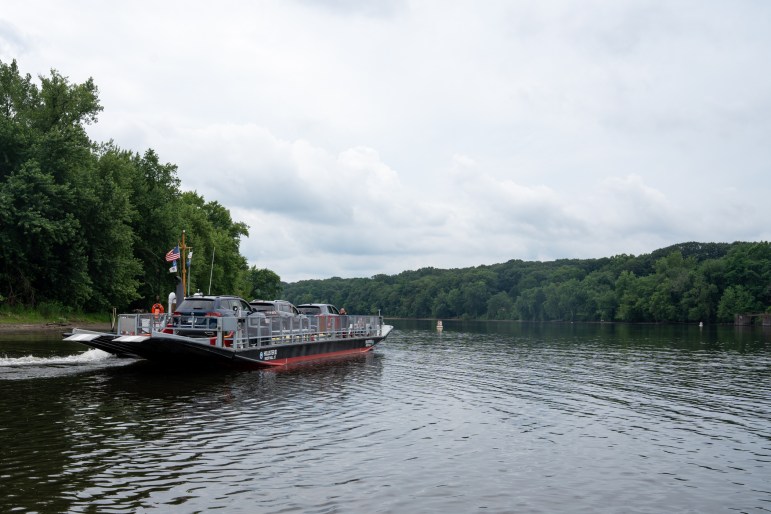
The current setup for the Rocky Hill-Glastonbury crossing, known as “towing on the hip,” consists of a tugboat that is secured to the side of a barge — the “Hollister III” — that carries cars, bicycles and passengers on foot. The Chester-Hadlyme Ferry, meanwhile, uses a single vessel, known as the “Selden III.”
Clemente estimated that roughly 90% of his passengers today are sightseers or infrequent customers — including the occasional traveler, following a GPS, who’s surprised to see the route leading onto a boat. The number of regular commuters has dropped since the pandemic, he said, when the ferry service shut down for several months.
The ferry operates annually between April 1 and Nov. 30, though its opening is sometimes delayed due to high waters, as was the case earlier this year. Fares are $5 per vehicle ($6 on weekends) and $2 for pedestrians and cyclists. Starting last year, passengers could purchase tickets through an app, Token Transit.
Beyond serving as a novelty for tourists and the occasional waylaid driver, the ferry also offers a convenient commuting option for a small number of residents on each side of the river. Without it, a 4-minute crossing becomes a 13-mile trek on highways that can take 20 minutes or more — without traffic.
“I usually come around 4:30 p.m., when everyone’s coming home from work,” said Lisa Lankton of Rocky Hill, who takes the ferry about four times a week to visit her grandchildren in Glastonbury. “It cuts out so much traffic. That time of day, going over the Putnam Bridge and going over [Interstate] 91 is a lot longer.”
Lankton added that while on the ferry, she has a few minutes to catch up on a book or simply enjoy being on the water. “Sometimes I’ll get carried away and I’m like, ‘Oh, we’re there already!'”
The ferry has also become a source of local pride, which swells up whenever leaders in Hartford — during occasional periods of belt tightening — propose cutting the service. Even more modest proposals to raise revenues from the ferries, including selling ads, have prompted pushback.
The yearbook of nearby Rocky Hill School even takes its name, “The Cumberland,” from the tug that drives the ferry.
“They talk about putting in a bridge every once in a while,” said Mark Packard, whose family has lived in the area since before the ferry opened three centuries ago. “I don’t know if you’ve ever been over here in South Glastonbury, but it’s a little chunk of farmland that hasn’t changed much in a very long time. [We’re] not interested in having a bridge with all kinds of cars coming through.”
As a kid growing up in Rocky Hill, Sandy Doran said she would take the trip every few weeks with her friends or while running errands with her family.
“We would take our bikes and go take the ferry,” she said. “My sister had riding lessons in Glastonbury, so she and I would go over there, and I would wait through her lesson and then we’d head back.”
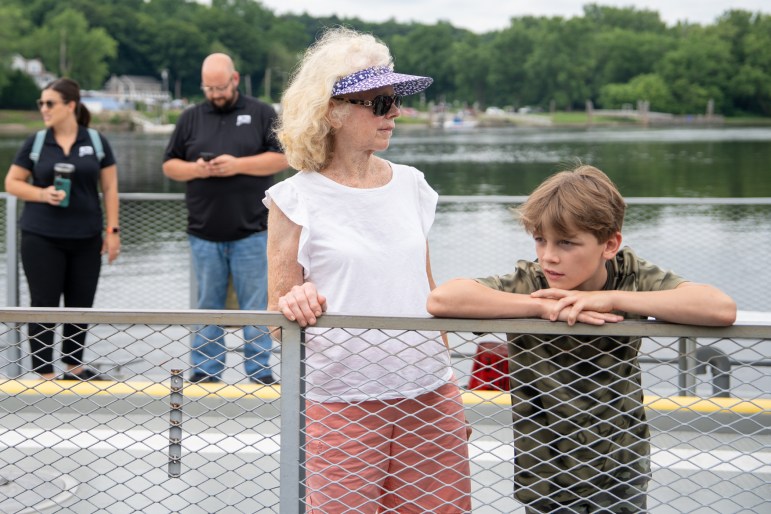
Decades later, she still takes the ferry on outings with her 10-year-old grandson, Henrik.
“This is such a unique experience,” she said during a recent trip. “Not every town has a nice ferry that goes from town to town.”
It costs the state roughly $1.4 million a year to operate both ferries, with roughly $900,000 of that coming from federal funds, according to the DOT. Total ridership last year surpassed 100,000 passengers and 45,000 vehicles.
Last year, the department also announced plans to upgrade the landing sites on either side of the river — in Rocky Hill and Glastonbury — by installing fencing, a new gate system and sidewalk and lighting improvements for pedestrian access. The project is expected to cost $600,000, to be completed during the upcoming off season.
For Clemente, the value of the ferry is more that a measure of its ridership or a line item on the budget.
“We’ve never lost a boat, we never lost a car off the deck, we’ve never had a collision, we’ve never had any of that,” the captain said. “You know, obviously we can’t handle the volume of a bridge, but I don’t believe that’s why this ferry is here. It’s to service the local community. It’s been doing so for 370 years.”
Crossing the river, Clemente and his fellow captains have to steer the barge in a sweeping arc, both to avoid a large sandbar on the Glastonbury side and so that they come into the slip at a perpendicular angle in case they need to back up. “At low water and low tide, you’ve got to be on your toes,” he said.
Still, Clemente said, the biggest hazard on the river comes from other boaters, particularly on the weekends.
“Rocky Hill’s boat launch is probably the best on the river, and it gets busy,” he said. “You have to keep a proper lookout.”
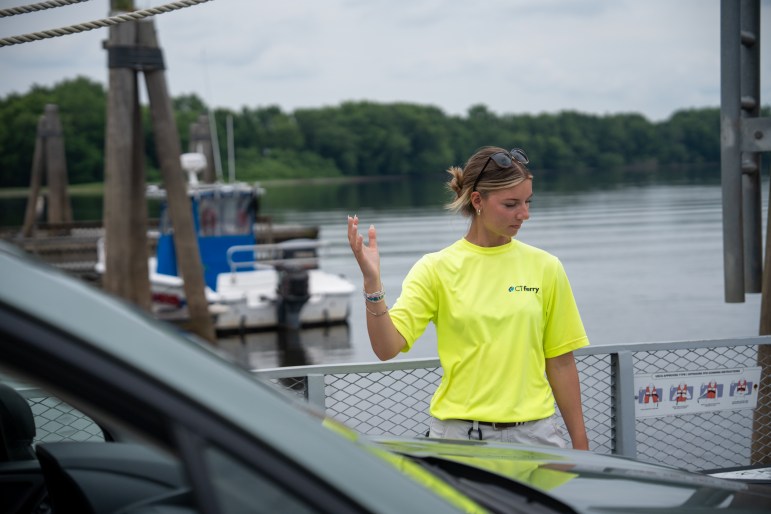
The crew’s summer intern, Makaela Wasik, recently returned for her third season in the ferry service. In the winter, she attends school at Central Connecticut State University, but she also hopes to get her own captain’s license one day.
Her biggest surprise on the job? “Honestly, how many people don’t know how to use a parking brake,” she said with a laugh.
Robert Laughlin, the executive director of the Glastonbury Historical Society, is a relatively recent convert of the ferry. Growing up in the area, he said he’d frequently drive past the landing area. But it wasn’t until after moving back to Glastonbury during the pandemic that he actually ventured on board.
On the deck of the “Hollister III,” Laughlin discovered “beautiful” views of the river and “a nice little seafood place” on the other side, the Ferry Grill, serving lobster rolls, fried calamari and other creations. Now it’s a trip he makes every so often.
“I call it my mini vacation,” Laughlin said. “A four-minute cruise across the Connecticut River.”