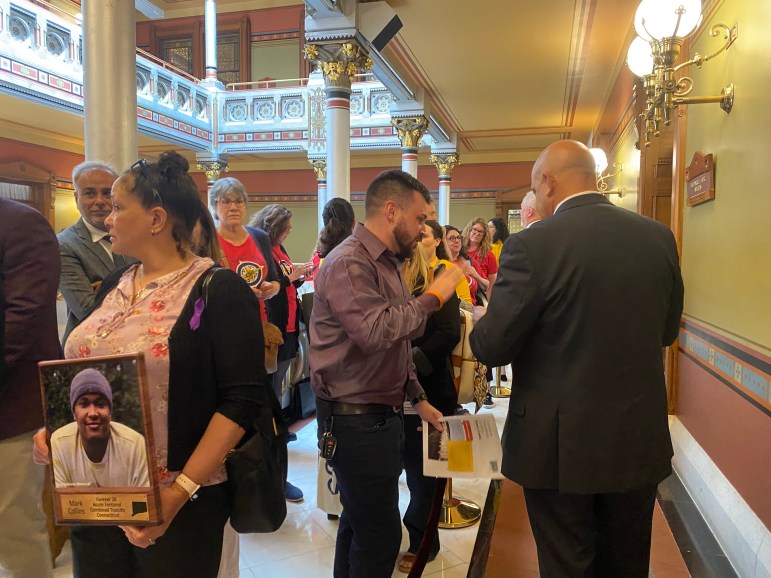
In late May, a group of people who had lost friends and family to drug overdoses gathered behind the velvet ropes just outside the House chamber at the state Capitol.
Many of them had come to this building time and again to tell their stories to lawmakers, reliving painful memories of some of the worst moments of their lives.
But on this day, they’d come full of hope: it was the final stretch of the 2025 legislative session, and they wanted to make one last push for passage of a landmark bill establishing Connecticut’s first overdose prevention centers.
As the day unfolded, though, it became apparent that the bill faced a major roadblock: Gov. Ned Lamont.
“‘We’re hearing that the governor’s threatening a veto,’” Diane Santos recalled another advocate telling her when she arrived at the Capitol. “I still didn’t fully grasp that it was going to play out the way that it was.”

Santos, who lost her 26-year-old son, Mark Collins, to an overdose in 2023, had spent the weekend emailing state representatives and had received encouraging responses. The measure was tucked into a bigger public health bill, and the odds of passage looked good, she thought. Another advocate had even spoken to Lamont by phone and came away feeling confident in his support.
But now the word was out that Lamont would veto the broader bill if it included the overdose prevention center.
The provision would have made Connecticut one of the only states in the country to have an overdose prevention center, or OPC, a space equipped with supplies to mitigate the dangers of drug use that would allow people to bring illegal drugs and use them under the supervision of trained staff, equipped with supplies, like Narcan, that can prevent and reverse overdoses.
The concept, though relatively new in the United States, had won approval in the Connecticut Senate, and advocates expected the House to follow suit. They anticipated that Lamont would then sign the bill into law, and that, in time, the new center would join OPCs in states like New York and Rhode Island as a lifesaving instrument in the fight against drug overdoses.
Last year in Connecticut, just shy of 1,000 people died of an overdose, down 35% from a peak of 1,530 in 2021, according to data from the Department of Public Health. Despite the unprecedented drop in deaths in both the state and country over the past couple of years, overdose remains the leading cause of death for American adults under 45.
Supporters of overdose prevention centers — also known as supervised consumption or safe injection sites — say they are a crucial part of the fight to save lives, one that has for too long been avoided in the U.S. out of stigma and fear. With the availability of naloxone, the overdose reversal drug, saving lives is relatively straightforward as long as people don’t use drugs alone. Therefore, advocates say, the argument in favor of OPCs comes down to a simple truth: no one can recover from substance abuse disorder if they are dead.
Skeptics question the legality of the centers and whether they encourage people to continue using instead of seeking treatment. Some also worry about their impact on the neighborhoods where they are placed.
Evidence from around the world indicates that no one has ever died of a drug overdose at an OPC and that the facilities reduce public drug use and decrease demand on local emergency services without increasing crime. But accounts from advocates and community leaders in Rhode Island, New York City and Canada show that, even with evidence, it can take time to build approval among a public that isn’t familiar with the concept.
Lamont: “Wait and see”
That afternoon at the Capitol, despite reports of the governor’s disapproval, Santos and other advocates kept on talking to legislators, hoping through some political maneuvering that their key issue would prevail.
But behind closed doors, the measure appeared doomed. The governor’s staff told House Speaker Matt Ritter, D-Hartford, that Lamont would veto the bill if it included OPCs. In an effort to save the rest of the sprawling legislation, which tackled issues from fluoride in drinking water to pancreatic cancer screening, lawmakers sacrificed the OPC measure.
“Just complete disappointment,” Santos said of the result. “Just heartache and heartbreak and feeling like I was letting my son down all over again.”
In an interview with The Connecticut Mirror in July, Lamont said he had wanted more time to consider results from other states and see whether the facilities draw the ire of the Trump administration.
“I think I said I’d have to take a look at it, but I’d be pretty reluctant to do it. I think it’s pretty early,” Lamont said. “I think Rhode Island really hadn’t gotten going yet. New York was going. Donald Trump was in office. He was coming down pretty hard.”
Plus, he said, Connecticut already uses nearly every tool at its disposal to combat the overdose crisis, including four harm reduction sites, with a fifth slated to open in Bridgeport, where people can get wound care, clean syringes, connection to counseling or just a cup of coffee.
“We have harm reduction sites already,” Lamont said. “We do everything in terms of Narcan and prevention and counseling and clean needles and such. We do everything except for the drug injection. And I just figured it was worth a little more wait-and-see.”
Lamont referenced a few conversations with individuals skeptical of the sites or their impact but said he hadn’t been on the receiving end of any significant opposition to the idea, either.
The legality of overdose prevention centers is itself controversial. Some question whether the centers violate the federal Controlled Substances Act, which prohibits maintaining a site “for the purpose of … using illegal drugs.” Others argue the law doesn’t apply to public health programs meant to prevent death. The sites in New York City and Providence have been able to operate mostly unbothered, but a 2019 Department of Justice lawsuit prevented the opening of an OPC in Philadelphia.
An executive order issued by the Trump administration last month directed agencies to withhold discretionary grants from organizations like “safe consumption sites” that allow for illicit drug use.
Lamont did, however, suggest a willingness to consider the policy.
“It’s not something we’re saying ‘hell no’ to,” Lamont said. “Let’s just get a little more experience based on Rhode Island and perhaps a couple other states.”
But the wait-and-see approach has enraged some advocates who say that people are dying now — advocates like Dita Bhargava of Greenwich, whose son died of an overdose in 2018.
“I know the governor. I know he has a compassionate heart. But at the end of the day, I think, unfortunately, he doesn’t understand the disease. He doesn’t understand the gravity of this epidemic. Lives that can be saved are being lost.”

Other states are also taking it slow
Lamont isn’t the only state leader taking a cautious approach, however. In 2022, Gov. Gavin Newsom vetoed a measure in California that would have allowed an “unlimited number” of sites, though he said he remained open to discussing a “truly limited pilot program.” Gov. Phil Scott of Vermont vetoed an OPC bill in 2022 and again in 2024, but, the second time around, lawmakers overrode his veto.
In 2023, Connecticut’s Public Health Committee introduced a bill to establish three “harm reduction centers” that would include, among other services, a space where people could bring drugs to use under supervision. But legislators removed on-site drug use from the version that went to the broader legislature out of concerns from the administration about the use of state funding and conflicts with federal law, according to Sen. Saud Anwar, D-South Windsor, the co-chair of the Public Health Committee.
This year’s effort would have established a pilot program of four OPCs without tapping state funding. The centers would include access to substance use disorder and mental health counseling, laundry, bathrooms and showers. The Public Health Committee passed the measure as a stand-alone bill, and the Senate cleared it as part of a sprawling public health bill.
Republican lawmakers on the committee, who nearly unanimously voted against the measure, voiced concern about the centers’ effects on surrounding communities and questioned whether they encourage drug use instead of treatment.
During an eight-hour public hearing, advocates presented personal stories and real-world evidence, including studies suggesting the facilities prevent overdose deaths for clients, increase uptake of treatment services, reduce emergency-related health care costs and reduce public drug use and publicly discarded drug paraphernalia, without increasing crime rates in the surrounding areas.

Cameron Breen helps to coordinate the Statewide Harm Reduction Project, or SHaRP, a group of more than 100 overdose prevention advocates from around the state. He said the focus on abstinence-only solutions can be frustrating.
“People think that the only truly successful intervention is the person stopping to use drugs altogether,” he said. “The reality is that substance use exists and too many of our community members are dying.”
But Breen agreed there’s room to increase community outreach in the future.
“Without it, we’re left in this limbo of people not having a good understanding of how much these centers save lives,” Breen said.
Rep. Tracy Marra, a Darien Republican and the only member of her party in favor of the measure during the Public Health Committee vote, said she understands her colleagues’ hesitation around community buy-in and potential effects on crime.
Marra agrees the sites reduce overdose deaths but said she’s also interested in exploring other interventions that could be effective, like cleaning up the drug supply and stopping drugs from coming in across the border.
With just three OPCs in the U.S., Marra added that studies about the effects of overdose prevention centers in this country are necessarily limited. There are over a hundred sites around the world, but what might work in Vancouver, for example, may not play out the same way in Waterbury, she said. Plus, she had concerns that the Connecticut bill proposed establishing four sites across the state, when New York City, with well over double the population, has only two.

Part of her questioning nature, Marra said, comes from witnessing the beginnings of the opioid crisis firsthand as a pharmacist.
“We were taught as pharmacists that if someone was in pain, they would not get addicted to opioids,” Marra said. “Shame on me if I believe anything that quickly again.”
Marra has focused her legislative work in part on addressing the crisis, including a 2023 proposal to put Narcan in vending machines. During a visit to one of the OnPoint sites in New York City a few years ago, Marra became convinced OPCs were a powerful solution. But still, she said, the decision to establish them in Connecticut is “much more nuanced than that.” Other factors, like location and timing, have to make sense, too.
She encouraged elected officials, including Democrats voting ‘yes’ along party lines, to visit.
“Seeing the site, seeing this done, was definitely eye-opening,” Marra said. “If you don’t know what this is about, then go see.”
Success in Rhode Island
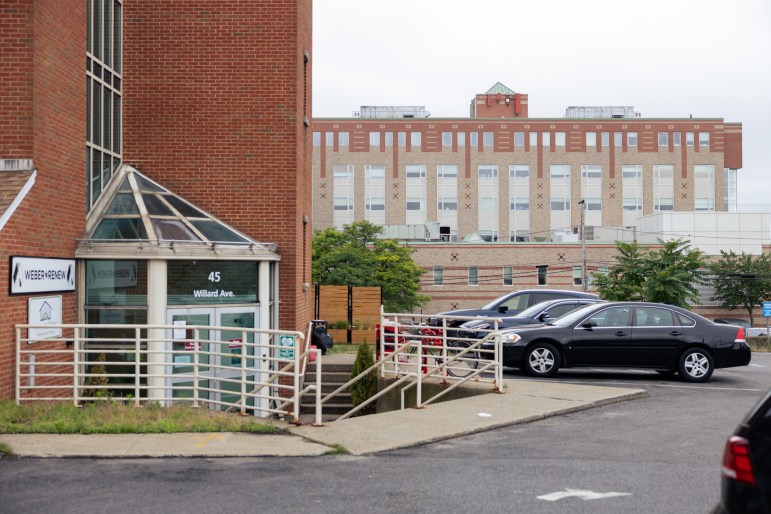
In an understated brick building in the heart of Providence’s medical district sits one of three OPCs in the entire country, Project Weber/RENEW.
From the outside, Project Weber/RENEW looks much like the OB/GYN and spinal health offices that surround it. The first floor is a common space that feels like a cross between a church basement and a community center, outfitted with showers and laundry machines. There’s also a medical suite, staffed with a full-time nurse, behavioral health physician and part-time doctor, available for walk-in patients, with or without insurance.
On the second floor, clients find the OPC. It’s a meticulously clean environment, with the hospitality of a better-quality medical office. There are individual stations for people to use illegal drugs with sterile supplies, a smoking room with a robust ventilation system, and of course, overdose-reversing naloxone kits. There are also oxygen tanks, which can prevent an overdose without painful withdrawal side effects.

The atmosphere is calm; a mellow Macy Gray song plays from a speaker, and staff members discreetly check in on clients every 10 to 15 minutes. There’s even a room equipped with soft surfaces for when clients inadvertently take a drug that agitates them.
[RELATED: What’s it like inside an overdose prevention center?]
The center opened in Providence in January and has received high marks from advocates, elected officials and community members. The staff exude pride in the OPC and their lifesaving work. But the road to realizing that goal was a long and at times heartbreaking slog, one that could offer lessons on Connecticut’s stalled effort to open a center of its own.
It took multiple attempts before Rhode Island’s governor, Dan McKee, signed an OPC bill in 2021, creating a two-year pilot. But the center still had to be funded, ultimately achieved with $2.6 million in settlement funds from opioid lawsuits. Then, organizations had to bid for the contract.
Project Weber/RENEW won the bid. The group was already doing harm reduction work, like providing clean syringes, wound care supplies and access to medical treatment. But to open the OPC, they had to find a location and win approval from the Providence City Council.
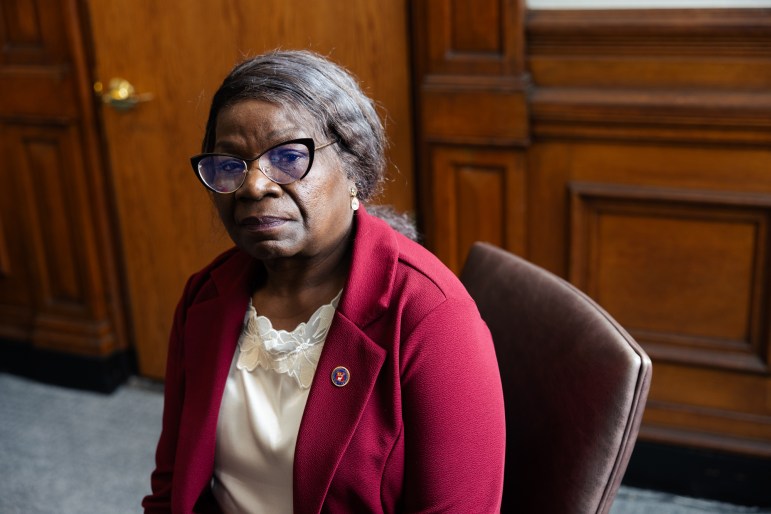
City Councilwoman Mary Kay Harris represents Ward 11, home to the hospital district. She grew up and raised four kids here. When it comes to Ward 11, “I just love it.”
Harris had some concerns about the OPC (like this common question: wouldn’t the OPC encourage drug use?). She wasn’t necessarily against the idea, but she didn’t want it in her ward, which includes Upper South Providence, a majority Black and Hispanic neighborhood where about a third of residents live below the poverty line. Neighbors there “had more than their fair share” of the city’s social services.
“No, absolutely not,” Harris remembers thinking at the time.“It’s just too much pressure on the ward.”
Harris prides herself on being a good listener and making decisions based on consensus; in rejecting the OPC, she believed that she was representing her constituents.
But in the months that followed, Harris began to hear from others, including advocates from Project Weber/RENEW, like Deputy Director Ashley Perry. Perry has lived experience with drug use and got involved with the organization as a volunteer running support groups for sex workers. Perry had been reluctant to engage with recovery groups in the past, which are often structured around repentant confessions.
“It didn’t feel good to always be reminded of the worst things that I’ve done,” Perry said. “I really wanted to move past that, and I really wanted to find safer ways for people who I knew were still suffering in a lot of different ways.” Project Weber/RENEW felt different, a nonjudgmental group giving people the tools to reduce harm and stop using drugs when they were ready.

But after Perry started volunteering, fentanyl sent the overdose death rate soaring. Then COVID worsened the isolation of the community, contributing to a leading cause of overdose: using alone.
The group staged a mock funeral procession in January 2021, with doctors carrying caskets on their shoulders, representing 384 people who had died in the nation’s smallest state of an overdose the previous year.
As time went on, Perry and her team became a constant presence in community and state-level meetings on the opioid epidemic, explaining why an OPC was needed. Their team also responded to calls from the community, like requests to pick up needles in neighborhoods. They were, Harris said, relentless. And Harris began attending meetings, too.
“The more I attended, the more I understood, the more I heard people struggling, the more I heard people losing their family members, the more I heard drug addicts who said, ‘I’m not ready to stop using drugs.’”
Harris’s own granddaughter died of a fentanyl overdose during that time period, at age 26, a young woman she describes as joyful and creative. Harris believes an OPC might have saved her life.
But it was before her death that Harris came around to the idea of putting the OPC in Ward 11, a change of heart she attributes partly to the location of the building. The proposed location wasn’t in a residential neighborhood or on a Main Street like she feared. Rather, it was a building in the medical district, accessibly located on a bus line.
Between opening day on Jan. 13, 2025, and July 8, Project Weber/RENEW saw 460 unique clients and performed 99 interventions to prevent overdose. They haven’t lost anyone to overdose so far.
Perry and Harris are quick to talk about the importance of community buy-in as Connecticut considers its own OPC.
In New York City, where the two other OPCs in the U.S. are located, that kind of participation did not happen. City Councilwoman Carmen De La Rosa explained to The Connecticut Mirror that she learned, along with her constituents, during a press conference on the last day of former Mayor Bill de Blasio’s administration that New York would get two OPCs and that one of them would be located in her district of Washington Heights, a low-to-middle income neighborhood where about half of residents are immigrants.
“I have to say that that has caused a lot of trouble in terms of the community feeling involved,” De La Rosa said. That includes the choice of location — near one of the largest and most popular parks in the neighborhood.
Though the OPC has since made progress in gaining some community support, De La Rosa said that complaints persist, and she’s often blamed for the OPC, even though she had no say in where it was located.
“The minute someone runs into a needle somewhere, they bring up the OPC,” she said. “The needle could just have come from someone who is in the throes of addiction and was using on that street. But they’re like, ‘Well, you know, if that OPC wasn’t here, they wouldn’t be able to get needles.’”
She wonders what it might have been like if the community had been involved from the get-go, as they were in Providence.

What’s next for Connecticut?
In late May and early June 2025, a spike in overdoses took dozens of lives in New Haven County, sparking a desperate attempt to stem a fatal mix of drugs. As this was taking place, Lamont sent out a press release announcing a significant drop in overdose deaths for 2024.
Though the release nodded to the seriousness of the issue, it did not mention the crisis that was unfolding. Advocates like Diane Santos, already raw from Lamont’s singlehanded move to prevent OPCs, said the announcement was jarring.
“To me it says he is either out of touch himself, or he’s getting bad information from somewhere.”
When a bill fails, advocates and lawmakers usually put their heads together and consider what strategy they might try next time to turn public opinion and rally support from other lawmakers. But some advocates in Connecticut say they already had the votes, and there was no public testimony opposing the concept, so they now face a different scenario: they must convince an audience of one, Gov. Lamont, to support the measure.
Sen. Anwar was among the most committed advocates of the OPC measure. Since the measure failed, he has been publicly criticizing Lamont and says he’s calling Lamont out every time there is an overdose death.
“It still makes me sad, and it makes me angry,” Anwar said of Lamont’s decision. “Because I value our citizens, and for somebody to make a decision knowingly and then shrug it away like it’s not a big deal is unacceptable to me.”
Bhargava also lobbied for Lamont’s support. Her son, Alec Pelletier, had been in and out of treatment for substance abuse disorder when he died of an overdose on his birthday in 2018 while living in a sober home. Like Harris’s granddaughter and Diane Santos’s son, he was 26.
Over the past year, as a student at the Yale School of Public Health and as an advocate, Bhargava educated herself about OPCs, visiting one in Vancouver and speaking with the program managers of the centers in Rhode Island and New York. She came away convinced that such a center could have saved her son’s life.
The issue, she says, is simply too urgent to wait.
“We don’t have the time. We just don’t. The time is now. And Gov. Lamont should hold a special session and get this done to save the people’s lives he’s serving to protect.”
When asked if he would visit an OPC, Lamont said he’s open to it.
“Visit or call, we’ll see what happens. I don’t want to overpromise. I have an open mind, if that’s what you’re suggesting,” he said.