


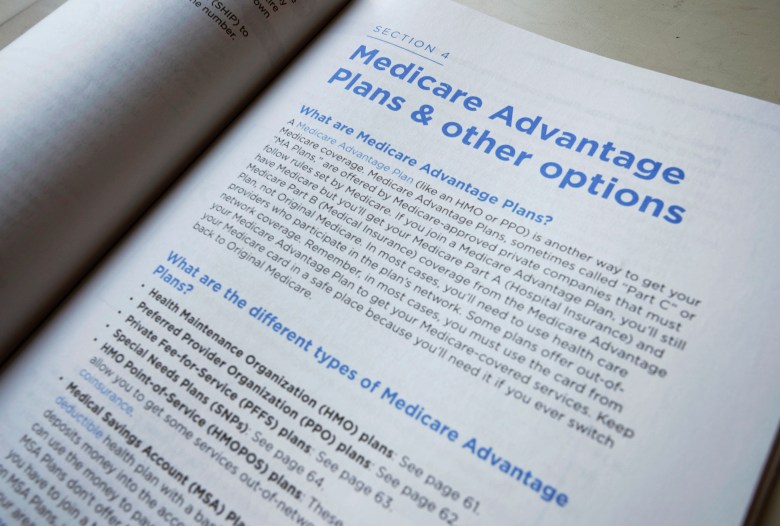
Medicare Advantage — a type of Medicare plan administered by private companies as opposed to the federal government — has come under fire in recent years for denying and delaying seniors’ access to certain care.
James Russell, a former sociology professor at Eastern Connecticut State University, and Gloria Bent, the wife of a former physicist at the University of Connecticut, have firsthand experience. They are both enrolled in a Medicare Advantage plan, the default coverage for retired state employees and their dependents over 65.
Their experiences led them to start Connecticut State Employees for Medicare Choice, which aims to “get Connecticut state employee retirees an affordable choice between Medicare Advantage and traditional Medicare,” Russell said. Already, the group has roughly 1,500 people signed up for its email distribution list.
In 2021, Russell was diagnosed with a rare form of lung cancer. When he called to make an appointment for chemotherapy at a major cancer center in Portland, Oregon, where he now lives, he was informed that the facility didn’t accept his Medicare Advantage plan, even though they would have accepted traditional Medicare, he said.
“I thought there was a mistake because up until then I had thought that the state of Connecticut had found a way to get an MA plan with a near-universal network like traditional Medicare,” Russell wrote in an email. “There was no mistake, the person on the phone told me.”
Covering retirees through Medicare Advantage instead of traditional Medicare can save states a lot of money. Connecticut made the switch in 2018 and it has led to nearly $1.7 billion in savings over the last five fiscal years, according to estimates from state Comptroller Sean Scanlon. He said the state is able to leverage the “scale and size” of the Medicare Advantage plan — which covers 64,000 people — to reduce costs.
Over breakfast one morning, Russell came across an article in The Guardian about Gary Bent, another Connecticut state retiree, who in 2022 was denied coverage by the state’s Medicare Advantage plan for intensive rehabilitation recommended by his doctors after a brain surgery left him with severe mobility and cognitive impairments.
Bent had since passed away, but his wife and daughter, Gloria and Megan, were quoted in the article. Russell immediately tried to get in touch. Once he did, the organizing effort began.
Connecticut’s Medicare Advantage plan is now run by Aetna, but prior to 2023 — when Bent and Russell both dealt with access issues — UnitedHealthcare provided the coverage.
A spokesperson for UnitedHealthcare said the company couldn’t comment on specific cases without a signed waiver from the patient allowing for the release of their medical records.
Bent declined to provide access to her husband’s medical records out of privacy concerns. Russell signed the authorization, but UnitedHealthcare did not answer specific questions about the challenges he faced in time for publication.
Asked for general information on the company’s prior authorization practices, UnitedHealthcare’s spokesperson referred to a page on the company’s website, titled “Get the facts: Why is prior authorization needed.” The page states that, “for all the recent noise around prior authorization, the reality is it’s rarely used.”
The fight for a choice
The contract governing retirement and health benefits for current and former Connecticut state employees expires in 2027. Early discussions have already begun between the state government and the State Employee Bargaining Agent Coalition, or SEBAC.
Russell said CT State Employees for Medicare Choice is pushing SEBAC to demand a traditional Medicare option in the new contract. “We have definitely made it an issue,” he said. “If we had not come along, I think this just would have sailed through with another Medicare Advantage plan.”
A spokesperson with SEBAC wrote in emailed comments that the bargaining coalition came to a mutual agreement with the state to switch to Medicare Advantage in an effort to help “find savings for Connecticut.” But SEBAC is aware, the spokesperson wrote, that “a small number of members began to experience serious access issues.”
A spokesperson with Aetna, which has administered Connecticut’s retiree Medicare Advantage plan since 2023, said the company is committed to providing state retirees with “quality, affordable and convenient health care.”
As of last year, 34 states offered their retired employees the option to enroll in Medicare Advantage, according to KFF Health News. But Connecticut is one of just 13 states where state retirees must enroll in Medicare Advantage, without the option to enroll in traditional Medicare. Russell and Bent want to see that change.
“Medicare Advantage programs as a whole continue to face rightful and concerning criticism over their business model,” the SEBAC spokesperson wrote. “SEBAC and the State instituted a workaround so that state retirees can receive the care they need to address the few cases brought to our attention.”
When asked whether the state would consider allowing retirees the option to enroll in traditional Medicare as part of the updated SEBAC agreement, Scanlon said anything is possible.
“Nothing is ever off the table in a SEBAC negotiation. These are one of the more important negotiations the state does,” Scanlon said. “My personal opinion is that what we’re doing is working.”
Scanlon said the state has made efforts to address issues raised by enrollees.
In January 2025, the state launched the option for people to enroll in a Medicare plan with Aetna — the current provider of the state’s Medicare Advantage plan — if they find a critical care provider that won’t accept Medicare Advantage. Russell will be enrolled in the Medicare plan as of September 1, a spokesperson for Scanlon confirmed.
“My personal opinion is that what we’re doing is working.”
Sean Scanlon, Connecticut state Comptroller
The state has also removed prior authorization for radiology services and has worked to improve the prior authorization practices for skilled-nursing facilities, or SNFs. Scanlon said his office identified SNFs as a pain point for enrollees and resolving those issues has been a “huge focus” for his staff. The prior authorization approval rate for SNFs is now at 92%, he said.
Medicare Advantage plans have come to dominate the market. Both nationally and in Connecticut, over half of Medicare beneficiaries are enrolled in Medicare Advantage as opposed to traditional Medicare.
Scanlon acknowledged that much of the criticism regarding these plans is warranted, but he said the service retirees receive through the state’s plan is very different from the experience of people who individually enroll in Medicare Advantage.
“We can pair big savings with responsive management of the plan and then can be adaptive to problems that come up,” Scanlon said. “Whether that’s dealing with specific cases for one of our 64,000 members or taking anecdotal feedback on things like prior authorizations.”
Many people like their Medicare Advantage plans, which often have lower premiums than traditional Medicare. For someone who is relatively healthy, Medicare Advantage will cover most of the services they need. But issues can arise when they face a catastrophic diagnosis, Russell said.
“It does work for people,” Russell said. “Until it doesn’t.”
Gloria Bent said, like Russell, she wants people who haven’t yet experienced issues with Medicare Advantage to understand that they might be one health disaster away from dealing with those problems themselves.
“I would ask them to just hold onto the awareness that when they need it most, if they’re in an acute crisis, they’re probably not going to get what they need,” Bent said.