


This story has been udpated.
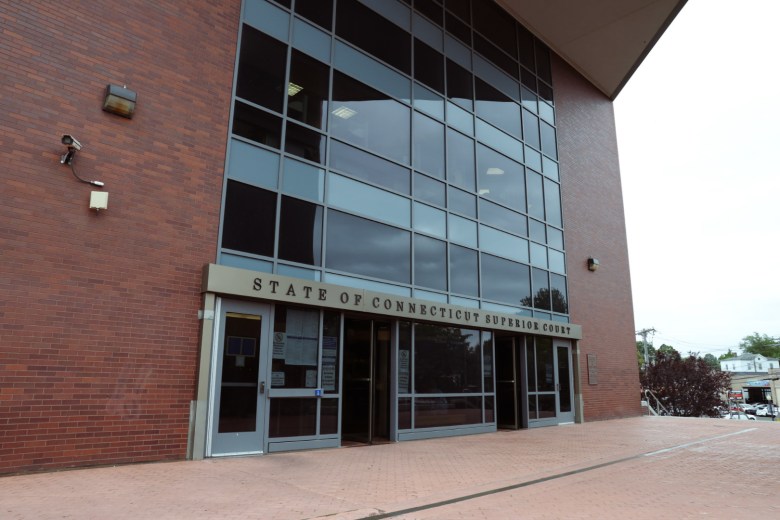
A group of state lawmakers is calling on Connecticut’s Chief Justice to issue an order banning U.S. Immigration and Customs Enforcement from arresting or detaining people in the state’s courthouses.
A group of 21 Democratic Senators, including Senate President Pro Tempore Martin M. Looney and Senate Majority Leader Bob Duff, sent a letter on Wednesday to Chief Justice Raheem Mullins asking for tighter protections
Specifically, they asked that Mullins issue an order similar to one the United States District Courts in Connecticut issued in early August banning federal immigration officers from arresting people anywhere in courthouses where judicial proceedings are taking place.
The Senators said their request came in light of an arrest in Stamford on August 11, where three ICE agents entered the courthouse without a warrant and arrested two men hiding in the bathroom, according to the letter. They referenced similar arrests in Danbury.
“Prior to recent incidents at the courthouses in Stamford and Danbury, ICE agents only apprehended individuals outside courthouses, a practice common since the Oval Office changed hands in January of 2025. Now, Connecticut residents cannot access the justice system without fear of potential apprehension by ICE,” the senators wrote.
They called the courthouse a “safe haven” for victims, particularly people who have been in car accidents, are in need of protective orders or who are going through a divorce. Looney told the Connecticut Mirror that people who come to courthouses could be witnesses of crime, domestic violence victims or involved in a civil case.
Constanza Segovia, lead organizer for Hartford Deportation Defense, said her organization had been pressing for restrictions on federal immigration enforcement in courtrooms since 2016.
“In our community, in our membership, we constantly hear from people who are concerned about appearing in court for basic court appearances that just feel risky and should have nothing to do with immigration status,” she told CT Mirror.
She said that while the organization generally encourages people to comply with court orders in order to avoid a higher level offense that could impact their immigration status, the recent federal activity has left her uncertain whether to continue offering that advice without protection from the state.
Data from the Deportation Data Project shows that arrests in Connecticut by federal immigration enforcement in the first half of 2025 are more than double what they were in the first half of 2024. Deportations have tripled.
On Aug. 20, ICE’s Boston Office announced the completion of what they called “Operation Broken Trust,” a four-day operation in which they arrested 65 immigrants in Connecticut. At the time, the group Greater Danbury Unites for Immigrants said in a statement that federal agents had been seen at the Danbury courthouse on a regular basis during ICE’s operation.
Videos posted on social media showed confrontations between advocacy groups and ICE agents in the parking lot of Danbury Superior Court, as officials arrested a man and a woman. The videos show a group of officers dressed in tactical gear, some of whom wore masks.
Advocates had asked that a prohibition on arrests in state courthouses be included in a bill updating the state’s Trust Act — the law that regulates how local and state law enforcement interacts with Immigration and Customs Enforcement. The provision did not make it into the bill.
Rep. Greg Howard, R-Stonington, one of the top Republicans on the legislature’s Public Safety Committee, criticized the senators’ letter in a statement, saying that such a policy would prevent federal officials from arresting unauthorized immigrants who have broken the law, putting the public at risk.
“Too often the Trust Act prevents local law enforcement from coordinating with ICE to arrange safe, controlled transfers. Instead of allowing orderly arrests in secure environments, this policy forces dangerous, transient individuals to be released on the hope they’ll return to court and avoid further crimes. Law enforcement wants to protect our communities through proper procedures, but current state policies tie their hands and put public safety at risk,” Howard said.
State Rep. Steven Stafstrom, D-Stamford, one of the chairs of the state legislature’s Judiciary Committee, told CT Mirror that he agreed with the concerns that the Senate Democrats raised in their letter.
“There seems to be a real escalation of the hostility with which ICE is entering our courthouses, and I think we need to take a very serious look at how we can respond to that and make sure that everyone who enters our courthouses feel safe and is able to participate peacefully in the justice system,” he said.
Stafstrom said he and his co-chair on the Judiciary Committee, Sen. Gary Winfield, D-New Haven, plan to meet with Mullins next week.
Karen Hunter, an organizer with Greater Danbury Unites for Immigrants, one of 90 organizations that sent a letter to Gov. Ned Lamont and state lawmakers asking for protections for immigrants to be a focus during the legislative session, said that on Wednesday she’d watched the father of two small children as he was detained near the Danbury Superior Courthouse.
“If people fear deportation when going to court, they effectively lose access to the entire justice system — whether they’re victims reporting crimes, witnesses, or family members,” said Hunter.
Hunter’s group asked that, in addition to focusing on ICE presence at courthouses, lawmakers limit the amount of personal data shared between state agencies and the federal government and continue to offer state health insurance to unauthorized migrant children and pregnant women.
The senators Thursday also requested that the Judicial Branch install additional measures, including limiting information posted online about court dates, allowing for electronic court appearances, requiring federal agents to provide courthouse security officers with names and badge numbers, and barring face coverings inside courthouses.
Chief Justice Mullins said in a statement that he is “committed to making sure our courthouses are safe spaces of fairness and protection for all who use them,” and that the Judicial Branch “will employ all legally supported methods to do so.”
Other states have proposed bans on courthouse arrests. Massachusetts in 2019 placed a ban on arrests by federal immigration enforcement agents in courthouses. The ban was later overturned by an appeals court. And the Trump Administration this June filed a lawsuit against the state of New York challenging a 2020 law blocking federal immigration authorities from arresting people in state courthouses without a warrant.
In July, a group of organizations advocating for immigrants filed a class-action lawsuit in the U.S. District Court for the District of Columbia against the Department of Justice in protest of several changes in federal immigration policy, including civil arrests in courthouses.
Looney said he didn’t know the likelihood of a ban on courthouse arrests in Connecticut being challenged, but he said he believed the state should have a plan and that it should look to the examples of other states. He said that while the state can’t “interfere” with federal immigration enforcement, there were still protocols that could be enforced.
He said the three branches of government needed to work together to address the problem, and that he would be open to discussing legislation at a special session.
Correction:
An earlier version of this story gave incorrect titles for state Sen. Martin M. Looney and state Sen. Bob Duff. Looney is Senate President Pro Tempore and Duff is Senate Majority Leader.