


This story has been updated.
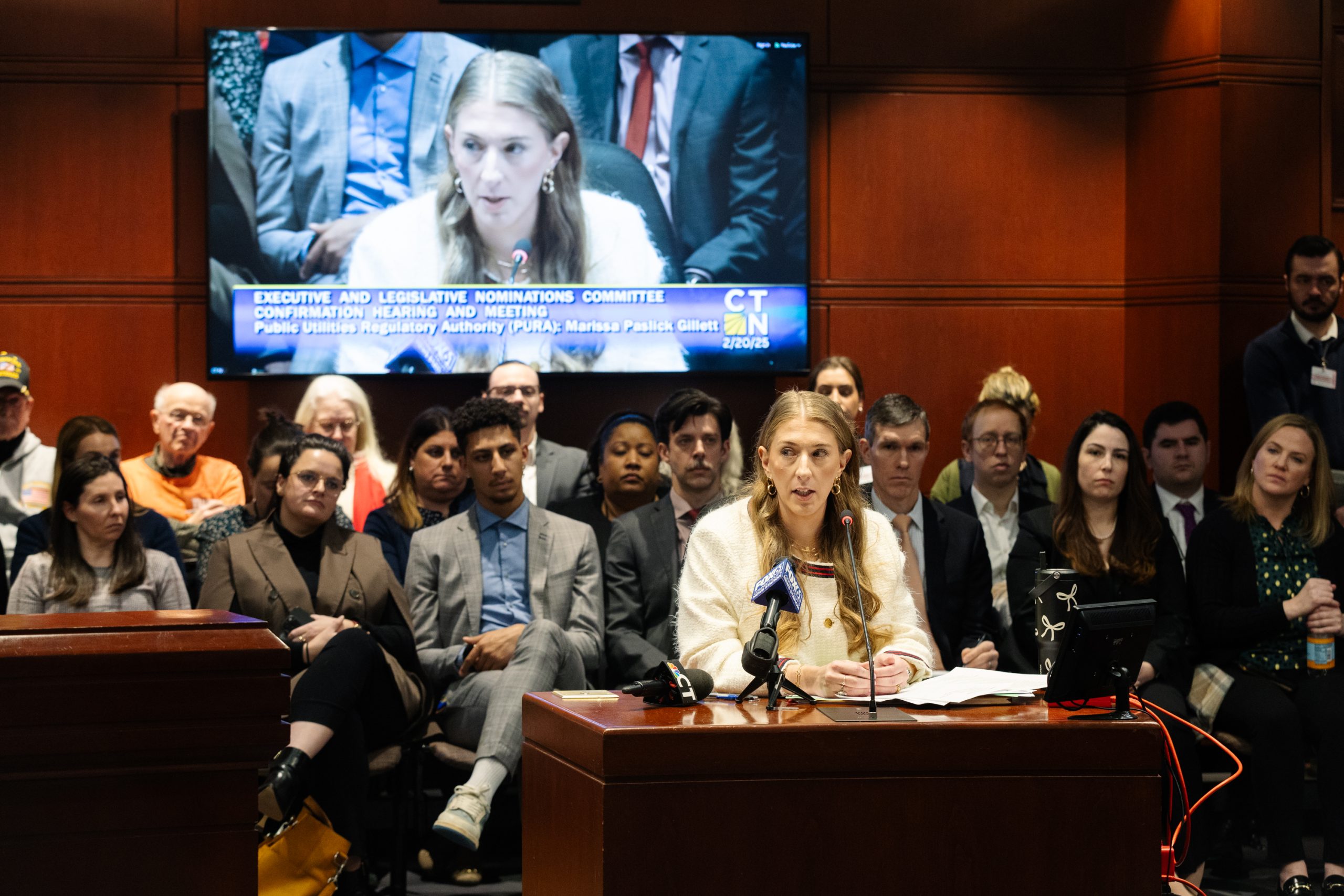
Public Utilities Regulatory Authority Chairwoman Marissa Gillett resigned her post as Connecticut’s top utilities regulator on Friday, ending a tumultuous tenure in which she frequently drew the ire of utility executives while struggling to bring down the state’s sky-high energy prices.
Gillett announced her decision in an email to staff members at PURA on Friday morning, which was followed by a press release from Gov. Ned Lamont.
In a letter she sent to Lamont explaining her decision, Gillett said frequent criticism by opponents and pushback against her efforts to implement regulatory reforms had become unbearable.
“While I have never shied away from principled disagreement, the escalation of disputes into a cycle of lawsuits and press statements pulls attention and resources away from what matters most: keeping rates just and reasonable, improving service, and planning a resilient, reliable energy future,” she wrote.
“It has also exacted a real emotional toll both for me personally, as well as my family, and for my team,” Gillett added. “I did not make this decision lightly, but there is only so much that one individual can reasonably endure, or ask of their family, while doing their best to serve our state.”
Her decision comes just five months after lawmakers confirmed Gillett to a second, 4-year term on PURA following a contentious confirmation battle during which opponents questioned her transparency and leadership style. In June, Lamont reappointed her as chair.
Those victories did little to quell the attacks from her critics, however, especially as new details about her tenure emerged through a series of lawsuits and public records requests.
On Thursday, House Minority Leader Vincent Candelora, R-North Branford, called for the opening of impeachment proceedings against Gillett after the Hartford Courtant released internal emails from 2023 in which Gillett’s chief of staff, Theresa Govert, asked other commissioners at PURA to route their requests to work with staff members through her.
Candelora said the emails offered evidence that Gillett had sought to solidify her authority by restricting her fellow commissioners’ access to staff. During a confirmation hearing earlier this year, Gillett had denied having any such policy in place, leading Candelora to question whether she had lied under oath.
“I sincerely regret having to make such a request; however, this institution must be protected and the integrity of our nomination and confirmation process demands that nominees conduct themselves with the highest level of honesty,” Candelora said in a letter said a letter to House Speaker Matt Ritter, D-Hartford, requesting the formation of a select committee to look into impeachment.
“Misleading or untrue statements provided by nominees during this process cannot be tolerated,” Candelora added.
While it is unclear whether Democratic leaders would have agreed to Candelora’s request for a formal inquiry, Ritter said Friday that he had directed staff to review the video of Gillett’s confirmation hearing and that he found the allegations “troubling.”
“I would say that, just based on my cursory review, at best it was misleading,” Ritter said.
At the time of her resignation, Gillett and PURA were also facing two active lawsuits from the state’s two largest utility companies: Eversource and Avangrid, the parent company of United Illuminating.
Spokespeople at both companies declined to comment Friday.
Gillett’s situation became even more precarious in recent days following a sudden turn in one of the lawsuits involving PURA and two Connecticut gas companies owned by Avangrid.
The case is an appeal of PURA’s decision to deny the companies’ request for a rate increase and instead cut their combined revenues by $35 million. Attorneys for the companies repeatedly sought access to Gillett’s email and phone records in hopes of proving their assertions that the chairwoman harbored an inappropriate bias against the utilities, a claim Gillett has repeatedly denied.
On Wednesday, lawyers for the state attorney general’s office, who had been representing PURA in that appeal, suddenly offered to settle the case by sending it back to PURA to reconsider — this time without Gillett’s participation.
The following morning, Lamont and his senior staff concluded at their daily meeting that Gillett’s situation was untenable, according to Rob Blanchard, the governor’s communications director.
Gillett, who spoke to members of the governor’s staff that day, was already weighing her resignation before Candelora’s letter arrived later that afternoon, Blanchard said.
In a statement on Friday, Lamont offered departing words of praise for Gillett, who he called “one of the most experienced and qualified public utility regulators in the country.” (Prior to joining PURA in 2019, Gillett served as a advisor to the Maryland Public Service Commission and later as an executive for an energy storage trade association.)
“Her breadth of knowledge, analytical skillset and experience in energy policy, combined with her commitment to fairness and her ability to navigate complex cases were beneficial to our state and ratepayers,” Lamont said. “Marissa brought an outsider’s perspective and a fresh set of eyes to help advance our policy goals of bringing cheaper, cleaner, and more reliable power to the people of our state.”
According to the governor’s office, Gillett’s last day will be Oct. 10.
Gillett’s supporters on Friday described her as the victim of a years-long “bullying” campaign waged by the utility companies as a result her efforts to apply greater scrutiny to their activities through what’s known as “performance-based regulation.”
Performance-based regulation generally refers to the practice of tying financial incentives to a utility’s ability to meet certain state-defined objectives, such as modernizing the electric grid or promoting renewable energy. Connecticut was among the first states in the nation to pursue adoption of that approach under Gillett’s leadership.
“It’s been obvious [the utilities] were very threatened by the performance-based review,” said Tom Swan, the executive director of the Connecticut Citizen Action Group. “They went scorched earth.”
State Rep. Jonathan Steinberg, D-Westport, co-chair of the legislature’s Energy and Technology Committee, said Gillett stood apart from other regulators in her willingness to challenge the rationale for the profits sought by utilities. “Connecticut will miss her, soon and for a long time,” he said.
Even Candelora, one of Gillett’s most steadfast critics, acknowledged on Friday that she had been an “agitator” against the utility companies.
“But beyond that, it hasn’t resulted in lower electric rates,” he said.
Utility officials, meanwhile, have argued that Gillett’s regulatory strategy resulted in repeated credit downgrades that made it more expensive for the companies to attract the capital needed to make investments in Connecticut.
In a statement on Friday, Connecticut Business and Industry Association President Chris DiPentima said that Gillett’s departure “presents an opportunity to find the path forward on energy policy and regulation to positively impact consumers, businesses, and the state’s economy.”
“Now is the time for utilities, the business community, policymakers, and regulators to come together and collaborate on sustainable solutions that will lower the cost of energy and develop the infrastructure to meet our long-term economic needs,” DiPentima said.
Gillett’s departure will leave PURA with just two sitting members come October: Vice-chair David Arconti, who was confirmed by lawmakers in April, and Michael Caron, who is serving out a term that formally expired in 2022.
Lamont had been seeking to fill two existing vacancies on the board when Gillett announced her resignation. The governor has repeatedly expressed a desire to find an another industry expert — as opposed to former lawmaker — willing serve on PURA, but he was having trouble due the many controversies swirling around the authority.
Blanchard, the governor’s spokesman, said Friday that Gillett’s departure may make recruitment easier. In the meantime, he said it is unclear who her successor at PURA will be.
“The chair hasn’t been decided yet and we are still actively working to fill all seats,” Blanchard said in a text message.
Whether PURA will be able to vote on matters with just two sitting members remains unclear. Blanchard said the authority requires a chair in order to conduct business.
Among the matters currently pending before the authority are the proposed sale of Eversource’s Aquarion Water Company to the Regional Water Authority along with UI’s most recent rate case for its electric customers.
Clarification:
This story has been updated to clarify that Lamont’s office did not explicitly ask for Gillett’s resignation.
CT Mirror reporter Mark Pazniokas contributed to this story.