


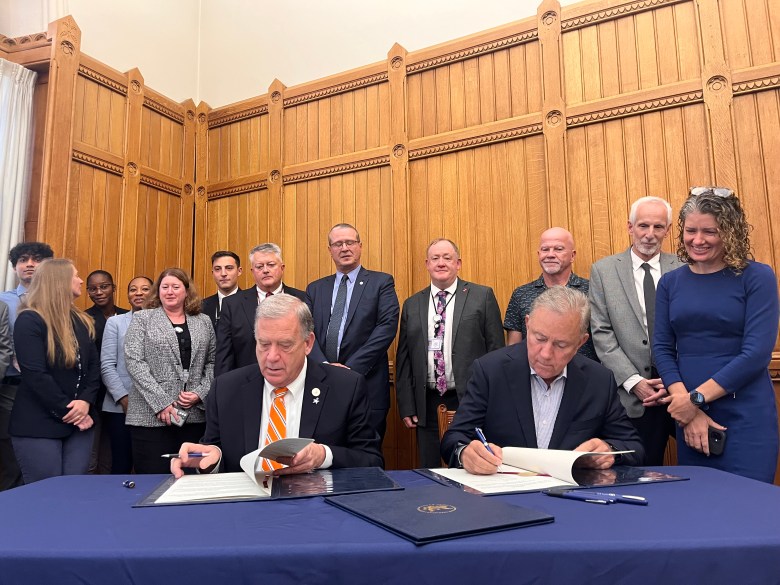
Gov. Ned Lamont signed an agreement with the U.S. Nuclear Regulatory Commission on Thursday that will delegate oversight of radioactive materials used in medicine, academics and industry to state officials in Connecticut.
The agreement expands the state Department of Energy and Environmental Protection’s current authority to regulate radiation-emitting devices such as X-rays and CT scans — which are typically the purview of the states — to also include radioactive substances such as tracers used to detect cancer or cracks in underground water pipes.
Radioactive material used in nuclear power plants, as well as its subsequent waste, will continue to be regulated and overseen by federal authorities at the NRC.
During a signing ceremony in the state Capitol on Thursday, NRC Chairman David A. Wright said the agreement eliminates duplicative regulations and allows professionals who work with nuclear materials to coordinate directly with state regulators to ensure proper handling and disposal.
“You know your people better than we do, and they know you,” Wright said. “So there’s that trust factor built in.”
Lamont, meanwhile, pitched the agreement as part of his administration’s efforts “to be a little more business friendly, and speed things up and make them happen.”
Connecticut is the 40th state to enter into such an agreement with the NRC covering nuclear materials. Two other states, Indiana and West Virginia, have also signaled their intent to sign similar agreements.
DEEP Commissioner Katie Dykes said there are over 100 business in Connecticut handling nuclear materials that will benefit from the agreement. “Connecticut will be able to streamline processes and increase efficiency, all while maintaining the highest safety standards,” she said.
As part of the agreement, Dykes said that the NRC will continue to monitor and provide support and training for the state-run program.
As part of the agreement, Connecticut will begin collecting roughly $1.7 million in annual revenue from license fees that previously went to the NRC to fund its regulatory efforts, according to Jeff Semancik, director of DEEP’s radiation division.
In order to take on additional duties required by the agreement, Semancik said the radiation division has already hired one additional staff member and plans to bring on two more, bringing its total number of employees to 15. Currently, Semancik said the division’s work includes hospital inspections, emergency management and responding to any incidents at Millstone Nuclear Power Plant in Waterford.
Connecticut first signaled its intent to enter into an agreement with the NRC in 2020, and Dykes said that formalizing the deal required several years of planning, drafts and adjustments to state law.
DEEP staff, she added, have received “thousands of hours” of training from their federal counterparts in licensing, inspection and enforcement of the rules pertaining to nuclear material handling.
The agreement formally takes effect on Oct. 1, when Connecticut assumes its regulatory authority from the NRC.