



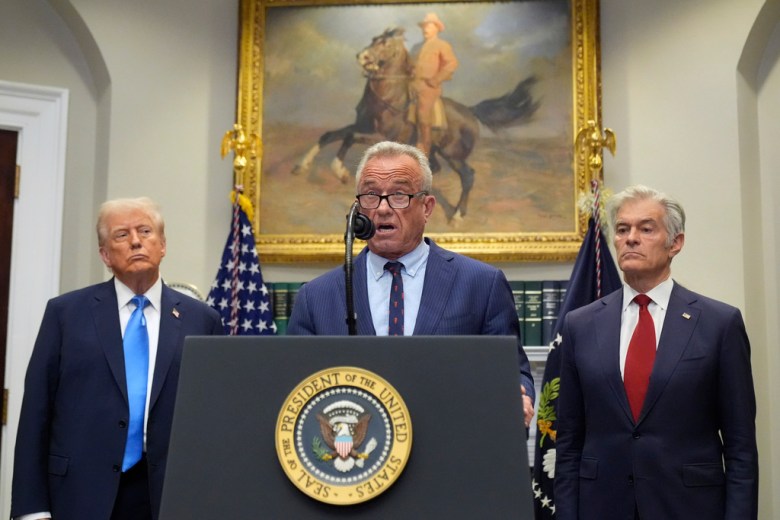
This month, President Donald Trump introduced his administration’s latest discovery: “the answer to autism.”
After Robert F. Kennedy Jr.’s months-long quest to eradicate autism spectrum disorder, he and his colleagues have apparently delivered on their promise to provide a so-called cure. This announcement is troubling considering that autism is not a disease.

Leucovorin, the drug Trump and his colleagues intend to use in autism treatments, normally offsets the toxic effects of cancer treatments, and boosts the amount of folic acid in the body. Evidence that leucovorin can have any effect on autistic behavior is limited, and the idea that this drug can remove autism – a neurotype passed down through genes – has no basis in reality. Medicines cannot remove characteristics of autism, nor can they alter any personality trait.
Up to this point, RFK and his associates have blamed vaccines for the recent rise in autism diagnoses. Now he claims that Tylenol use during pregnancy causes autism. Neither of these assertions are true. In actuality, this increase in diagnosis comes, at least in part, from growing awareness of what autism really is. For most of its history, autism has been underdiagnosed in girls and women, who often mask their autistic traits more successfully than their male counterparts due to social pressure. Underdiagnosis also disproportionately affects autistic people of color, whose characteristics are often ignored, misread or demonized by health professionals. As research on autism has expanded and knowledge has spread, diagnosis rates have naturally risen. These growing numbers reflect important advancements in the scientific world and indicate that more autistic people may be receiving the support they need.
RFK’s misinformation has contributed to measles outbreaks, chaos at the CDC, and a moment of misguided empowerment for the anti-vax movement. It has also put autistic people everywhere in danger, especially autistic children with high support needs (more commonly known as “low-functioning” autistics). Instead of receiving accommodation and assistance, these children will face even more judgement and contempt. Many children, whether autistic, disabled, or neither of the above, will lose life-saving healthcare. The misconception that autism is a disease rather than a neurotype – a way of being a person in the world – destroys and ends lives. Autism itself, though it can and often does present serious challenges, is not a curse, nor is it a death sentence.
If our society made room for its autistic population, providing compromise and understanding, the lives of autistic people everywhere would become not only more manageable, but happier and richer. These advancements might include more accessible diagnoses and mental health support, more diverse options in schooling and employment, and above all a shift in perception. Widespread, accurate information on autism and empathy for autistic people can vastly improve their lives. As a lower support needs (or “high-functioning”) autistic adult myself, I have felt this lack of kindness and understanding deeply throughout my life, in ways both big and small.
I have empathy, too, for the parents of struggling autistic children looking for a cure that does not exist, although their actions frustrate me and have devastating consequences for their families. These people, in their desperation and their need to provide happiness for their kids, have been taken advantage of by leaders with no regard for their well-being.
Autism, as the term “autism spectrum disorder” suggests, affects different individuals in profoundly different ways. However, I’m willing to bet that all autistic people – as well as their loved ones, communities, and society in general – would benefit from compassion. Donald Trump and Robert F. Kennedy Jr.’s “answer to autism” shows no compassion, but rather bravado and a fundamental misunderstanding of the issue at hand.
In order to soothe the suffering of autistic individuals and their families, we must listen to the wisdom of autistic voices, and we must lead with a willingness to learn and adapt. The answer to autism is empathy.
Isabelle Farnham lives in West Hartford.