



|
Getting your Trinity Audio player ready...
|
This reporting was supported by the International Women’s Media Foundation’s Women on the Ground: Reporting from Ukraine’s Unseen Frontlines Initiative in partnership with the Howard G. Buffett Foundation.
On a cold, rainy day in late March, Evgenia Natsevych lifted her daughter Angelina, allowing the 7-year-old to peer through the waiting room window of a New Haven dentist’s office.
“I want her to see the ocean,” she said, pointing to Long Island Sound. “We had the sea in Odesa.”
Angelina began experiencing tooth pain in the days leading up to Russia’s full-scale invasion of Ukraine in 2022. Three years later, her mother was finally able to get her care through Connecticut’s Medicaid insurance, known as HUSKY.
Caught in the whirlwinds of war and migration, Evgenia and her family are just a few of the 120,000 Ukrainians who arrived in the U.S. through a program known as Uniting for Ukraine (U4U). Created under the Biden administration, the program has been paused indefinitely by the Trump administration. As the intensity of the war escalates, it is becoming increasingly difficult for Ukrainians to seek refuge in the U.S.
Evgenia’s story, like many Ukrainians’, transcends borders. The war opened up her family photo album and scattered its pages.


As Evgenia resettled in the U.S. on October 2022 with her husband and children, her mother and stepbrother resettled in Germany. Her father and stepfather remained in Ukraine. Her father is his ill wife’s caregiver, and her stepfather is a hospital director and a first responder to airstrikes.
It was in the midst of these changes and the uncertainty of their family’s residency status that Evgenia and her husband Vitalii finally began to find steadiness — in Connecticut.

War at home
In the early morning of Feb. 24, 2022, Evgenia was sleeping with her 3-year-old daughter Emma in their home in Odesa, Ukraine, when she was woken by a loud noise. She called her husband Vitalii out of bed.
“It’s a firework,” she recalled him saying. Moments later, as they stood in front of their bedroom window, a missile flew by, close enough for them to discern its shape. Then the sky went white with another bang.
Russia’s full-scale invasion of Ukraine had begun.
Later that morning, Evgenia’s phone glowed with messages pouring in from the WhatsApp group chat for Angelina’s nursery.
“Is anyone going to day care today?” asked one mom. “We are operating as usual,” answered a teacher.
Evgenia and Vitalii’s home had no basement, and it was near a military station, which they worried would be a target. They decided to leave.
“I had one hour to pack everything. So I got my plant, I got my camera or something like that, a few books, and that’s it,” Evgenia said. “We didn’t realize what’s going on. We thought we would just take some stuff, but it’s not forever.”
It was one of many moments, at the time and since, that residents of Odesa have had to weigh whether to leave. And it wasn’t a clear call.
Just a few evenings earlier, Evgenia’s university friend Julia Abramova had come over for dinner. They prepared burgers, and Julia had sat between Evgenia’s two daughters, little Emma and Angelina, whom she adored.
As Evgenia was considering her options, Julia was panicking, pacing around her apartment. After a few hours of indecision, she began throwing things into a suitcase. “It’s hard when you can see all of your life in one luggage,” Julia said.
Ultimately, Julia decided to remain in Odesa — and she’s still there, living through the frequent drone strikes that have only grown in number. She and Evgenia haven’t seen each other since that evening they made dinner together.

A woman washes away glass in a courtyard days after a drone struck the surrounding residential complex. Credit: Shahrzad Rasekh / CT Mirror 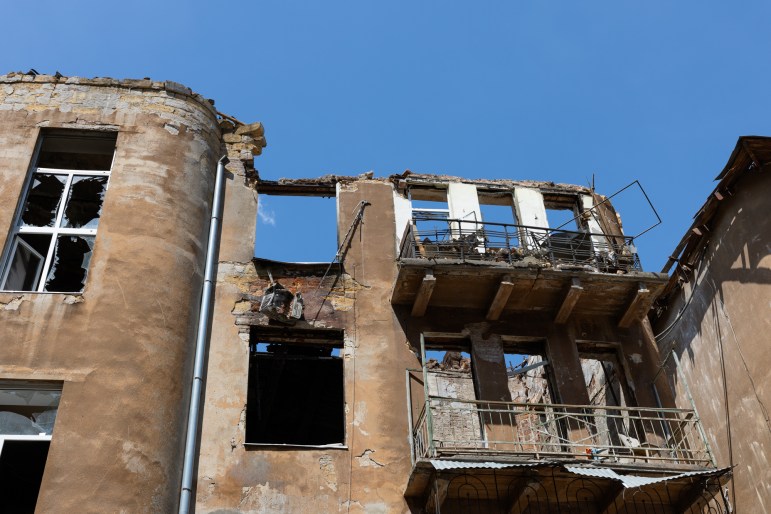
A four-story apartment complex in Odesa was burnt following a Russian strike Credit: Shahrzad Rasekh / CT Mirror 
A piano inside a second-story apartment in Odesa. The room is lit from above, as a strike destroyed the roof and units on higher floors. 
Vorontsov Palace is a cultural heritage site and national landmark that was struck by a Russian drone. 
A series of strikes destroyed a shopping center and office building in Odesa. 
A residential apartment building in Odesa’s Prymorskyi District was struck, rendering many units uninhabitable. Credit: Shahrzad Rasekh / CT Mirror 
Hotel Bristol, a landmark hotel in Odesa, underwent renovations following a strike. Credit: Shahrzad Rasekh / CT Mirror
Evgenia documented her thoughts on social media as she and her family made the drive north to her inlaws’ house. “We took the most valuable thing — the children,” she said in one Instagram story. “There are many other pieces of life left.”
Those physical remnants of memories can’t be replaced: her late grandmother’s strawberry plants and tulips, which Evgenia had planted in her home. Or the piano, which she had had shipped across the country after her grandmother’s death so her daughters could learn to play.
“What if I don’t come back,” she continued in the social media story. “Or there’s nowhere to come back to.”
The family thought they’d be safer with Vitalii’s parents, farther north in Ukraine. But soon after they arrived, they discovered they were just over a dozen miles from the Kyiv battle lines, where Russian and Ukrainian forces were fighting for control of the capital. By the third day of the invasion, the house shook and sirens wailed.
The three generations took shelter in the unfinished basement, where Evgenia continued to work remotely as a marketing manager. Then she began to develop sensitivity to certain odors. She was pregnant.
“Oh god,” she thought. “Why now?”
Evgenia’s belly grew as Russia’s military bombed hospitals and maternity wards. She read reports of pregnant women moved to hospital basements and didn’t want to become one of them.
“I decided that I have to go out (of the country) somewhere, at least to have my baby. Because I was scared.” She left for Chemnitz, Germany, with her mother and daughters, while Vitalii stayed in Ukraine. He had no choice.
Ukraine had already mobilized its men of fighting age, but fathers of more than two young children were exempt. This baby would be the couple’s third.
After two months of trying, Vitalii was able to leave and join his family in Germany. They then connected with a university professor in Arkansas named Ken Olree, whose church helped a number of Ukrainian families through the U4U program.

At the edge
Like countless other Ukrainians, Evgenia and her family thought their stay in the U.S. would be temporary.
“I was living the wonderful life in the house of my dreams,” said Evgenia of her life in Ukraine. Three years later, the war shows no signs of stopping, and Russia continues to pummel Ukraine with ever-increasing drone attacks.
The third most populated city in Ukraine, Odesa is a seaside city known for its architectural heritage and its inhabitants’ distinct sense of humor. Its historic downtown is peppered with lush parks, coffee shops with bustling terraces, boutiques and rooftop restaurants with unobstructed views of the Black Sea.
The city’s proximity to Crimea, which Russia invaded and annexed in 2014, and the magnitude of its port make it a target for Russian airstrikes. While Ukraine’s air attack alert system can successfully warn civilians of an impending air strike in places like Kyiv, drones can cross the distance to Odesa fast enough to leave little to no time for cover.
The port, near the city’s historic center, was where Evgenia and her husband dated, got engaged, and were married soon afterwards. Today, it is closed to the public, partially burned and damaged by strikes.
Evgenia had bathed in the sea’s calm waters during her first pregnancy and later would take leisurely walks by the water on workday lunch breaks. “It felt like the sea was where we drew strength,” she said.
Just months after her family’s emigration, sea mines, both Russian and Ukrainian, forced Odesa to close its coast for some time after a few swimmers died from explosions.


The seashore was also where Evgenia would go on walks with Julia, who works for a maritime employment agency, and where they had partied as single women, dancing at the upscale Ibiza Beach Club.
Strolling through Odesa’s Lanzheron Beach on a warm Sunday in June, Julia thought back to the time she had spent there with her friend, tears gliding down her cheeks as she recalled when they’d lived mere minutes apart. Life in Odesa had changed so much since that time.
Now the days were punctuated with air alerts signaling potential incoming drones. Even a visit to the mall could turn into a waiting game, as it had for some the day before. Shoppers filed down escalators to the basement-level parking garage, standing among cars as they waited for threats to subside.
A robotic voice announced the all-clear through the mall’s loudspeakers, and shoppers quickly lined back up outside stores, waiting for the security gates to lift. Outside, people resumed evening walks and happy hour chats on restaurant terraces. It was like pressing “play” on a paused movie.
Just hours later, a Russian drone struck a high rise across town. Alarms wailed on and off into the early morning.




But the new day brought renewed energy. Children splashed around in the waves, the water’s green tint a reminder of ecological warfare resulting in algae. Elderly women chatted on lawn chairs, basking in the sun. A man sporting a bandage down his arm pushed a wounded friend through the sand, his leg propped up on his wheelchair.
The whiplash between the mental toll of Russia’s psychological warfare and residents’ grasp on a ‘normal’ life was palpable.
Russia’s invasion, Julia said, made her “realize that life will never be the same.” By the time she had calmed down that first morning, the military activity made it too risky to leave the city. She decided to stay in Ukraine to be near her parents, even as her friends left the country one by one.
The last time Julia saw Evgenia, in early 2022, she had two cheery toddlers. “I don’t really know when I will feel or touch them, hug them,” Julia said in June. Now, Angelina is 7, Emma is 5, and Olivia, whom Julia never met, is 2. Evgenia is 38.

Resettling
Olree picked up the family in October 2022 and welcomed them into an extra home he owned in Searcy, Ark. The house was furnished, there were clothes for them, and the refrigerator was stocked with food.
“He’s our angel,” said Evgenia.
She gave birth to their third child, baby Olivia, soon after, and Vitalii began looking for a job. (Under the U4U program, Ukrainians received humanitarian parole, which automatically grants the right to apply for work authorization.)
The main challenge in his job search was the language barrier because his English wasn’t strong. Back in Ukraine, Vitalii had worked for the same food company for 10 years, where he was a regional manager, and had dozens of people reporting to him. In Arkansas, he settled for changing tires.
Believing they would soon return to Ukraine, the family left Arkansas after three months to see more of the country before returning home. For more than a year, they lived in Florida — alternating between a rental home belonging to an acquaintance of Evgenia’s in Delray Beach and a hotel when the rental was occupied.
They were still hoping for the war to subside so they could return to Odesa. “We see the war getting worse. And I tell my husband we have to stay,” Evgenia said.
Evgenia cleaned houses to earn an income.
After a few months, the couple began looking for a home to rent more permanently. But they didn’t have a credit score, among other standard requirements for housing applicants in the U.S.
“I was trying to find something. They said, ‘No, no, no, no, no, no.’” Eventually, one Russian-American couple responded to her husband’s Facebook message on a housing post in Lake Worth, Fla.
“She says, ‘We don’t need any documents. We want to help you.’ So we got house, we rented it. So the house was very bad, very bad with cockroaches, with mice, rats. Living in a zoo, but it was a house. I was not homeless anymore. At least I was happy.”
The house was a small source of relief from the violence and heartbreak they were following from afar. “I missed home. I was watching all (the) Ukrainian news, every bomb, every house, and they killed a lot of kids. I was crying all the time,” Evgenia said.
To stay afloat, the couple picked up odd jobs, with Evgenia eventually cooking in a daycare and Vitalii working as a handyman. Then one day, a job listing in Evgenia’s Telegram app stood out. It was for a sales manager at a food company in Connecticut.
“I immediately call them and say, I have my husband. He was a top manager in Ukraine. He’s very good in sales. He knows everything. Your company will benefit.”
Vitalii got the job, and the family of five moved to New Haven. It was February 2024, two years after Evgenia fled her homeland.

Stability in New England
In Connecticut, the family began to find their footing.
They fulfilled their dream of purchasing an RV, which they found discounted on Facebook. That allowed them to make summer road trips to places like Hammonasset State Park and Cape Cod. “This would have been great when we were homeless,” said Evgenia, pointing to the camper parked in their backyard, near a small trampoline for the girls.
Their sun-drenched home in New Haven’s Amity neighborhood echoed with the girls’ joyful squeals as they chased each other. Their drawings, taped to the walls, brought life to the kitchen. Outside, a white picket fence.
Their living room was decorated with hints of their heritage, and a Ukrainian flag hung proudly in the window. Back in Ukraine, Evgenia said, “We didn’t need to think about identity. We just were there.”
Being removed from their homeland pushed Evgenia, Vitalii and their three children to seek out others in the diaspora.
“We met a lot of Ukrainian people and Ukrainian Americans who were born here,” she said, “but they keep the traditions.” She began studying Ukrainian embroidery and architecture. “I understood that it’s important. I want to know it, and when I know it, I can share it with my kids.”
The eldest, Angelina, now speaks English, but her mother says she struggled through kindergarten and first grade. “I was sad about that, because I feel like she’s stressed all the time.” Her limited grasp on language impacted her confidence. “She didn’t understand English, and it was hard for her,” Evgenia said. “She’s good in math because math, you don’t need English for that.”
Beyond raising three daughters and working as a home aide for the elderly and people with autism, Evgenia took on the role of art director for an event organized by the New Haven Ukrainian American Humanitarian Aid Fund. Tapping into her past experience working at an art gallery, Evgenia named, priced, and categorized the pieces that will be sold at the Wounds to Wonders event on Oct. 26.
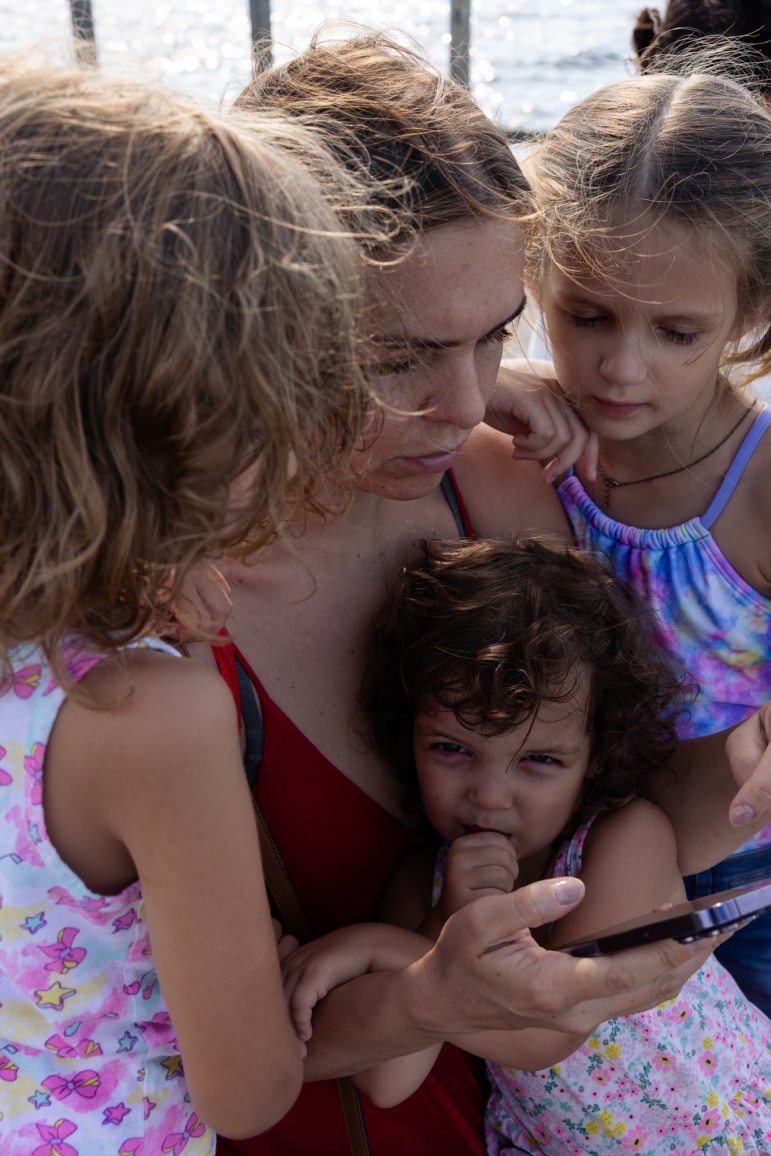
The event will take place in St. Michael the Archangel Ukrainian Catholic Church, the same church where Angelina recently received her First Communion, and where the family attended events as some of New Haven’s newest community members.
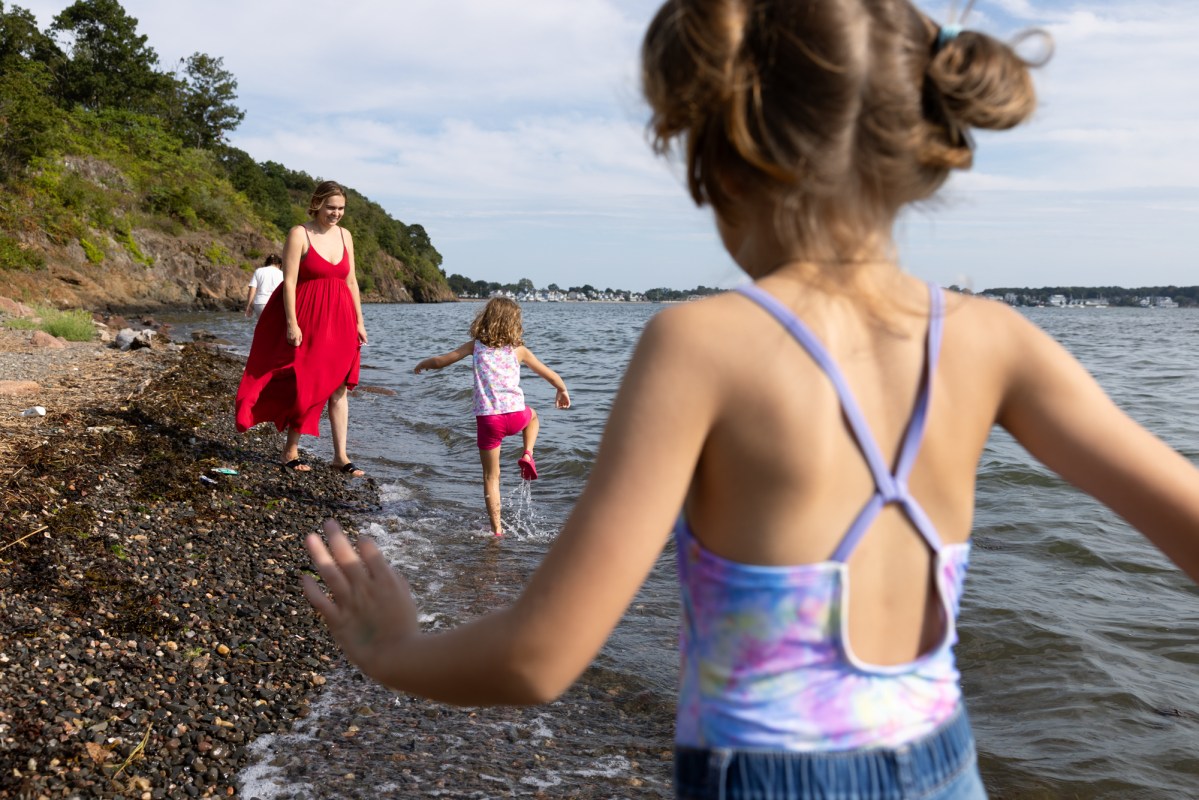
As the weather warmed up last summer, Evgenia began to take the girls on highly anticipated trips to beaches along the shoreline. On one excursion in mid-August, the girls splashed in Long Island Sound’s gentle waves. Later, they took turns on the swings and shrieked as they played with other children in Lighthouse Point Park’s splash pad in New Haven.
Summer was coming to a close, and so was their chapter in Connecticut.
On Sept. 9, the family made one more move, leaving New Haven for Duncan, South Carolina, where Vitalii took on a new role in his company.
The plan was for Evgenia to stay back with her daughters for the academic year, as they had gotten off the wait list for their desired schools. But when Evgenia’s car was stolen in front of their home in August, she decided the family should stick together.
“I will always be grateful for Connecticut and for the people there, and I think [Connecticut] is the best,” Evgenia said. “I could get a counselor from CIRI or from IRIS, they’d help me,” she said, referring to two refugee resettlement organizations whose services made her feel supported during her move to Connecticut. Evgenia placed her children in IRIS’ summer program during their first summer in New Haven.

Both CIRI and IRIS have been forced to cut back on the services they offer following funding freezes by the Trump administration, and more recent refugees to Connecticut can no longer access the type of help that was available to Evgenia and her family.
The status of Ukrainians across the U.S. remains in limbo following the pause on the U4U program. And high-profile meetings between President Donald Trump, Ukraine President Volodymyr Zelenskyy and Russian President Vladimir Putin have failed to bring about a solution to the conflict. That has left Ukrainians at home and abroad in a holding pattern.
Evgenia is taking life day by day, but amid the precarity of her family’s situation, she is certain of one thing: “Connecticut gave us jobs, insurance, school, and community,” she said. “Connecticut saved me.”

Tetiana Burianova and Anna Nemtsova contributed reporting in Ukraine.