


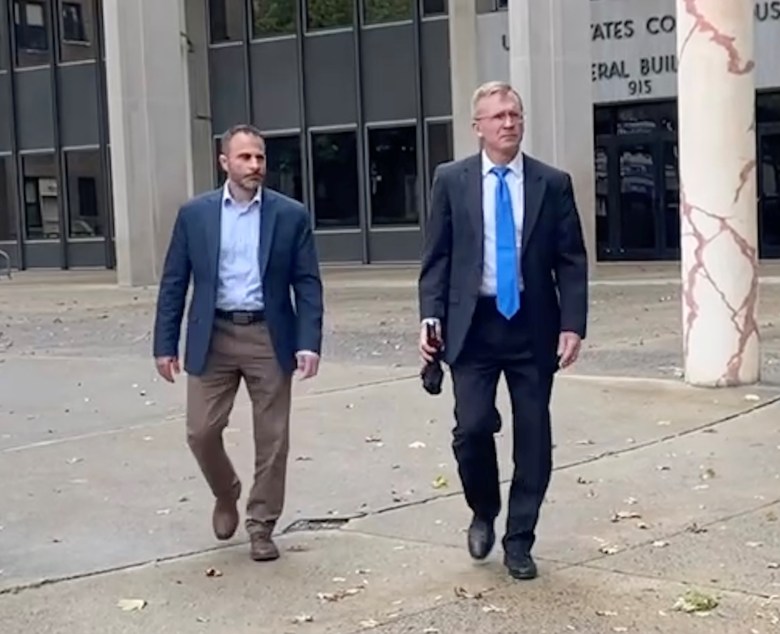
Federal prosecutors spent the first two days of the criminal trial of Konstantinos Diamantis portraying the former director of Connecticut’s school construction office as a public official who extorted contractors into paying him bribes.
But on Wednesday, Diamantis’ defense attorney, Norm Pattis, sought to shift the narrative to show that it was Diamantis who was being taken advantage of.
Pattis used the cross examination of Antonietta DiBenedetto Roy, the owner of Construction Advocacy Professionals, to argue that she willingly hired Diamantis’ daughter in order to gain favor with him.
Roy told the jurors on Tuesday that she selected Diamantis’ daughter for a $40 per hour job at her firm and that she later secured several lucrative contracts overseeing local school projects in Tolland, Hartford and New Britain, as a result.
Pattis argued on Tuesday, however, that Diamantis never forced Roy to hire his daughter or to award her additional bonuses.
“Mr. Diamantis never told you to hire his daughter, correct?” Pattis asked.
“Not directly,” Roy replied.
Roy also acknowledged after further questioning that Diamantis never directly threatened to harm her company if she refused to keep paying his daughter.
[The Kosta Diamantis Timeline: What you need to know]
Pattis suggested to the jury that Roy’s statements were evidence that she undertook those actions on her own to gain influence with Diamantis and to profit off the work on Connecticut school projects.
“I did need to keep him happy,” Roy told Pattis during the exchange.
“But that was on you,” Pattis said, adding that Diamantis never made a direct threat to harm Roy’s company.
“Mr. Diamantis created an atmosphere of fear,” Roy said, adding that he had immense influence over who worked on school projects.
“It was his demeanor within the industry,” she added. “You didn’t want to be on his bad side.”
Pattis did not try to directly refute any of the hard evidence that prosecutors shared with the jury the day before, including the existence of several checks that Roy made out to Diamantis.
But he used Roy’s testimony to argue that that money was intended as political contributions that were needed to get construction projects accomplished in places like Hartford.
Pattis openly acknowledged on several occasions that Diamantis held a large amount of “power” and “clout” as the head of the Connecticut Office of School Construction Grants and Review, but Pattis argued it was that prominent position that prompted construction contractors to try to cozy up to Diamantis.
Pattis’ defense strategy focused on showing that Diamantis never extorted any school construction contractors, as the prosecutors have claimed.
The two assistant U.S. Attorneys leading the prosecution allowed Pattis to question Roy with nearly no interruptions or objections. And when she was done testifying, they quickly moved ahead with other parts of their case.
During his opening statement, Assistant U.S. Attorney Jonathan Francis said the case against Diamantis could be summarized in two parts: “bribes” and “influence.”
The first two witnesses to testify in the trial — Roy and John Duffy, the vice president of Acranom Masonry — told jurors that they bribed Diamantis by hiring his daughter and paying him tens of thousands of dollars.
The witnesses who took the stand on Wednesday afternoon, however, were meant to highlight the vast influence Diamantis exerted on behalf of those contractors.
First, the jury heard from Brian Ouelette, the president of Newfield Construction.
Ouelette, who worked as a construction manager on the Weaver High School project in Hartford, told the jury how Diamantis helped to resolve a billing dispute between the city and Acranom Masonry, which resulted in the company earning an additional $300,000.
And he described how Diamantis stepped in to make sure Acranom won another contract worth more than $3 million for that same high school, despite concerns about the company’s reportedly “subpar” workmanship on the project.
Ouelette told the jury that Diamantis directly intervened on Acranom’s behalf to make sure they were paid. During the billing dispute, Ouelette said, Diamantis called him and other construction officials into his office in Hartford and took Acranom’s side.
Prosecutors also showed the jury an email in which members of Ouelette’s team said they had no choice but to hire Acranom on another phase of the project because Diamantis controlled the “power of the purse” and said the state would not pay for the masonry work unless Acranom got the job.
“The project has no financial choice but to award to Acranom,” the email said.
During that testimony, Diamantis rocked slowly in his chair at the defense table.
Pattis portrayed Diamantis’ actions as those of someone who was trying to save the state money and to avoid a costly lawsuit with Acranom.
“Kosta was a hands-on director, and that rubbed people the wrong way, right?” Pattis asked Ouelette.
“Is that a question?” Ouelette asked.
After Ouelette was done testifying, prosecutors called Sal Salafia, another experienced construction official, to the witness stand to testify about how Roy’s company was picked to be a project manager on the Bulkeley High School project in Hartford.
Salafia, who worked for O&G Industries for more than 30 years, said his company was already representing the city of Hartford on that project as a project manager.
But he told the jury that Diamantis issued a directive for the city to hire another company to perform the same type of work. That company ended up being Construction Advocacy Professionals.
The trial is expected to continue Thursday.