


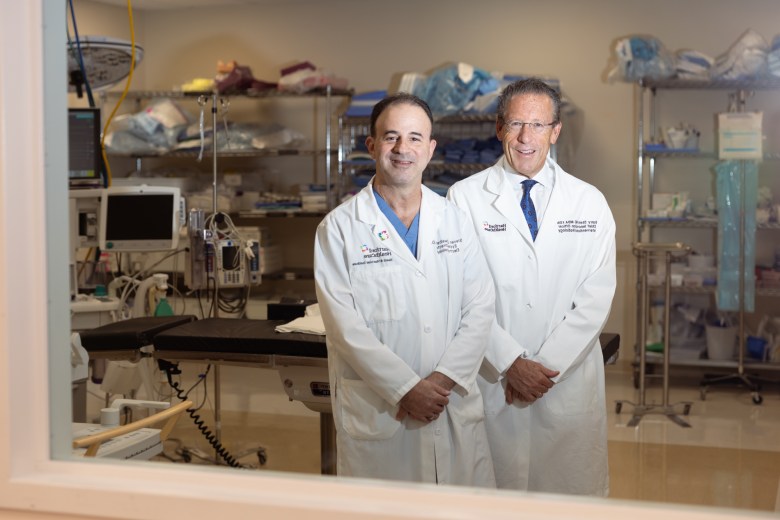
Doctors at Yale New Haven Health and Hartford HealthCare — Connecticut’s two largest health systems — say a new artificial intelligence tool is transforming how they interact with patients during appointments.
The tool, called Abridge, records conversations between doctors and patients during clinical visits and then uses a large language model to produce after-visit summaries.
Steven Zweibel, a physician at Hartford HealthCare and the medical director of innovation at the organization’s Heart and Vascular Institute, said Abridge has freed up his attention during appointments so that he can focus more energy on patient care, instead of furiously typing notes.
“I wasn’t in front of my computer. I was just sitting there eye to eye with my patient. [It’s] the first time I can remember doing that since before electronic medical records,” he said, recalling his early impressions of the technology.
Once a patient consents to having their appointment recorded, the conversation is captured through either a secure smartphone app, laptop or computer. The technology is HIPAA-compliant, encrypted and built to protect patient information, a spokesperson with Abridge said in an emailed statement. The physician then reviews the notes, makes any edits and submits them directly into the patient’s electronic medical record.
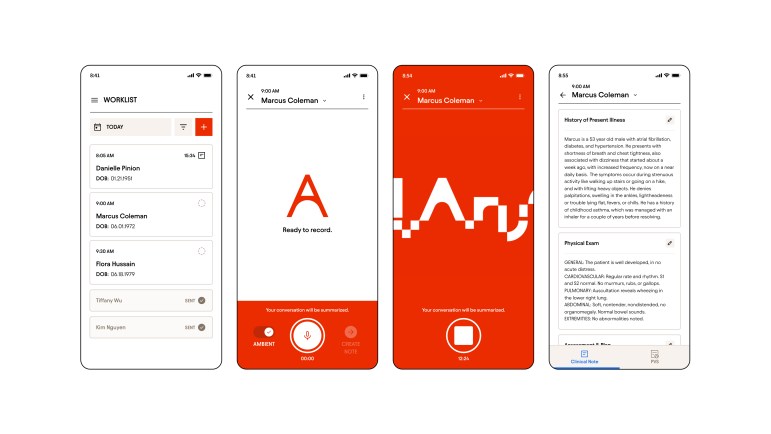
Allen Hsiao, a pediatric emergency physician and chief health information officer at Yale New Haven Health, said nearly all patients agree to have visits recorded once he explains it helps him focus on them. Some ask about data security, and in the rare cases they decline, he said, physicians readily comply.
At Yale, the response to Abridge has been overwhelmingly positive. Over 1,100 physicians at the health system now use the app, and upwards of 80% of those who tried it decided to adopt it — a higher uptake rate by far than any other tool the health system has offered to physicians, Hsiao said.
One colleague told Hsiao the app was “the best thing since the birth of my children.” Another reported that “the only thing that saves me more time everyday is my car.” Hsiao said Abridge is particularly useful in an emergency setting, where physicians often don’t get the chance to document visits until after the end of a long shift.

“You’re spending a lot of time after hours trying to remember the details from potentially dozens of patients you saw over your shift. You’re exhausted, and it’s probably not the best quality notes,” Hsiao said. “Abridge has really alleviated that.”
Both Hsiao and Zweibel said they’ve been impressed with the level of detail the app picks up during clinical visits.
Zweibel said he once asked a patient whether he experienced shortness of breath when he climbed stairs. The patient said no, but then his wife, who was also in the room, said it seemed to her like he did. When Zweibel went to look at the notes Abridge produced, it pointed out that the patient did not report shortness of breath, but his wife disagreed.
Barry Stein, a physician and chief clinical innovation officer at Hartford HealthCare, said it’s important to weigh the risk of AI solutions when considering whether to bring them into a health care setting.
“As the excitement and the hype has built, there’s also been an increasing consideration for the risk,” Stein said. “We have to be cognizant of that in health care.”
When considering whether to adopt technology like Abridge, Stein said the key concerns were security and “hallucination” — a term used to describe a situation in which artificial intelligence produces false, incomplete or incorrect information.
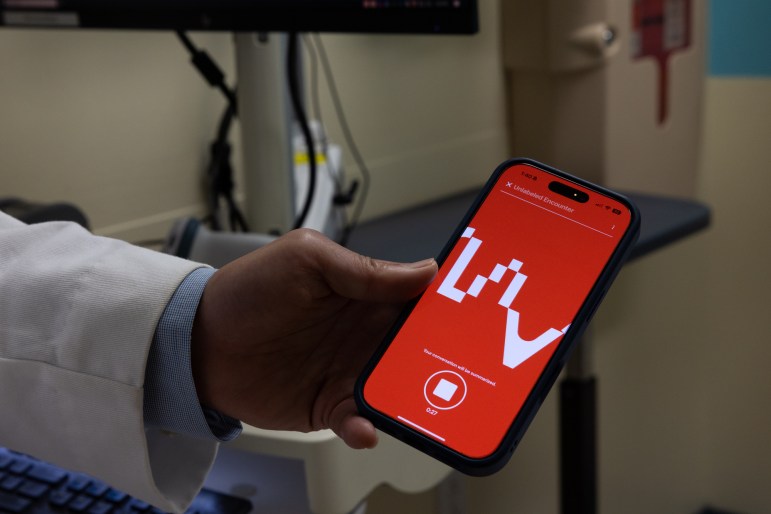
Abridge’s security protocols met the standards at Hartford HealthCare, Stein said. Zweibel added that he’s never seen the technology put something in the note that wasn’t actually discussed between him and a patient. And if physicians ever doubt the content Abridge produces, they can click on anything in the notes, and the technology will take them back to the point in the original transcript where the item was discussed.
Like any organization figuring out how to deploy AI tools, the health systems wanted to make sure Abridge was the right fit. To do that, they used a gradual approach.
Hartford HealthCare started with an initial testing phase where 20-30 physicians from across different specialties tried two different products and provided feedback on their experiences, Zweibel said. Once they decided to move forward with Abridge, a broader scope of physicians was invited to use it. Everyone received training documents and a support team was available to immediately respond to any issues that arose.
“This is huge for us and for provider wellness,” Zweibel said. “When you have a provider who’s happy, that shows in the care and then the interaction with the patient.”