


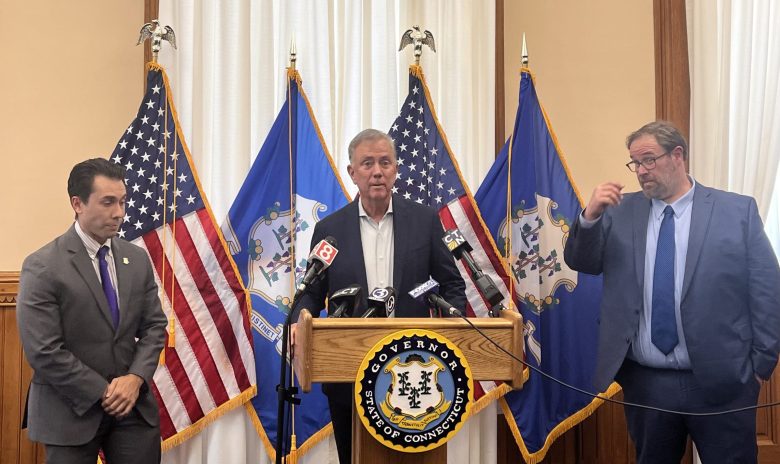
Gov. Ned Lamont began his rebuild of Connecticut’s Public Utilities Regulatory Authority on Monday, appointing four new members to the body and naming its new chief, the consumer advocacy attorney Thomas Wiehl.
Wiehl, of Madison, will replace Marissa Gillett, who resigned from her role as the state’s top utilities regulatory earlier this month. Joining him will be three new commissioners: former state Rep. Holly Cheeseman of East Lyme, energy policy professor Janice Beecher of New Britain and investor Everett Smith of Greenwich.
“These four nominees have an extensive amount of expertise and a diverse set of experience in energy and utilities,” Lamont said in a statement announcing his picks.
“In nominating new commissioners and completing a full board, I implore everyone to remember that it’s the public whose interests should always come first and must be protected,” he continued. “The entire purpose of PURA is centered on the understanding that utility companies all provide an essential public service that everybody depends on, and we must have an independent authority providing careful, rigorous oversight to ensure that these services are safe and reliable and that the consumers paying for them are doing so at just and reasonable rates.”
The appointments, which Lamont was largely commended on, will almost completely transform the makeup of PURA, which is in charge of reviewing and approving the rates charged by the state’s major investor-owned utilities such as Eversource and United Illuminating.
Lamont opted not to renominate commissioner Michael Caron, who has served at PURA since 2012. His departure will make Vice Chair David Arconti, who was appointed by Lamont last year, the longest-tenured member of the authority’s board.
Wiehl comes to PURA from the Office of Consumer Counsel, the state agency that advocates on behalf of utility customers during rate cases. He served as the office’s legal and regulatory director.
The other new appointees — with the exception of Cheeseman — also fulfill Lamont’s public desire to find candidates who come from professional backgrounds outside the halls of the state Capitol.
Beecher is a professor emeritus at Michigan State University, where she previously served as director of the school’s Institute of Public Utilities. She is also the editor-in-chief of the trade journal “Utilities Policy.” Smith is the founder and chief executive of GoldenSet Capital, which has investments in solar, wind, energy storage and natural gas. He previously worked in finance for GE Capital.
Cheeseman served in the legislature from 2016 to 2024 and was a member of the Energy and Technology Committee.
In selecting his nominees, Lamont said he looked for candidates who could “hit the ground running, with a breadth of experience.” However, a number of controversies swirling around Gillett’s departure also made the recruitment process difficult. Lamont previously told reporters that he’d been turned down by more than one potential hire.
PURA has operated with only three commissioners for most of Lamont’s time in office, despite lawmakers voting to increase the size of its board to five members in 2019.
The authority’s ranks were further depleted last month when Gillett suddenly stepped down amid mounting criticism over her leadership style and threats of an impeachment inquiry from Republicans in the state legislature. Those threats came after it was revealed by the Hartford Courant that Gillett’s chief of staff had directed the other commissioners to route all requests for information from staff members through her office — a policy that Gillett previously denied existed. Her resignation took effect on Oct. 10.
Adding to the authority’s myriad challenges are public frustrations over Connecticut’s chronically high cost of electricity as well as complaints from utility executives who say that the state’s regulatory environment is bad for business.
When asked about PURA’s relationship with the utility companies on Monday, Wiehl said that it “should be improved” while avoiding any explicit critiques of Gillett’s leadership.
“My focus is on being collaborative, making sure everyone at the commission, from staff all the way up to every commissioner, is part of the conversation,” Wiehl said.
Wiehl’s appointment drew praise from a spectrum of onlookers that included both utilities as well as consumer advocates.
In a statement, Eversource spokeswoman Jamie Ratliff said the company was supportive of the governor’s picks, and specifically singled out Wiehl as a “moderating presence” while at OCC.
“With this new commission, there is a genuine opportunity for balance and collaboration among all parties to ensure that the needs of Connecticut residents and businesses are met in the most affordable and transparent way through an open, lawful, and predictable regulatory process,” Ratliff said. “Critical needs exist for state and regional infrastructure investments to maintain a reliable and resilient grid that can accommodate new sources of generation to meet historic levels of electric demand projected in the coming years.”
A spokesperson for Avangrid, the parent company of United Illuminating, declined to comment on the picks Monday.
Tom Swan, the executive director of the Connecticut Citizen Action Group, said he believed Wiehl would likely continue the tough regulatory approach established under Gillett. “It’s clear that [Lamont] has chosen to stand up to the bullying by Eversource and UI,” he said.
Lamont’s office said the picks will also shift the partisan makeup of PURA to an even split between Democrats Wiehl and Arconti and Republicans Cheeseman and Smith. Beecher, a political independent, will round out the group.
Republicans had been broadly critical of both Gillett’s leadership as well as Lamont’s decision to leave other vacancies at PURA unfilled for years. House Minority Leader Vincent Candelora, R-North Branford, said the governor’s appointments on Monday were both welcome and overdue.
“I’m hoping that a new broom sweeps clean and that we will be moving Connecticut in a better direction,” Candelora said.
Each of the new members will serve in an interim capacity until their appointments are confirmed by lawmakers during the next legislative session.
Wiehl said that his first day of work will be on Tuesday and that he will be followed by Cheeseman and Beecher in the coming weeks.
Smith, who may need more time to consult with state ethics officials and divest from his holdings in the energy industry, is expected to join the other commissioners at a later date, Lamont said. As a result, Caron is expected to stay on for the time being until he can be replaced by Smith.
Caron said Monday that he felt “lucky” to have served at PURA and offered praise for Lamont’s new crop of commissioners. “I think he’s got a good crew … they’ll have no learning curve to speak of,” he said.
In the short term, the appointments also solve a thorny question brought about by Gillett’s departure: whether PURA, with just two commissioners, could issue final decisions on rate cases and other pending matters.
Lamont’s office took the cautious view that state law requires PURA to have at least three members in order to reach a quorum, according to spokesman Rob Blanchard. As a result, the governor needed to appoint at least one member right away in order to keep the authority functioning.
PURA’s current docket includes requests to raise rates for customers of both United Illuminating and the Yankee Gas Company, as well as a proposed sale of Eversource’s Aquarion Water Company to the South Central Connecticut Regional Water Authority.
Wiehl said on Monday that he would recuse himself from those cases due to close work on them with OCC. However, his joining PURA will give the authority the quorum needed to render a decision.
Late last week, UI offered a proposed settlement to PURA that would increase the company’s annual revenues by $63.7 million. That amount is less than original $105 million increase sought by the company when it filed its rate case last year and above OCC’s proposal for a $54 million increase.
PURA is currently scheduled to issue a final decision in that case on Oct. 28.