


This story has been updated.
Connecticut voters were greeted with a cold, biting wind as they stepped out Tuesday morning, with gusts knocking down signs and prompting some people to jog from their cars to the polls.
Secretary of the State Stephanie Thomas said at an afternoon press conference that voting went “pretty smooth” statewide throughout the day. But she urged anyone who hadn’t yet cast their vote to get out to the polls in the evening.
“Local elections are often overshadowed by national issues, but they’re so important to our everyday lives,” Thomas said. “So, I just like to remind voters, they still have until 8 p.m. to get to their polling location.” Anyone who is in line by 8 p.m. is allowed to vote.
The weather may have had an effect on morning turnout in some towns. Dianne Slopak, one of Norwich’s registrars of voters, described voter turnout as “slow” in an email Tuesday morning.
Slopak said early voting — which ran Oct. 20 to Nov. 2 — was around 2,000 ballots in Norwich, or 10% of the electorate. That number was lower than the roughly 25% of voters who cast early ballots last year, but it was within expectations for an off-cycle municipal election.
“Early voting definitely ate up much of the foot traffic,” said Kevin Saythany, the chair of the Norwich Democratic Town Committee and a candidate for the local Board of Education.
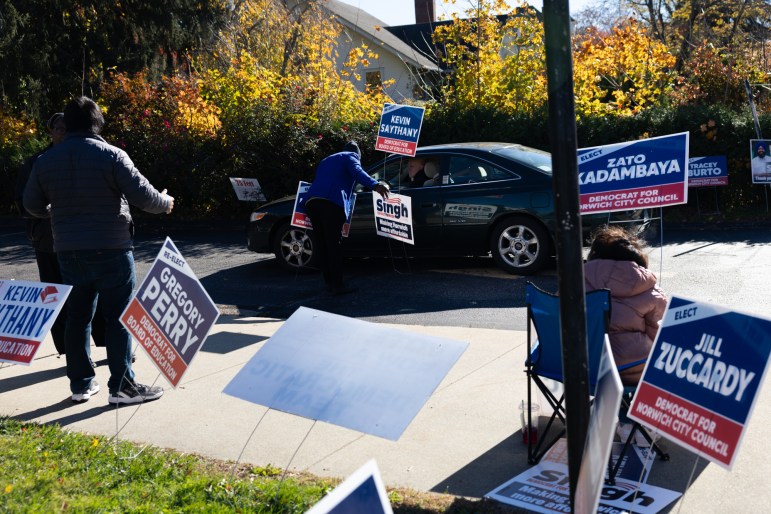
But Saythany was optimistic. Gripping his puffer jacket closed as he stood outside the polls at the Holy Trinity Greek Orthodox Church, he said voter education had activated new parts of the electorate. “In terms of voter turnout for early voting, Norwich is in the top 10, and now we’re like the top three in terms of turnout,” he said. “So that’s great.”
At John B. Stanton Elementary, one of the busier polling places in Norwich, more than 400 voters had turned out by midday.
For those who braved the cold, coming out on Election Day was an important way to make a statement. “I feel like it’s my responsibility to vote,” said Ellen Carenza, who briefly chatted with the Connecticut Mirror after voting at the John Moriarty Elementary School, the city’s first precinct polling place.
“I believe in certain things that I want for our country, and the way I can get that action is through voting,” she added.
New machinery
This year marked the first for Connecticut’s new tabulator machines. And they ran into a few snags. Seven of the 1,200 tabulators used across the state encountered problems Tuesday according Secretary of the State Thomas.
“As you know, this is the first election where we’re deploying the new tabulators,” she said Tuesday afternoon. “And as can be expected with the rollout of any new machinery, we had some glitches and a few polling places.”
When tabulators were down, voters were directed to put their ballots in auxiliary bins, which are part of the tabulator equipment. But Thomas said “very few” voters had to put their votes in the bins, based on the number of calls the state received.
There were almost 40 technicians on the ground across the state, and Thomas said many of the issues were resolved as they occurred. Thomas said the problems will not affect any race’s results.
Most of the malfunctions occurred in situations where ink from markers hadn’t dried before ballots were fed into the machines, Thomas said. However, the state will conduct forensic analysis of the equipment to determine issues, she said.
‘Steady’ voting habits
In many parts of the state, poll workers and political leaders described turnout as, at the very least, “steady” — in some cases stronger than they’d anticipated.
Election Day turnout for the West Hartford election hit about 10.8% by midday Tuesday, and West Hartford Town Hall was busy as people squeezed into elevators up to the voting booths on the third floor.
“It seems like a normal municipal election,” Elizabeth Rousseau, one of the two West Hartford registrars of voters said.
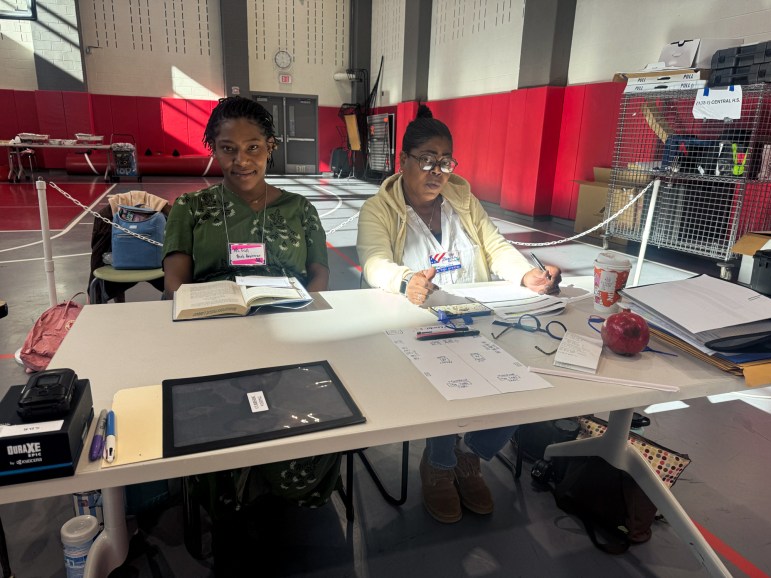
Takira Gill, a polling place supervisor in Bridgeport’s District 133, said voter turnout was steady there Tuesday. “I feel like a lot of people in this district are coming out to vote,” she said. “I thought it was going to be slower, but no.”
Bryson Moore, a Bridgeport parent, said he’s deeply invested in his community and he wants local leaders who will address educational disparities. “Top of mind was definitely the Board of Education,” he said.
“I just want to make sure that I’m doing my part,” Moore said. “I’m living here, my kids go to school here, so I just want to make sure that I’m doing my part.”
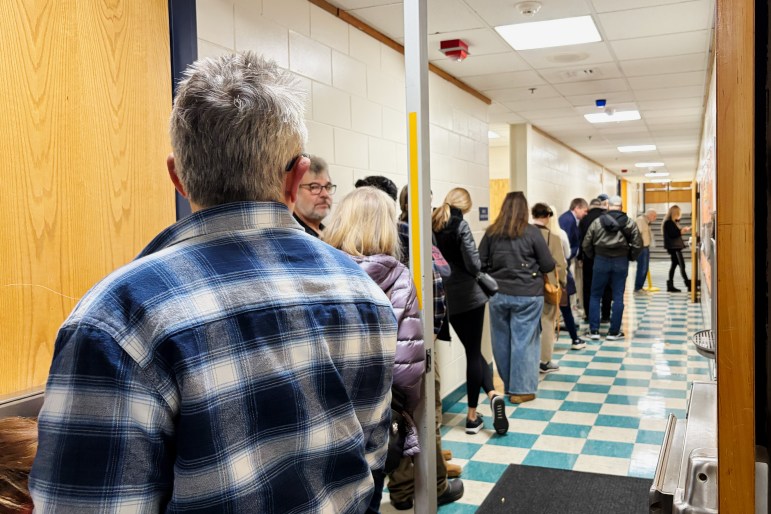
Voters were lined up Tuesday at the Irving A. Robbins Middle School in Farmington, where poll worker Joanne Lawson said she was impressed with the turnout.
“It’s like a presidential election,” Lawson, who has been working elections for over a decade, said. “People are energized.”
Connecticut’s Congressional delegation stumps for local candidates
U.S. Rep. Rosa DeLauro, D-3rd District, was visiting polling places across many towns in her district Tuesday, offering her support for local Democratic candidates.
“The local elections are bellwethers for how people are feeling about what’s happening overall,” she said. “People are looking for change in some of these areas and want to see a vision for the future, where we should take our cities and towns. I think that’s also going to be true at the national level.”
DeLauro said she observed steady turnout in the communities she visited, including Ansonia, Milford, Woodbridge, Hamden and Stratford.
In Stratford, the congresswoman stood next to Democratic mayoral candidate David Chess, who is challenging Republican incumbent Mayor Laura Hoydick, outside the polling location at Stratford High School. “We have opportunities to pick up seats. I think we will pick up seats,” she said.
This is Chess’ first run for elected office. He said he’s knocked on more than 5,000 doors.
“It’s been very exciting and there’s been tremendous enthusiasm,” Chess said Tuesday. “People are excited. They’re hungry for change, they’re hungry for hope.”
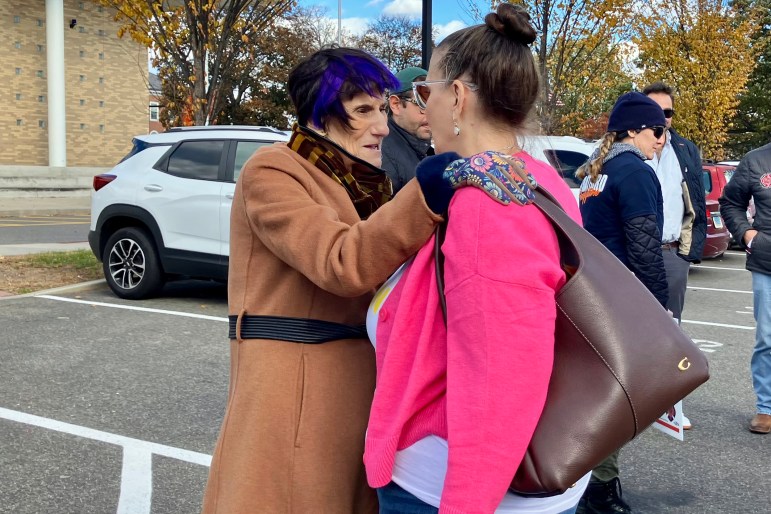
Lisa Noble, an Ansonia resident who works as an attendance specialist at Stratford public schools, said she was excited for Election Day and she hoped local races could help shift national politics toward being, “a little more centered and kinder to each other.”
Noble said she was driven to the polls this year because the effects of the government shutdown have hit home. She wore rainbow-colored socks and a T-shirt emblazoned with the phrase, “All for love and love for all.”
“I have a 31-year-old son who didn’t get his food stamps. What happens to the people who are intellectually disabled and don’t get their food stamps?” Noble said.
CT Mirror reporters Jenna Carlesso, Katy Golvala and Reginald David contributed to this story.