



Do you want to hear about a strange journey of a single plastic film, as I have witnessed it, first as a child in rural Nepal, and now as a vegetable specialist in the United States?
I grew up where a plastic grocery bag was a treasure. When my mother found one, she folded it like fine linen and used it at least three times: rice today, lentils next week, and mustard greens the following month, until the handles finally gave up or there was a big hole. At the end of its life, a man on a bicycle would ride through our village, trading the torn plastic bag and other scraps for potatoes for a head of cauliflower. Nothing was “single-use.” It was resourcefulness by necessity.
Fast-forward to American supermarkets in 2025: the average plastic grocery bag is used for about 12 minutes, just long enough to move from the store to your kitchen counter, then it becomes trash destined to persist for up to 300 years in landfills or as wind-blown litter.
Then came the “reusable” fix: ban the thinnest bags, sell shoppers thicker plastic bags that, in theory, can be reused and recycled. But who really reuses them? Be honest: how often do you remember to bring your plastic bags back to the store? Most of us don’t, including myself, despite the pile of bags at my garage door. The outcome is poor: total plastic used per checkout has increased because the replacement bags are three to four times thicker than the single-use bags, and they end up as trash without being reused.
The lesson is plain: if the fix relies only on wishful consumer behavior, it’s unlikely to be very effective. So who benefits and who loses? Manufacturers benefit from selling heavier bags; the public pays for waste fees, and microplastics persist in soil and water for up to 300 years.
There is, however, one plastic story that gives me hope because it is grounded in horticulture, my specialty: soil-biodegradable mulch (BDM).
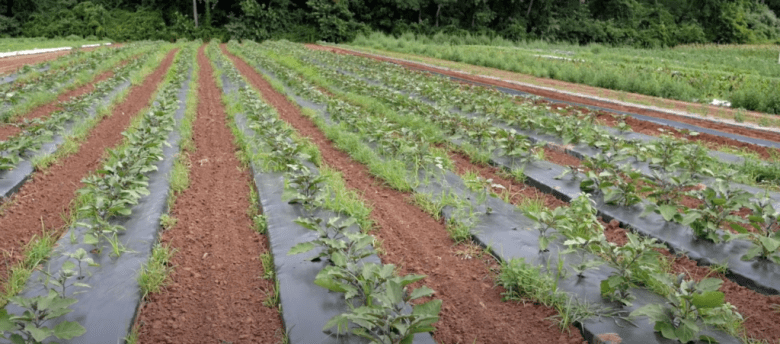
For those who don’t farm, plastic mulch is a thin film laid across beds to warm soil, conserve moisture, and suppress weeds. The conventional mulch version, polyethylene (PE), works perfectly for horticultural benefits but creates headaches environmentally. It must be pulled, removed, and landfilled (or worse, burned in some places or stockpiled) at season’s end. By contrast, BDMs are engineered to deliver the same horticultural benefits and then be tilled in and broken down by microbes in the soil over time. Research across many regions shows that BDMs match PE in yield and weed control performance, occasionally outperforming it and, at worst, coming close behind.
Indeed, a roll of BDM costs more upfront, but that’s not the full picture. What really matters is the total system cost. When you count the labor to pull PE, machinery time, and trucking and tipping fees, BDM comes closer to the cost of PE use. Recent extension economics from Washington State University lay out exactly how the savings from not removing and landfilling PE can offset the higher purchase price of BDM. Case studies in Tennessee and Washington show scenarios with similar or even improved net returns.
What about soil health and decomposition? Long-term research teams from UConn, Washington State University, University of Tennessee, and beyond have tracked what happens when BDM fragments are tilled in year after year. The emerging picture is reassuring that the degradation proceeds under field conditions, with recovery of only few residual fragments a couple of years after incorporation, and soil health indicators are mostly driven by climate and site, not by whether mulch was PE or BDM. Is decomposition instantaneous? No, and it depends on climate, soil microbes, and the specific polymer blend of the BDM.
Over the last decade, the U.S. Department of Agriculture (USDA) has invested many millions of dollars to study BDM, from lab tests to field trials to farm budgets. That is great news, and we should be funding this kind of practical, science-based work. But policy has not kept up with the evidence. In organic farming, the rules say biodegradable mulch is allowed only if the film is fully bio-based. No mulch can meet that standard, and in practice, that rule acts like a ban even though BDMs on the market today meet the biodegradability standards. The result is that organic growers, who could benefit most from better weed control with less plastic waste, have fewer choices.
I hear another argument: “compostable” bags tear and are made from petroleum-derived components, and so aren’t they just as bad or even worse? Some biodegradable polymers are fossil-derived (e.g., PBAT), and some are biobased (e.g., PLA, PHA). The relevant comparison is not biobased versus petrochemicals, it’s whether the film biodegrades in the intended environment without accumulating as plastic pollution. If a plastic polymer blend that is 20% biobased and 80% fossil-derived meets the biodegradability standard, this beats a 100% fossil PE film for persistence, microplastic generation, labor, and landfill use.
From Nepal to the Pacific Northwest to New England, I’ve seen plastics used frugally, used wastefully, and used wisely. I think BDMs are “wise use”: they deliver horticultural benefits and cut the ugliest part of plastic’s end-of-life. The USDA helped prove that through research. The USDA could now take the important next step of aligning organic standards with the science and growers’ feedback.
Third-party standards already exist to ensure mulch films truly biodegrade in soil and meet soil-safety (toxicity) limits, and we can get into those details next time. For now, my recommendation to USDA is that the “fully biobased” standard for organic use should be revised to reflect what is feasible now or in the near future, while ensuring transparency through accurate labeling, including third-party certification.
If we could trade a torn grocery bag for potatoes in a village without paved roads, surely the richest food system on earth should be able to trade a plastic that lasts 300 years for one that quickly returns to the soil, or at least give consumers the choice to do so. The choice is not between perfect and nothing; it’s about giving the earth, consumers, and our children a better choice.
Shuresh Ghimire is a Vegetable Extension Specialist for the University of Connecticut