


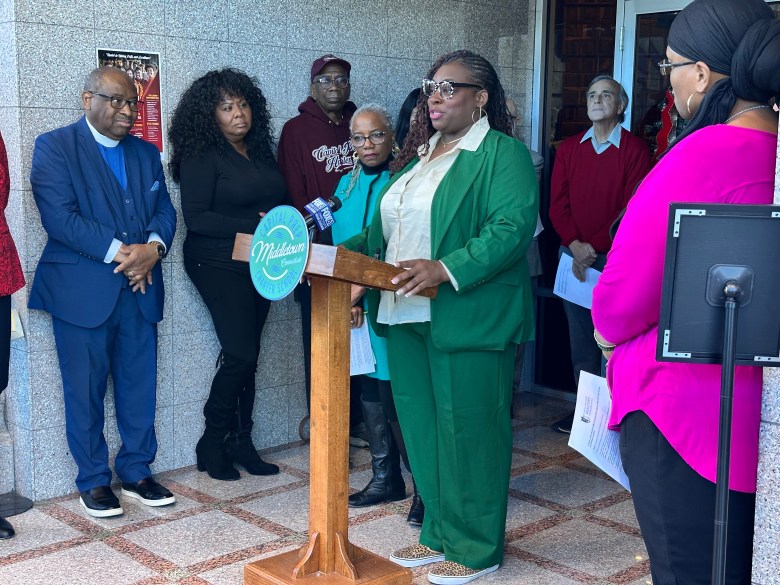
Capital Preparatory Charter School announced on Thursday a lawsuit that seeks to reverse an October ruling by the Connecticut Board of Education in which the board claimed it was not responsible for determining which charter schools receive state funding. The state legislature allocates charter school funding, but the lawsuit contends that the decision of which schools get funded should lie with the state Board of Education.
The board’s ruling, and the subsequent failure of the legislature to allocate funds to the previously approved school, has left Capital Preparatory’s plans to open a school in Middletown in the lurch.
In the lawsuit, the school asks a New Britain judge to decide whether the power to fund such schools lies with the state Board of Education or not.
At an impassioned press conference in the Cross Street AME Zion Church in Middletown, representatives of Capital Preparatory Schools said they were compelled to file the lawsuit after many previous attempts to resolve the issue with members of the legislature, the state Board of Education and Gov. Ned Lamont.
“We hope this lawsuit will expose flaws in the current funding and selection process,” said Michele Clay, the co-chair of the Capital Preparatory School planning committee. Clay said that “when transparency is replaced with backroom decisions,” the system of allocating funding becomes a barrier for school success. “This is a systemic issue and it deserves a systemic solution.”
In March 2023, the state Board of Education voted to grant an initial certificate of approval for Capital Preparatory Schools to open a charter school in Middletown. In doing so, it overrode the recommendations of Education Commissioner Charlene Russell-Tucker, who wanted to give community members more time to submit comments to the board. But the school ultimately has never received funding.
The group then appealed directly to Gov. Ned Lamont and were met with what they described as a “stern” response from his office. That response, from Natalie Braswell, an attorney for Lamont, states that Capital Preparatory’s allegation that the state Board of Education acted unlawfully in its failure to fund the school is “both baseless and concerning, as it misrepresents the SDE’s legal authority and the legislative process that governs charter school funding,” according to a copy of the document reviewed by The Connecticut Mirror.
Responding to a request for comment, a spokesperson for Gov. Ned Lamont said his office cannot comment on ongoing litigation. A spokesperson for the State Department of Education declined to comment for the same reason.
At the press conference, supporters of the school also named Sen. Matthew Lesser, D-Middletown, Senate President Pro Tem Martin Looney, D-New Haven, and Sen. Jan Hochadel, D-Meriden, as key figures that undermined the funding of the school. Looney, Hochadel and Lesser did not immediately respond to a request for comment.
“What they’re trying to argue is that one state legislator has a one person vote. So, Matt Lesser did speak to Marty Looney with Jan Hochadel, and they said, ‘take Middletown out of the budget,'” Steve Perry, founder of Capital Preparatory Charter School, told the CT Mirror. “Even if they said that, they don’t have the authority to do it.”
Years ago, a charter school only needed approval from the state Board of Education to begin the process of opening.
But in 2015, the legislature changed the law to require lawmakers to approve the school’s funding. Earlier this year, Capital Preparatory asked the state Board of Education to specify which body is responsible for funding specific charter schools.
In that petition, Capital Preparatory argued that it should be up to the Board of Education to decide which schools receive the funds. Representatives of the proposed school have repeatedly argued that because Capital Preparatory Middletown’s application for initial approval was awarded the highest score of any the board approved that year, it should be funded first. That did not happen.
Other charter schools have also faced opposition in Connecticut, like an effort to open a charter school in Danbury. There, Danbury lawmakers urged fellow legislators not to fund the school.