



Last month Abdulah Kanchero, of New Haven, and Francisco J. Diaz-Aquino and Johanna Beatriz Navas-Gonzalez, of Stamford, died in the cold, unsheltered.
On the night Kanchero passed, the Unhoused Activist Community Team (UACT), including 18 people who had been turned away from full warming centers, occupied New Haven City Hall. After sending police to throw everyone out into the frigid night, the administration relented and opened an additional overflow warming center in a meeting room in the Hall of Records.
Following the deaths in Stamford, Gov. Ned Lamont released state funding for homelessness services to partially make up for federal cuts in that area.
Whenever the death of an unhoused person makes the news, there is wringing of hands and perhaps token action. Here’s the thing: Winter comes every year; and we know that it will kill about 700 unhoused people in this country. We do so little to prevent these deaths, there is only one plausible conclusion: We are okay with it.
Our economy needs homelessness, to support the commodification of real estate, which makes a few people rich while leaving housing unaffordable for the rest of us, and to keep worker bees buzzing busily. This year the Harris Poll found that 40% of U.S. Americans were dissatisfied with their jobs but would not quit because of fears about an uncertain economy.
“Why work?” you may ask.
“So that you don’t die on a park bench,” is a compelling answer.
Though we need homelessness, most people dislike coming face-to-face with it. My friend Rico, who has frequently lived unsheltered, once told me, “If you’re visible, you’re criminal.” The day before any parade or festival, hit the streets at dawn, and you will see police rounding up unhoused people. Sometimes they take a social worker along for cosmetic purposes, but these workers do not have enough safe accommodations to offer everyone being displaced or arrested for the crime of being poor.
New Haven Police ticketed and arrested U-ACT members and unhoused people on the Green the day the Christmas tree was erected. God bless us, everyone.
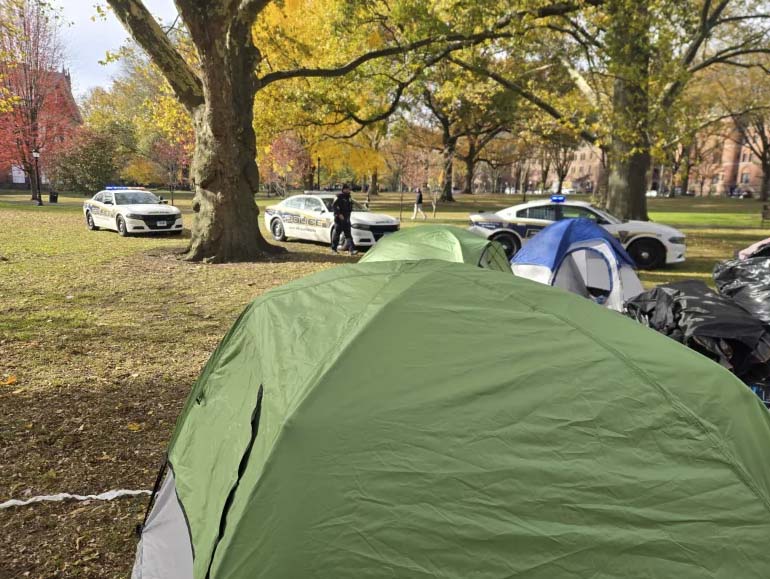
Government’s power to criminalize homelessness was bolstered by the U.S. Supreme Court’s Grants Pass decision and an executive order issued by President Donald J. Trump, which I’ve written about in depth elsewhere. When the president acted on that executive order with a militarized response to homelessness in the nation’s capital, unhoused people endured arrest and involuntary psychiatric commitment. Some took refuge deep in the woods, disconnected from any services through which they might have obtained housing.
The point has never been to end homelessness, only to punish people who experience it.
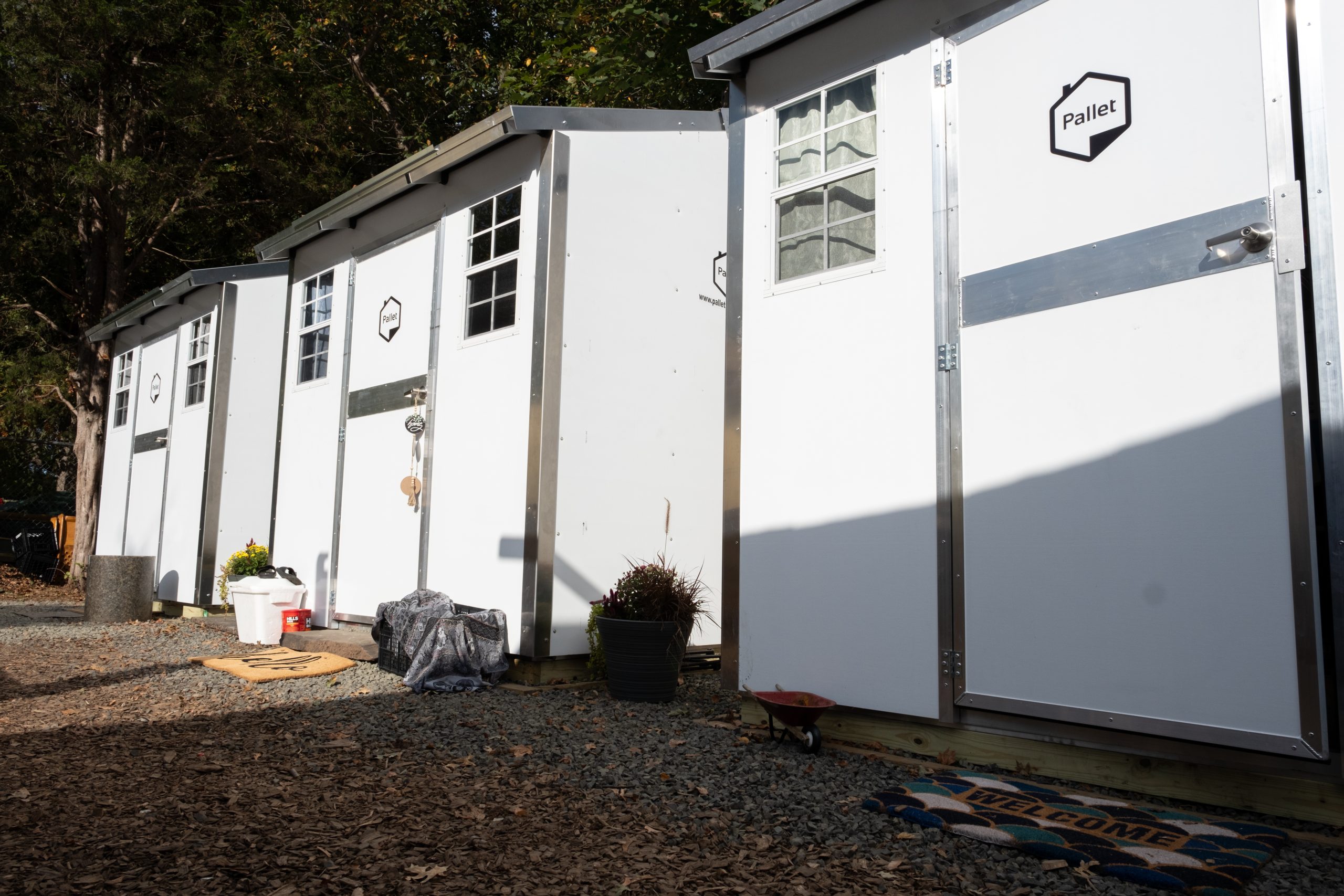
I am part of a crew of volunteers who raised the funds for and continues to support Rosette Neighborhood Village, tiny homes in New Haven for formerly unhoused people. After a tent encampment was demolished by the city, we envisioned a place where that community of neighbors could stay together. We also knew that people need a door to close, for privacy and safety. Modular units were a tenable solution. We put them up in a day for about $20,000 each. That is how you respond to an emergency.
When I visited my friends at Rosette Monday, I explained to one man how to get rid of the condensation in his unit. We’ve had a problem with drips ever since the city ordered United Illuminating to turn off our power and hence the built-in heating. Space heaters don’t warm the units evenly. Condensation results. Ostensibly, the city cut power because we do not meet state building code, which requires an individual kitchen and bathroom in a dwelling unit. (Residents share kitchen and bathroom facilities in the Amistad Catholic Worker House only steps away.)
When we appealed to the state, the city sent its own lawyer and building inspector to argue against our petition. Twice, sympathetic state representatives have introduced enabling legislation for tiny home communities administered by faith groups for unhoused people. But the bills never make it to the floor.
My colleagues came up with a rapid and affordable way to provide dignified transitional housing, without spending a dime of public money. If homelessness is a problem in search of a solution, why wouldn’t our local, state and even national governments be beating a path to our door to learn how to replicate the program?
Simple – because homelessness is not a problem. It’s a strategy to maintain an unjust economic system – and a highly effective strategy at that.
Colleen Shaddox is chair of the Good Neighbors Community Fund and co-author with Joanne Samuel Goldblum of Broke in America: Seeing, Understanding, and Ending U.S. Poverty.