



|
Getting your Trinity Audio player ready...
|
This story has been updated.
In a year filled with power struggles between Congress and the White House, Jim Himes is one of the small group of lawmakers who have felt the brunt of it.
That came into stark relief last weekend after the U.S. strike on Venezuela and the capture of its president. As a high-ranking official on the House Intelligence Committee, Himes is one of the “Gang of Eight” who traditionally get some of the earliest information about major military operations.
Yet he was left in the dark for days.
So Himes, who represents Connecticut’s 4th District in the southwestern portion of the state, has had to learn to navigate not only the challenges of serving in the Democratic minority but also in a Congress that the executive branch increasingly bypasses on some military and federal spending issues, despite Congress’ constitutional authority.
But despite the Venezuela snub, the Democratic minorities in Congress and the broader challenges to democracy here and abroad, Himes says he’s still in the game and still able to wield power as a top Democrat on a key committee.
That’s partly because the sands are slowly shifting in Washington.
Back in January 2025, “that was a pretty defeated moment, and almost all the Republicans were 100% Donald Trump,” Himes said in an interview from his Washington, D.C., office last week. “That’s changed, partly because of the result of the November elections.”
“So politics is back because Republicans know that if they are unquestioning in their support of Donald Trump, they’re going to get shellacked” in the midterm elections this fall, he said.
‘Dangerous and unprecedented’
Himes went into the past year with some expectations of how President Donald Trump might operate in his second term, given his experiences the last time. But that has looked different, he said, with the vast expansion of executive powers. He argued the current administration has taken it to a “dangerous and unprecedented place.”
“A lot of this stuff is just picking up a baseball bat and hitting yourself in the head,” he said, running through a list of threats Trump has made regarding other countries in the wake of Venezuela. “We get nothing for that, and it hurts us.”
When Himes was preparing for Trump to take office almost a year ago, he devised a system of when to engage and decipher what was serious and what was just rhetorical bluster. At the time, he wrote off Trump’s comments about Greenland, calling it “obvious nonsense.”
Given Trump’s repeated overtures about the autonomous island that’s part of Denmark, the congressman said, he’s coming around to the plausibility of it becoming a reality, even as some downplay or rebuff the possibility of taking Greenland by military force.
Himes sees his job through different lenses, with varying degrees of interference. On the issues that are more Connecticut-specific — transportation and infrastructure chief among them — he said they’re “grinding away pretty well,” even with issues like the stop-work order at Revolution Wind. But from the vantage point of national security — the bulk of his job in D.C. — it’s “much more of a mixed bag.”
If you as a citizen decide that this is a Yankees-Red Sox game and the other side is evil and treasonous and seditious and you are the sole arbiter of truth, we’ll have an authoritarian government.
U.S. Rep. Jim Himes
Serving in the minority party typically comes with its limitations, especially with Republicans’ political trifecta of the White House and both chambers of Congress. Yet the GOP’s narrow majorities means they need to take Democrats into account, given their votes are needed on most legislation, particularly in the Senate.
While some elements of his job involving intelligence matters have been hindered, other things haven’t changed as he had anticipated at the start of 2025. And he still feels like he’s able to assert himself.
“I don’t feel like I have no effect. And I worried about that a year ago. Republicans can’t ignore Democrats entirely,” Himes said, whether it’s on an annual defense policy bill or appropriations. “So I don’t feel irrelevant on a lot of things.”
The role of the Intelligence Committee
Because of his prominent role in Congress, Himes has repeatedly found himself at the forefront of major foreign policy matters with wide-ranging implications.
As a member of the “Gang of Eight,” a group of the Republican and Democratic leaders in the House and Senate plus the chairs and ranking members of both intelligence committees, Himes typically gets a heads-up on major military actions.
The House Permanent Select Committee on Intelligence has oversight over U.S. intelligence agencies as well as some issues concerning the Pentagon and other government agencies. He’s served on that committee since 2013 and was elevated to ranking member in 2023.

But for Democratic leaders who are usually privy to such information, Himes said, he hadn’t received any communication from White House officials in the days since the capture of Venezuelan President Nicolás Maduro and his wife until the Monday evening briefing with the Gang of Eight.
Lawmakers pushed back on the administration for not notifying Congress before the attack. But Trump officials defended the decision, saying it could have compromised the operation and put U.S. troops at risk. That has become more common of presidential administrations, led by both Democrats and Republicans. One recent example is former President Barack Obama not seeking congressional authorization or providing Congress a heads-up before bombing Libya in 2011.
“Presidents of both parties have long relied on their constitutional authority to act when foreign actors pose a direct threat to the safety and security of the United States and its people. President Trump did exactly that,” the Connecticut Republican Party said in a statement after the capture of Maduro, specifically naming Himes and a few other Connecticut Democrats for “playing politics.”
This wasn’t the first time Himes learned of significant military action through other channels.
When the U.S. launched strikes on nuclear facilities in Iran last June, Himes learned of the news through social media.
It was nearly déjà vu last weekend. Himes told NPR’s “Morning Edition” his wife woke him up on last Saturday, saying, “You won’t believe what’s happening.”
While he has said it was successful as a military and tactical mission, Himes called it “illegal” and “unwise.” And after sitting in on briefings, it was clear to him that officials had no plans for what to do after.
But from a morality standpoint, it’s a bit more nuanced, because Maduro is a “bad, bad guy.”
As the administration maps out its next moves in the region, officials like Secretary of State Marco Rubio and Secretary of Defense Pete Hegseth have defended their approach.
“Our military is prepared to continue this,” Hegseth told reporters after Wednesday’s Venezuela briefings with all members of Congress. “The president, when he speaks, he means it. He’s not messing around. We are an administration of action to advance our interests, and that is on full display.”
In his own words, Trump made it clear how he views the limitations of his own powers, particularly abroad.
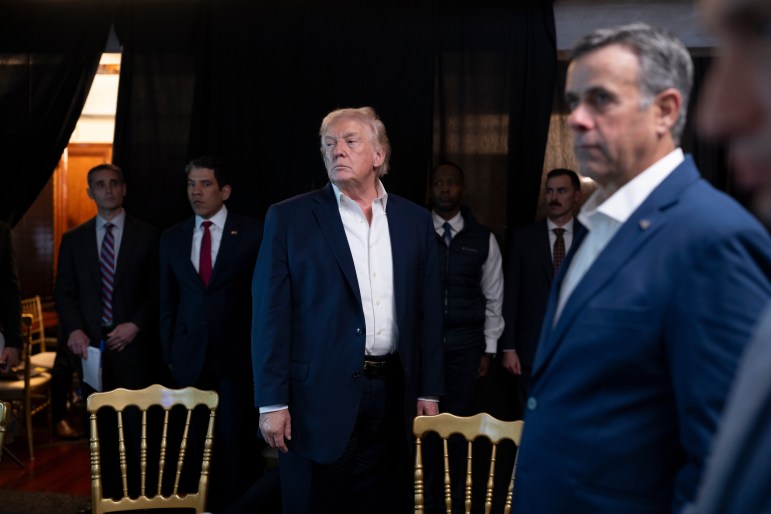
“Yeah, there is one thing. My own morality. My own mind. It’s the only thing that can stop me,” Trump said in an interview with The New York Times on Wednesday.
Even so, Himes said, he’s had small victories, particularly in the intelligence community — including some he can’t discuss, given the classified nature of the job. He said he helped add a measure into the National Defense Authorization Act that supported the North Atlantic Treaty Organization. Trump’s administration has been skeptical of NATO, and the alliance faces a potential crisis if the U.S. seizes Greenland.
Himes’ role in it all
When it comes to Congress’ war powers, Himes acknowledged that administrations led by both parties have been chipping away at that for years.
In defending Trump, Republicans argued that Democrats didn’t take issue when their own party had taken unilateral action, like when the Obama administration intervened in Libya in 2011. At the time, Himes voted to limit further military action in the region.
“The other thing as a member of Congress that is really irritating is that we’re a participant in the now 100-year-long argument over who gets to approve the commitment of our troops,” Himes said. “Now the Constitution to me is pretty clear, but to be fair, we’ve had this argument with presidents of both parties.”
But he argued the Trump administration has taken that to a new level.
That has left him to reflect on his role as a member of Congress and as a top member of the intelligence committee — even in more hyperbolic terms.
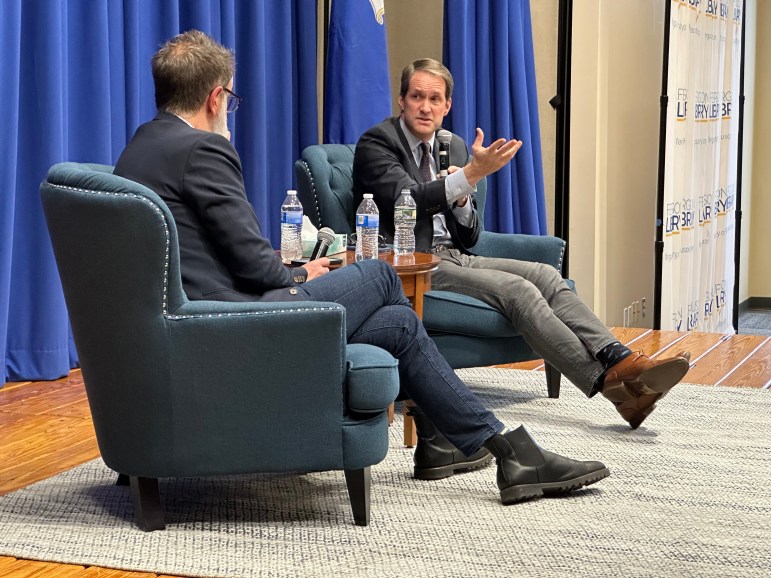
“In looking at the administration’s planned intelligence activities, I’ve had deep moral qualms, and I have expressed those, and I think I’ve had some effect on altering programs in ways that are not to my satisfaction but at least move, in my opinion, those programs in the right direction,” Himes said.
When speaking at the Connecticut Mirror’s “In the Room” event back in April, he mused about whether he’d need to break the law by speaking publicly about classified information, if it meant holding the administration accountable, in extreme circumstances. The hypothetical scenario he gave at the time was if Trump mobilized the CIA to target an American within the country.
He stands by the comments he made but said there’s a blurred line because “you got to think about policy disagreements differently than you think about clear moral stands.”
“If you had something that was legal and profoundly immoral, I’d be like ‘OK, what do I do?’ Himes said. “And in some ways, that’s the failsafe, right? If the administration, which I think has been authoritarian and beyond the pale, if it spun in a far darker direction, I would not be looking to compromise with that.”
Over the past year, Himes has mused about a democracy sliding closer to authoritarian system. Himes said it’s incumbent on everyone, including Democrats, to figure out why some Americans are turning away from it.
“It’s in dramatic retreat in the United States, and it’s in retreat all over the world,” Himes said. “That’s a belief that democracy is not providing for them. And we have some self-soul-searching to do in that regard.”
“If you as a citizen decide that this is a Yankees-Red Sox game and the other side is evil and treasonous and seditious and you are the sole arbiter of truth,” he said, “we’ll have an authoritarian government.”
Small shifts in Congress
Trump is at the end of the first year of his second term, but Himes sees the tide slowly turning with elections on the horizon. That has given the self-described optimist some glimmers of hope — among them, those sporadic moments when Republicans have been more willing to buck the president.
To Himes, it’s a byproduct of the election cycle.
Last week, Congress pushed back repeatedly at the White House as it sought to reassert itself on policy fronts and matters of national security.
For example, the GOP-controlled Senate gave a rare rebuke of Trump as it voted for a war powers resolution to rein in Trump on Venezuela. Under that bill, Trump would need approval from Congress before further engaging in military action in the region.
And nearly a dozen House Republicans joined Democrats to pass the revival of lapsed pandemic-era enhanced subsidies for Affordable Care Act plans, as Trump has given mixed messaging on how to proceed with health care.
On the same day, the House sought to override Trump’s vetoes on bills with overwhelming support, although those efforts fell short, with enough Republicans blocking the effort.
But Himes isn’t shy about criticizing his own party, which he says still needs to learn “how to center the core concerns” of Americans, such as the cost of living. Or that Trump shoulders the blame for everything.
Himes said the bipartisan infrastructure law passed under former President Joe Biden did “jack shit” for his southwestern Connecticut district.
“Shame on us,” Himes said. “That’s not Donald Trump’s fault.”
The Connecticut Mirror/Connecticut Public Radio federal policy reporter position is made possible, in part, by funding from the Robert and Margaret Patricelli Family Foundation.
