



What can a $1,200 monthly allowance do for young adults experiencing homelessness?
In The Bronx, a 22-year-old said she is finally able to save up for a rent security deposit for the first time since entering the shelter system a year and a half ago.
In Harlem, a 19-year-old Lehman College student said her dream of pursuing a cosmetology license finally feels within reach.
New York City is home to more than 6,800 homeless youths who are not in the physical custody of a parent or guardian, and who either live on the streets or are sheltered in temporary settings. Since December, 60 of them — aged 18 through 24 — have been receiving monthly cash payments of $1,200 after they were selected at random to participate in a program called “Cash for Care,” run in partnership with Covenant House New York, a non-profit service and shelter provider for homeless and runaway youths.
The $1.5 million initiative, funded by the City Council under the leadership of former speaker Adrienne Adams, also provides recipients with a one-time lump sum of $5,000 — accessible at any time during the program — in addition to the monthly payments. The program includes services such as help with financial planning, housing searches and career development, and will run through this June.

The program was introduced in collaboration with policy research center Chapin Hall to test whether a guaranteed income can help youths transition out of homelessness. The idea, which has gained some nationwide traction in recent years, is to simply give people cash and let them decide what to do with it.
The new project builds on the research center’s “Trust Youth Initiative”, which was launched during the pandemic in June 2021 and also offered monthly stipends to a few dozen homeless young people in the city.
More than 90% of participants in the 2021 initiative said the monthly stipends helped them find stable housing. The current iteration, though, is looking to reassess the efficacy of the payments in light of dramatic rent increases and rollbacks in emergency rental assistance in the years that followed, said Chapin Hall policy fellow Sarah Berger Gonzalez.
Researchers will measure outcomes in housing stability and food security through surveys and casework data among program participants, she added, and compare the results against a control group of another 60 Covenant House youths who will not receive the support. (All survey responders can earn up to around $400, depending on participation.)
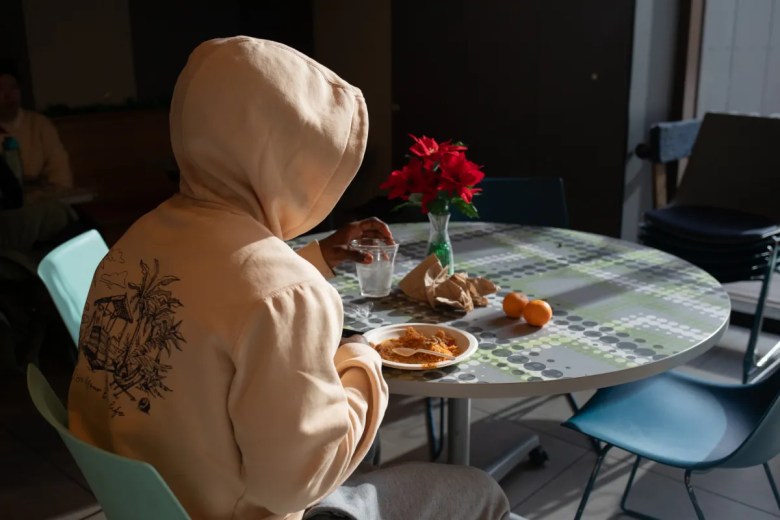
So far, youth participants who spoke to THE CITY said the cash assistance has opened up new possibilities for them. Those youths spoke under the condition of anonymity to protect their privacy and to avoid conflict with other youths in the shelters who were not selected for the program.
For the 22-year-old, who currently lives in a Bronx shelter, the new stream of income means she’s now able to explore permanent housing options outside the city’s rapid re-housing program, where her application has been pending for months.
“I’ve been in the shelter for so long, it sometimes is a little depressing, because I’m just like, ‘OK, when are they going to get back to me about this apartment?” said the 22-year-old, who has cycled in and out of youth shelters since her family was evicted from their home a year and a half ago. “Now, with this money, me and my sister are like, ‘OK, it may just be easier to get that apartment ourselves.”

She also plans to use the money to explore new skills, she said. She had been unable to attend cost-free training in medical billing or sterile cleaning techniques, she noted, because they conflict with her work as a sales associate at Bronx Zoo. But with the monthly stipends, she said, she can now pay out of pocket for ones that fit her schedule.
Soon, she’ll start driving lessons, too.
“The options are unlimited now,” she said.
‘Are We Crazy?’
Covenant House New York CEO Shakeema North-Albert said she wasn’t always convinced that a guaranteed income program would work when Chapin Hall initially approached her with the idea.
“Putting myself in the shoes of someone else, who’s not rich and who had to figure it out, if someone gave me $1,000 a month and said, ‘you could just do whatever you want with it,’ I probably would have blown most of it because I would have went out and got all the things I thought I was lacking,” said North-Albert. “It would have taken me maybe three months to get it figured out and say, like, “girl, you’re running out of money, you need to figure something out.’”’

But, North-Albert said, she hoped the program could nonetheless pose an opportunity to shift away from the crisis shelter model and towards innovations that could help youths transition out of homelessness entirely, looking to the Trust Youth Initiative as a model. Unlike some other guaranteed income programs, she said, that model incorporated services designed to help people find stable housing.
“The supportive services piece made it more attractive to me,” said North-Albert, who now hopes to secure more funding to scale up the program. “The youths still have the autonomy to make whatever decision they want to make, but at least we’ll help coach them and help them look at this opportunity in light of their current situation to help them get closer to whatever their goals are.”
Lyndell Pittman, the organization’s senior vice president of support services, said he initially shared similar doubts.
“Quite frankly, when [North-Albert] told me what we were doing, I was like, ‘Are we crazy?’” Pittman said. “But I got to see young people with a desire to change their situations, and willing to learn and accept the support to learn.”

Many youths, he said, talked about paying off debts and bills at the onset of the program. One youth in particular, he said, shared how the money would help get her on track to reuniting with her child, who is currently under foster care.
“I’m not at a 180 but I’m at a 160,” Pittman added, describing his change in attitude. “Watching the young people’s lightbulb come on about finances has been a real thing.”
One 19-year-old Covenant House resident told THE CITY her approach to the stipend has already shifted from when she received her first deposit last month.
“I didn’t want to save that first paycheck. I just wanted to have a bit of fun, so I bought a phone and just kind of tried new places outside,” she said. “But I met with my case manager, and she kind of encouraged me. She’s like, ‘Are you saving?’ And then I thought about it, and I also thought I should save.”
She’s currently taking a break from her studies at City College to discover more about herself and what she may want to pursue as a career, she added, and has struggled to find a job due to her mental health.
“You don’t get money going to school, so it just felt like it wasn’t a priority right now,” she said.
The monthly allowances, meanwhile, have helped ease her financial anxieties.
Another 19-year-old, the Lehman College student, said she had initially increased her spending after the first infusion of cash, but now limits her spending to $100 or less a week and saves at least $500 from each deposit.

The steady monthly payments, she said, mean she’s no longer looking for financial support from her mother, who she said lives with alcohol dependency and kicked her out in October after an argument. Their relationship has since improved, she added, and she moved home to live with her mother a few weeks ago.
She now plans to set aside part of her monthly stipends for a cosmetology license and to buy makeup so she can begin offering workshops and classes, she said.
She showed off her vision board for the year, and described the photos and quotes she pasted on a piece of paper: “Savings, 8 A’s, a candle, coffee, the bible, hot girls, driver’s license, and then my cosmetology license is also on there.”
“My birthday is about to come up, I’m going to be turning 20,” she continued. “And I’m trying to convert to better habits. So I’m like, ‘OK, let me lock in.’”