



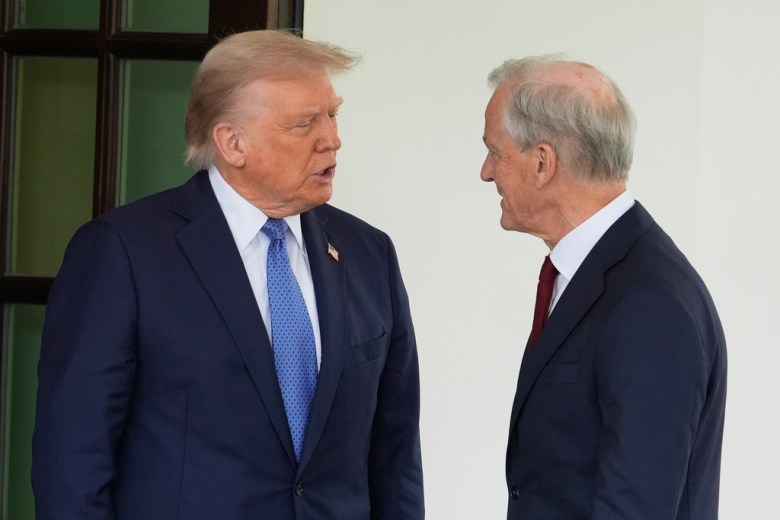
President Trump is not the first leader in Western civilization to see himself, as he says, “the only one who matters.”
Western civilization is littered with rulers who convinced themselves that “there is only one person who is master in this empire and I am not going to tolerate any other” – Wilhelm II, Germany’s Kaiser from 1888 to 1918.
Numerous wildly misguided European kings and one Fuhrer led their countries into war with neighboring states throughout the 19th and 20th centuries – with disastrous consequences: Napoleon III initiated the Franco-Prussian war, which was a disaster for France. Kaiser Wilhem II of Germany banked his country’s future on its ability to overpower France in 1914. We all know how that turned out. Spoiler Alert: it was not good – and definitely not to the benefit of Germany.
So, when a U.S. president says something both belligerent and strange to the leader of a European NATO nation, one is inclined to take more than passing note:
“Considering your country decided not to give me the Nobel Peace Prize for having stopped eight wars PLUS, I no longer feel an obligation to think purely of Peace…” President Donald Trump, to the Prime Minister of Norway, Sunday, January 18.
If this is a threat, it is hardly veiled. Wars between European trading partners began on grounds of considerably less during the 19th and 20th centuries.
Whatever his motivations, beyond being obsessed with militarism, Kaiser Wilhem II was more than a tad myopic in waging war against the neighboring nation of France. In 1914 France “was a top destination for German exports” – ahead of Russia. France contributed to Germany’s balance of trade, positively and significantly. The Kaiser’s Germany was the direct beneficiary of multiple millions of dollars in trade with France, which plummeted, disastrously, after Wilhelm’s declaration of war in August of 1914, after declaring war on Russia three days earlier.
Presently, there can be no disagreement over the fact that the European Union is a “premier trading partner for the U.S.; it is the largest trading bloc and a top destination for export of U.S. goods and services – exceeding $1.5 trillion in trade.” The reality that the EU has “a massive, deeply integrated economic relationship with the U.S., underpinning millions of jobs” cannot be denied. The EU trade deficit with the U.S. can hardly be grounds for grievance worthy of unsettling the peace between Europe and the U.S. – unless the U.S. State Department and the Department of Commerce are totally inept. (Quotes from an AI overview.)
Where is the fly in the ointment that could undermine peace between two longstanding compatible nations? Alain Berset, secretary general of the Council on Europe says, “I did not think that I would ever have to write about the possibility of the United States taking military action against a member state (of NATO). Yet, here we are. President Trump has vowed to make Greenland – a semiautonomous territory of Denmark….part of the United States, and that he will do so ‘the easy way’ or “the hard way.”
Wake up people!
This fight is not necessary. This fight is more than dangerous; this fight would be deadly. To be over a perceived slight? What’s not ridiculous about that?
A rather extraordinary similarity of personality characteristics exists between Germany’s Kaiser of 1914 and America’s president of 2026. Based on English historian M.J. Carter’s consequential historic analysis, none are flattering. As Carter says, “You don’t really want a narcissist in control of global power.” (See The New Yorker, reprint, “What Happens When A Bad-Tempered Distractable Doofus Runs an Empire.” By Miranda Carter, June 6, 2018.
Sallie Marsico live in Norwalk.