



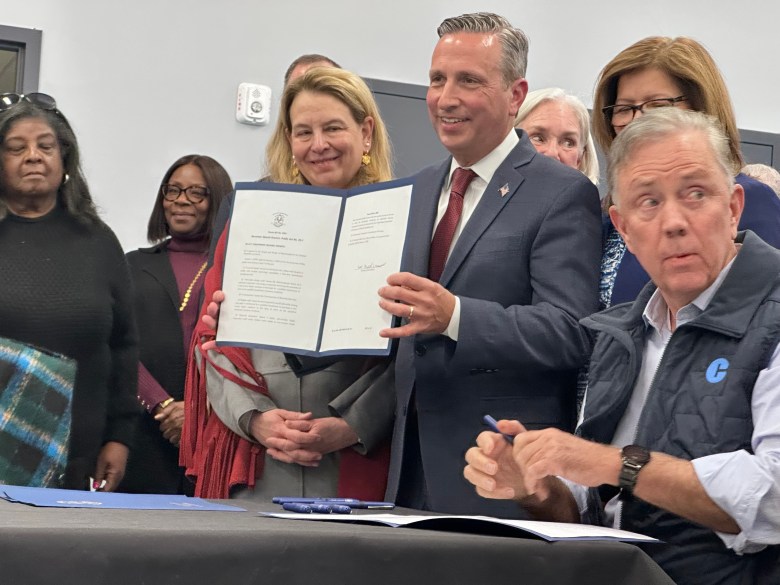
Gov. Ned Lamont on Wednesday said he will propose legislation in the upcoming session to limit rent increases for out-of-state landlords who purchase apartments in Connecticut, an idea that immediately drew opposition from some Republican lawmakers.
Lamont, speaking at a Partnership for Strong Communities event, also criticized President Donald J. Trump’s approach to housing affordability and accused 169Strong, a local group that has argued against zoning reform, of being “really, really unhelpful” by spreading misinformation on housing issues.
“As I try and talk about housing, I also try … to make sure that I’m talking about the most vulnerable in the state,” Lamont said. “I need to get people on board with an aggressive housing agenda.”
In November, the governor signed a wide-reaching piece of legislation that mandates that towns create plans that show how they’ll allow for a set number of units of housing. The law also expands fair rent commissions, offers help to the homeless population, and eliminates parking minimums for some smaller residential developments.
Lamont, who is running for a third term, negotiated the law with town leaders after he vetoed a bill the legislature passed during the 2025 regular session. He later called a special session to pass a bill he said would give towns more control, although the new bill faced heavy criticism from Republicans.
The governor acknowledged that some advocates may be frustrated with him after the veto, but said he hopes the new law helps.
“I want them [towns] to take the lead,” Lamont said. “I don’t want them just to say no. I want them to say yes.”
The governor spoke at an event focused on a new report from the Partnership for Strong Communities about the large number of Connecticut residents who pay too much of their income to rent and the lack of housing choice in the state.
Lamont’s proposal would limit how much out-of-state landlords who buy property in Connecticut can increase rents. He said he wants to keep people in their homes. Many people have faced eviction after the apartment complexes where they live are sold and the new landlord raises rent.
“It’s related to out-of-state buyers, buying up the market, using that monopoly to jack up rents,” Lamont said Wednesday. “I’ve seen that result in homelessness. A lot of seniors who can’t afford it. They get very little notice. They’re pushed out the door. We’re not gonna let that happen.”
Mixed reaction
The proposal, a limited rent cap, will likely face fierce opposition from Republicans in the General Assembly. And bills intended to cap rents have not fared well in the past.
In 2023, a broad measure to broadly limit annual rent increases failed to get a vote before the Housing Committee. And in 2025, a bill to offer more protections to mobile and manufactured home residents that included rent caps also failed.
Also last year, the state Department of Housing pushed for a bill that would have required that local fair rent commissions consider any rent increase greater than 10% unfair if the apartment had been sold recently and no major renovations were done. The bill didn’t pass.
Landlords have said rent cap proposals limit their ability to renovate and take care of their property while earning the profit they want.
The Connecticut Apartment Association issued a statement Wednesday saying they oppose any rent control measures.
“Rather than improving the availability of much-needed housing, rent control laws carry the unintended consequences of reducing housing supply and residential mobility, and causing higher rents in uncontrolled units, and reduced quality in controlled units,” said Jessica Doll, executive director of the association, in a statement.
But tenants say rent increases are sometimes unfair, which pushes them out of their housing.
“For the one-third of Connecticut residents who rent our homes, it’s no exaggeration to say that hearing the governor speak in favor of rent stabilization feels like a light going on in a dark room,” said Luke Melonakos, vice president of the Connecticut Tenants Union. “Half of us are already paying more than we can sustainably afford in rent. A quarter of us are rationing food, medicine, and other basic needs. Speculative investors are running unchecked in our communities, forcing long-term residents out of their homes and tearing at our social fabric.”
Housing Committee co-chair Sen. Martha Marx, D-New London, said she doesn’t think the governor’s proposal goes far enough. She added that she’s interested in seeing further expansion in the number of fair rent commissions, which are local bodies that have the power to hold hearings to determine whether rent increases are fair. They can order the rent to be lowered.
“We need bold legislation in order to fix the housing crisis that we’re in, and it certainly will help, but it’s not going to make that big of a difference,” Marx said, of the governor’s plan.
Republican leadership for the Housing Committee said they’d be opposed to any rent cap, no matter how limited in scope.
“It’s a very slippery slope,” said committee ranking member Rep. Tony Scott, R-Monroe. He said bills often get expanded. “Once you theoretically let them go and just take a step, they’re going to take five steps the next year.”
Ranking member Sen. Rob Sampson, R-Wolcott, said the idea would send the wrong message and discourage landlords from investing in Connecticut.
“This is a terrible idea. It will not result in lower rents for anyone. What it will do is discourage the people in the marketplace who are trying to survive from engaging in economic activity,” Sampson said.
Lamont criticizes president, local group
Lamont also criticized Trump’s speech Tuesday on affordability, which he said didn’t clearly enough lay out his plan for housing.
Trump on Wednesday signed an executive order to ban large investors from buying “single-family homes that could otherwise be purchased by families.” He’s also proposed ways to cut interest rates and allow people to use their retirement savings for down payments on homes.
“He’s talking about taking money away,” Lamont said. “You can take money out of your 401K, and use that to overpay for housing. If you’re a senior, rob your retirement.”
However, Trump’s first year back in office was largely focused on immigration and foreign policy rather than housing.
Lamont also joked about the problems that he said a local group called 169Strong has caused. The group galvanized people to call the governor’s office to urge him to veto the first housing bill the legislature passed last year.
Lawmakers and housing advocates have said the group participates in misinformation campaigns.
“There’s a group called 169 that just studied fiction in college. They just are making stuff up. It’s just really, really unhelpful,” Lamont said.
The group in a statement said it is proud of the information it deliver to residents. It also criticized the new housing law passed during the special session, which it said contained many of the same problems as the first bill.
“Our thorough analysis of HB 5002 played a key role in highlighting critical concerns — contributing significantly to Governor Lamont’s decision to veto the bill,” the statement said. “Residents and municipal leaders are wide awake and watching, and what is not ‘fictional’ is the sentiment of the voters of Connecticut who collectively sent thousands of letters to the governor on this issue.”