


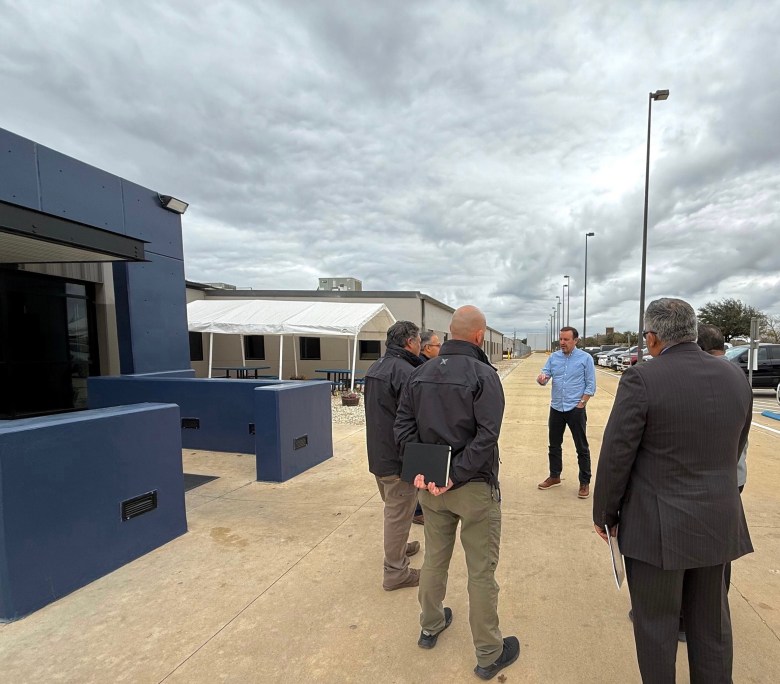
After weeks of warning about the Trump administration’s escalating immigration crackdown, U.S. Sen. Chris Murphy flew to south Texas this week to see the enforcement efforts firsthand.
The Connecticut Democrat, who made the trek on his own, tried to go inside two detention centers operated by U.S. Immigration and Customs Enforcement, but he said he was denied entry on Tuesday. The U.S. Department of Homeland Security requires members of Congress to give seven days’ notice of a visit, a policy that is being challenged in court and has been temporarily upheld.
On Wednesday, he sat in on proceedings for individuals and families seeking asylum at an immigration court in San Antonio. He described the scenes inside as “bone-chilling,” noting the hallway right outside of the courtroom was lined with ICE officers.
Over the two-day trip, Murphy gave a play-by-play over social media of his whereabouts in south Texas: his attempts to get inside ICE detention centers, attending immigration court hearings and meeting with families with young children who were recently detained. In an interview, he said the reason for his visit to Texas specifically was because he believes the “abuse is most acute” around San Antonio.
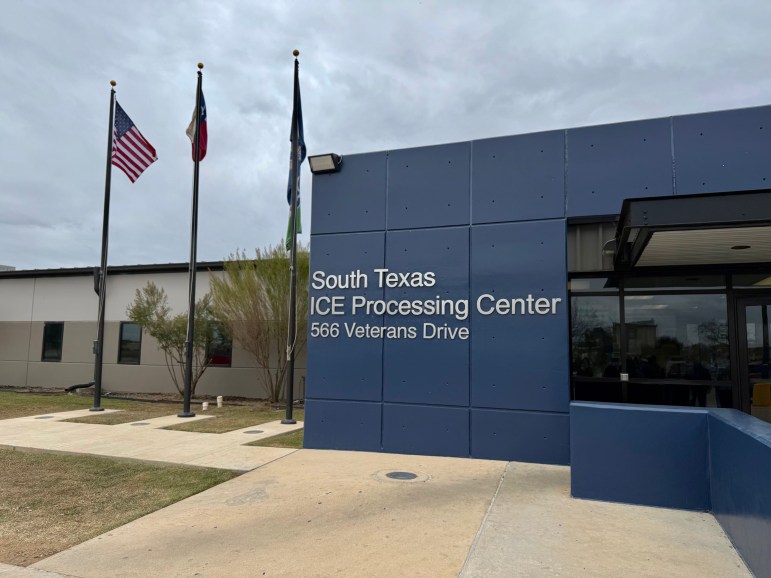
Murphy said he provided more than 24 hours’ notice before his arrival to tour the facilities on Tuesday. He was ultimately barred from getting into two detention centers in Dilley and Pearsall, both about an hour and half southwest of San Antonio.
Calling it “patently illegal,” he said the denials impede congressional oversight, which he believes is even more pertinent given his role as the ranking member of the Senate Appropriations Homeland Security Subcommittee. That panel oversees and funds the overall department, which has jurisdiction over ICE.
“I wasn’t sure that I was going to be turned away. I didn’t show up unannounced. I gave them a day and half notice. I am the ranking Democrat on the committee that funds DHS. They had no reason to turn me away. And the fact that they did gives me an idea that they’re trying to hide something,” Murphy said in an interview Thursday.
“It was more evidence of how critical this moment is and how DHS does not deserve to be funded without reforms,” he continued.
Tensions with ICE have become even more strained after the fatal shooting of Renee Good in Minneapolis by a federal agent earlier this month.
Multiple Democratic members of Congress have tried to get into ICE detention centers around the country, including the most recent attempts by three lawmakers from Minnesota.
Last month, a federal judge temporarily blocked a Trump administration policy that required members of Congress to provide at least seven days’ notice before entering such facilities. But after an emergency hearing, followed by the denial of the trio of Minnesota lawmakers, the judge ruled that a similar policy blocking unannounced visits will remain in place.
When Murphy tried to enter on Tuesday, DHS noted the 7-day policy on notification and told him that all facilities in the area are being completely funded by Republicans’ “big beautiful bill,” which allocated $75 billion over four years for ICE. They claimed that was a reason they didn’t have to follow appropriations law regarding congressional oversight.
“If they are not letting members of Congress in with less than seven days’ notice, it tells you how much work they know they need to do to cover up and hide the things they don’t want us to see,” Murphy said over social media. “You get to see the videos of what’s happening in Minneapolis. You don’t get to see anything that’s happening behind these walls.”
U.S. Immigration and Customs Enforcement did not respond to a request for comment on Wednesday afternoon.
DHS issued a memo on Jan. 8 instituting a new policy that mirrored a past one requiring notification of at least a week.
“The basis for this policy is that advance notice is necessary to ensure adequate protection for Members of Congress, congressional staff, detainees, and ICE employees alike. Unannounced visits require pulling ICE officers away from their normal duties. Moreover, there is an increasing trend of replacing legitimate oversight activities with circus-like publicity stunts, all of which creates a chaotic environment with heightened emotions,” the memo reads.
While he didn’t get to tour either facility, Murphy said he spoke with some of the people who run them. At South Texas ICE Processing Center in Pearsall, Murphy was told there are 1,800 people at that facility, with 5% of them considered security threats, with convictions or arrests for violent crimes.
Murphy also met with two families who were recently detained in Texas. Both had young kids and were going through the court-ordered process as they apply for asylum when they were detained by federal agents.
“What they described is fundamentally un-American,” he said. “It’s fundamentally inhumane.”
On Wednesday, he sat in on proceedings at an immigration court in San Antonio for about two hours. Murphy said he received an urgent request from lawyers and advocates who knew he was in town. They asked him to sit in on one of the hearings of a young couple with a 2-year-old daughter, hoping that the presence of a U.S. senator would make detainment less likely. Murphy said he helped walk the family out of the courtroom and to their car.
But that wasn’t the case for another individual whose hearing Murphy also sat in on. The senator said the man didn’t have legal representation, but the judge ordered him to finish his asylum paperwork and return in a year. Despite the permission he got to remain in the country during that time, Murphy said the man was immediately apprehended by ICE officers when he exited the courtroom, though he wasn’t sure about his whereabouts after that happened.
This week’s trip was much different from the one he took to the southern border in 2023. That visit was with a bipartisan group of senators who were looking for a compromise to reform the immigration system. That led to Murphy negotiating a bipartisan border bill a year later, which ultimately fell apart after Donald Trump’s opposition.
Since Trump’s return to office, Murphy’s role in the U.S. Senate has evolved. He has become a vocal critic of the administration’s immigration crackdown, which he argues isn’t focusing on dangerous and violent criminals.
One of the ways Murphy and other Democrats have sought accountability for ICE is through the congressional appropriations process and placing limits on the enforcement agency through the budget of the Department of Homeland Security, which oversees ICE among many other offices.
In the days leading up to the compromise bill, Murphy signaled he wouldn’t be able to support a bill without certain reforms or guardrails surrounding ICE.
Congress is finishing its work to fund the rest of the federal government before its Jan. 30 deadline. One of the biggest obstacles to averting a partial shutdown is the bill that funds DHS. A growing number of congressional Democrats have wanted to defund or add in reforms.
Now that he’s seen the final proposal, Murphy said he won’t vote for it when it comes over to the Senate.
Other Connecticut Democrats have since come out against the DHS funding bill, including U.S. Rep. John Larson, D-1st District, U.S. Rep. Jim Himes, D-4th District, and U.S. Rep. Rosa DeLauro, D-3rd District, who helped negotiate the spending bills. Republicans have a narrow margin in the House but can still pass funding bills without Democrats’ help. If the funding package makes it to the Senate, Republicans will need the votes of some Democrats to move them forward.
As the House takes up the DHS funding bill Thursday, most Democrats are expected to oppose it. If it clears the House, the measure will move over to the Senate next week. But senators won’t get the chance to vote separately on the DHS measure, which will be included in a larger package to fund the remaining three government funding bills. That could raise the possibility of a partial government shutdown.
Murphy said he can’t support funding for Homeland Security without reforms — and the bill coming before Congress falls short of that threshold. Some of those demands that didn’t make it into the final product included preventing U.S. Customs and Border Protection agents from being moved off the border and into the interior, requiring warrants for certain arrests and protocol around mandatory training.
“We shouldn’t let Republicans bully us again into funding a lawless administration,” Murphy said Thursday. “I just don’t think we will be perceived as credible if we vote to fund DHS’ illegality and abuse for the rest of the year while talking like it’s a moral and legal crisis.”
The Connecticut Mirror/Connecticut Public Radio federal policy reporter position is made possible, in part, by funding from the Robert and Margaret Patricelli Family Foundation.