



The biggest threat to Connecticut’s children isn’t beyond our borders. It’s right here at home.
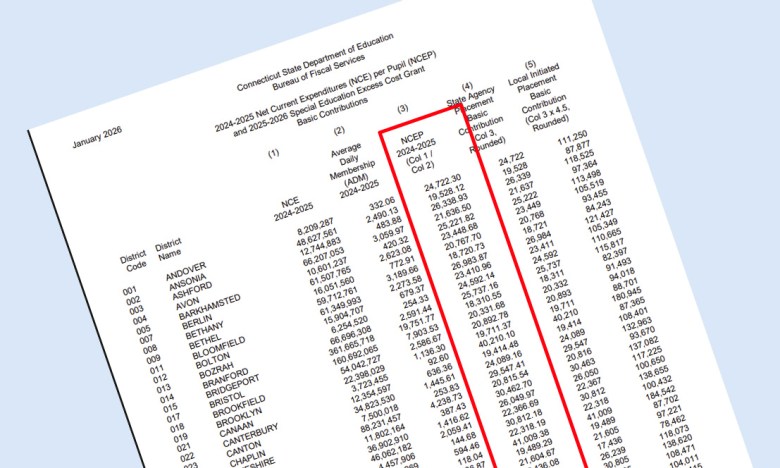
Connecticut loves to brag about being a leader in education. On paper, we spend more than $22,000 per student statewide. Sounds impressive, right? But that is on average. Walk inside classrooms in Bridgeport, New Britain, or Waterbury, New Haven and Hartford you’ll see a very different reality entirely.

The truth? Our state’s borders, while invisible, impose significant barriers. The lines between wealthy and struggling districts have created a crisis. These borders decide whether a child learns in a classroom with modern technology and psycho/social services or one where even basic resources are stretched thin.
Where you live should determine how you learn. Consider this: Bridgeport spends $18,565 per student. Just a few miles away, Fairfield spends $23,083. That’s a gap of more than $4,500 per child, every single year. Multiply that by Bridgeport’s nearly 20,000 students, and you’re looking at an $88 million shortfall every year.
And Bridgeport isn’t alone. Stamford vs. Darien? $4,400 gap. New Haven vs. Woodbridge? $2,900. These aren’t just numbers, they’re lost teachers, paraprofessionals, assistant principals, tutors, math and literacy coaches, closed libraries, and fewer counselors for kids who need them most.
How did we get here?
This isn’t an accident. It’s the predictable result of decades of discriminatory policy choices that tied education funding to property wealth. Connecticut’s school funding system depends heavily on local property taxes. Wealthy towns can raise more money. Poorer towns can’t.
That gap has deep roots in history:
Redlining: In the 1930s, federal maps labeled certain neighborhoods as “hazardous” for investment, often communities of color. Those areas were cut off from mortgages and development, locking families into cycles of poverty.
Restrictive zoning: Towns adopted policies that limited who could live where, often excluding affordable housing. These zoning laws don’t just exclude people from neighborhoods they shape school student demographics.
Property tax reliance: Because school funding is tied to property wealth, privilege gets rewarded while poverty gets punished.
Connecticut tried to fix this with the Education Cost Sharing (ECS) formula, designed to consider both town wealth and student need. But the foundation amount has been frozen at $11,525 since 2013. Adjusted for inflation, it should be $16,500 today. Advocates are calling for $17,000 per student and a formula that actually reflects student need.
If lawmakers act, districts like Bridgeport could gain millions annually just enough to match inflation since 2013, and erase Connecticut’s $972 million dollar racial funding gap. That means more teachers, mental health supports, and stability for schools that have been scraping by for decades.
What’s at Stake? Every year we delay, kids lose opportunities they’ll never get back. Libraries close. Counselors disappear. Class sizes grow. And the promise of public education, the idea that every child deserves a fair shot, dies a little more.
The time is now, with the Governor’s race looming and the legislative session beginning on February 4, we need to advocate for a foundation amount of $17,000 in order to increase the funding for our public schools, which as of today will add zero additional dollars to the Education budget next year.
Will you stand with us? Contact your legislators. Testify at a budget hearing. Share this message. Join a local advocacy group like the NAACP. Organize. Because every child deserves a fair shot, no matter their Zip code.
Joseph Sokolovic lives in Bridgeport.