


Two years ago, Connecticut legislators backed a novel idea: making the cost of child care more affordable by encouraging employers to help pay for it.
They designed a pilot program for New London County to test a model known as “Tri-Share”, a cost-sharing program that evenly splits child care costs among three groups: employers who volunteer to participate, eligible employees of those companies and the state.
The program, part of a larger $100 million dollar initiative to support state early education programs, received $1.8 million in federal pandemic relief funds to support the effort.
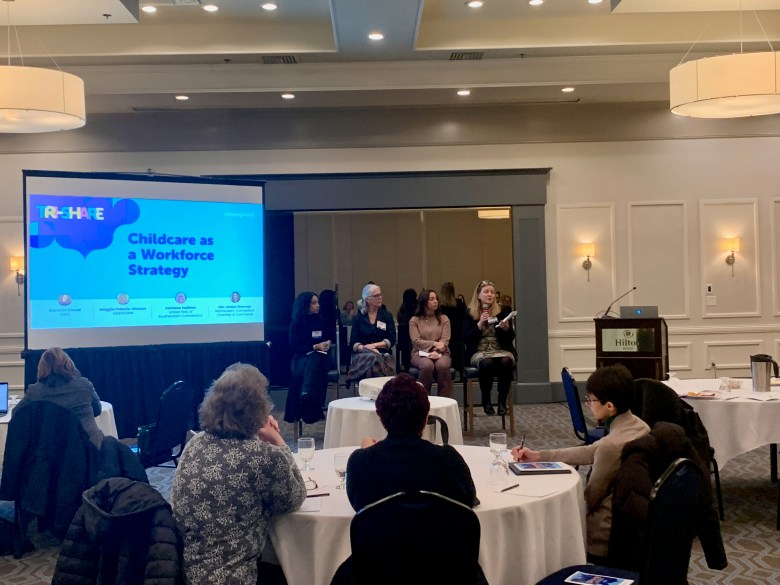
The Connecticut pilot is still in the early stages, but businesses in New London County got significant updates this week at an event hosted by the Connecticut Business and Industry Association.
The model has spread to a number of states in recent years as officials try to address the ongoing child care crisis, an issue that threatens to leave a $329 billion hole in the national economy over the next decade and costs Connecticut an estimated $1.5 billion a year.
Alongside speakers from the state and LEARN, the local organization helping to coordinate the pilot, child care advocates framed the Tri-Share model as a smart financial investment for Connecticut employers, enabling them to help address child care affordability for working families, while boosting employee retention, increasing productivity and improving recruitment.
“It’s important to look at this when you’re talking about wages or scheduling,” said Elle-Jordyn Sherman, the executive director of the Northeastern Connecticut Chamber of Commerce. “It’s truly like infrastructure.”
But the program’s success is largely dependent on how many people, both employers and employees, are willing to actually use it. And that will require an increase in both awareness of Tri-Share and adoption of the program.
A new tool for employee recruitment and retention
According to the U.S. Department of Health and Human Services, families should spend no more than 7% of their income on child care.
Most families in Connecticut are spending far more than that.
Data on child care affordability in the state put costs at anywhere from $14,000 to $20,000 a year, with the exact cost changing depending on things like the age of the child, the amount of time they need care and the type of care a family enrolls in.
The Tri-Share model allows a family’s contribution to shrink by two-thirds. The program is largely targeted at moderate- and middle-income households in Connecticut. Employees who are enrolled in other state child care subsidies, like the Care 4 Kids program, cannot use Tri-Share.
Cost sharing, advocates said, gives both employers and employees flexibility in the process. Employees are able to select the child care provider.
Employers, meanwhile, can set the specific amount and duration of their contributions to an employee’s child care. Speakers at the CBIA event encouraged New London employers to set their specific programs up in a way that will minimize disruptions to employees and will keep them from sudden financial shocks.
“There was definitely a huge appreciation from so many employees” who have entered the pilot, said Adrenna Paolillo, the assistant director of early childhood education at LEARN, the educational service center tasked with administering the pilot program and managing the paperwork for local employers and employees.
“Their children were in a place that they felt comfortable, employees were in a place that found comfortable, and then in turn, they’re hopefully being a really productive employee.”
That is especially important in New London County, where ALICE families — an acronym for households that are asset-limited, income constrained, and employed — are spending close to a third of their salaries on child care.
“If your employees are paying upwards of 27% of their income, that’s not health care, that’s not food, it’s not housing,” said Kathleen Hollister, the facilitator of the SECT Childcare Collective, a 40-organization collective housed in the United Way of Southeastern Connecticut. “I think that just reinforces this whole need for flexibility to understand that this is what people are experiencing in our community.”
So far, the earliest adopters of the pilot program have, ironically, been child care providers themselves. These providers usually already offer child care subsidies and discounts to their employees, lowering the costs for their children in exchange for their work. Adopting the Tri-Share model allows those providers to pay even less.
“It saved us money as an employer,” said Linda Fecteau, a business advisor for child care programs and the founder of her own early childhood education business. “It’s really been very helpful for the staff members and as a recruiting and retention tool.”
So far, the pilot program is still in the process of drawing in new employers. In November, submarine manufacturer Electric Boat announced that it would enter the Tri-Share pilot to help employees as the company launches an ambitious expansion effort in the state.
Tri-Share is gaining national support — and criticism
The Tri-Share model, supporters say, gives businesses the ability to directly assist their employees by helping share a significant expense. In this framework, child care costs are treated much like other employee benefits like a flexible spending account or health care. And similarly to those benefits, employers hope that offering child care support can increase employee loyalty and productivity.
The model, which first drew attention in Michigan after the state launched a pilot in 2021, is becoming a popular initiative in states looking to address child care gaps in ways that reduce the amount state governments need to invest. Close to a dozen states, including West Virginia, Ohio and New York, have launched full programs or are currently running pilots.
There’s federal interest in the concept as well: members of Michigan’s congressional delegation introduced a bill that would create a federal Tri-Share pilot late last year.
But the Connecticut pilot, which expects its $1.8 million in funding to last through 2027, faces some visibility challenges as the program gets underway. Around 150 families are currently enrolled, according to LEARN. One of the biggest issues highlighted at the CBIA event was the need to make more employers aware of the fact that the pilot even exists.
And there’s still a question of exactly how the program will scale and what types of employers will embrace the model.
Some child care advocates in the state have also voiced concerns that Tri-Share, while making costs affordable for employees working at participating companies, does not increase the number of child care providers in the state and is also unlikely to help many of Connecticut’s lower-income residents. The program also doesn’t address the state’s shrinking child care workforce, which urgently needs more workers.
Some of these criticisms have been echoed nationally, with policy organizations noting that while the Tri-Share model has an obvious impact on affordability for working families, the program is not structured to address a more fundamental issue: supply.
And on a deeper level, there is a worry that an overreliance on Tri-Share will shift responsibility for addressing the child care crisis from policymakers onto the private market, forcing people to rely on their employers to maintain access to affordable child care.
“I’ve never been really excited about the idea,” said Merrill Gay, the executive director of the Connecticut Early Childhood Alliance. “If I’ve got my kids in a child care program, and then either my employer downsizes or I’d rather work for somebody else, I now lose the subsidy that made it possible for me to pay for the child care program where my kid is comfortable.”
“It’s not my preference on how we do things,” he added.
In an interview, Gay said that he is currently focused on shoring up the Care 4 Kids program for low-income families, which is currently dealing with a significant waitlist, and monitoring Connecticut’s new Early Childhood Education Endowment, which will be used to expand funding for various state programs.
“We’ve been much more focused on efforts that will serve more families and focus on the families who are most in need of care,” he said, noting that the state’s lowest income families will not benefit from Tri-Share.
That reality was acknowledged at this week’s event, with participants noting that Tri-Share is far from a singular solution that can fix the range of issues driving child care needs in the state. CBIA has also acknowledged that Tri-Share isn’t the only way businesses can help employees struggling with child care costs, noting that employers could explore flexible and remote work options, on-site child care, and stipend programs to help.
But at a moment where state funding must address a variety of child care system crises, and a lack of affordable child care continues to impact the workforce, advocates say the model is still worth trying.
“The issues related to child care are complex, and no one organization can fix it,” said Hollister. “This is a situation where everyone needs to come to the table and see what role they can play, what part they can play.”