



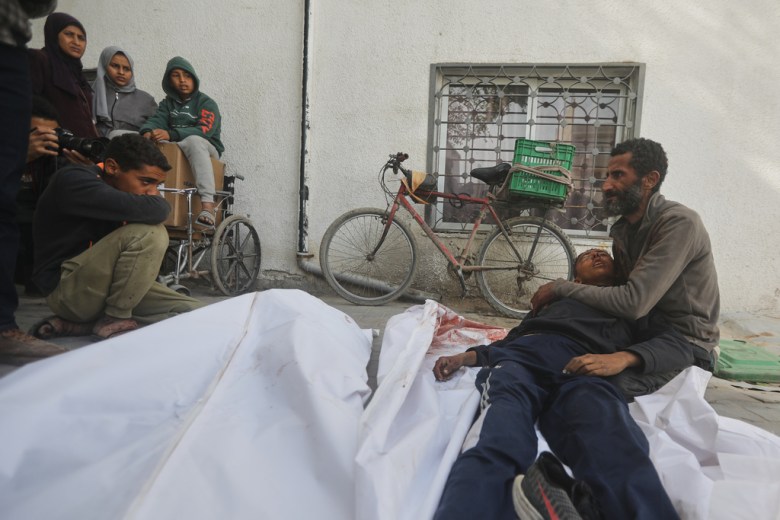
As we begin the new year, I have found myself reflecting on the past year and its happenings. And the one that continues to plague me most is the destruction of Gaza––its people and their habitat.
Don’t be duped by a ceasefire declaration, the silence in mainstream media about the plight of Palestinians in Gaza and the West Bank today, or a U.S.- backed riviera plan for Gaza. These are only strategies to delude us into thinking that all will be well. The reality is quite different.
Palestinians in Gaza continue to be killed despite the ceasefire. Heightened attacks on Palestinians in the West Bank are taking place while Jewish settlements are being expanded. Greedy U.S. contractors are lining up to see what profits can be made by business deals and investments in the Gaza riviera plan––a callous and unjust project before it even begins since it completely excludes the voices and representation of Palestinian people.
As winter sets in, freezing temperatures and a glaring lack of food, clean water, heating, not to mention housing, is not available for thousands of people in Gaza trying to restore their lives––a feat not even imaginable for those of us not living there. The presence of amoral political leaders in the U.S. and Israel calls for a moral reckoning and a recalibration of one’s moral compass. Unfortunately, many people become indifferent, even complacent in the face of futility. Anyone with any hint of compassion does not have to think very deeply to conclude that the situation in Palestine is a moral tragedy.
Unfortunately, the way the geopolitical system is set up gives license to political leaders to commit crimes against humanity and enjoy impunity. Israel and the United States have breached international law repeatedly and continue to do so with no apparent repercussions, as yet. Benjamin Netanyahu travels to the United States freely when if in another country he would be arrested. And it seems that the global community is not in any rush to change international law: doing so threatens national sovereignty, and also national economic interests. There are many governments, Israeli, the United States, British, Italian, Australian and others, as well as transnational corporations and financial institutions benefiting from the war in Gaza through arms production, intelligence, technology, investments, humanitarian aid, etc.
What needs to happen? The pressure needs to come from below. Palestinian resistance is not new––it started a century ago after the Balfour Declaration in 1917. From 1936-1939, The Great Revolt took place which was a popular uprising against the British style of governance and Zionist motives. Around the world, not many people know or even understand the extent of the oppression of Palestinian people over the years or of their resistance. But this seems to be changing with a growing international solidarity for the Palestinian people.
Even in Connecticut we are seeing a growing number of groups in solidarity with Palestinians. Groups such as the Jewish Voice for Peace, Connecticut Solidarity Palestine Coalition, We Will Return CT, American Muslims for Palestine, CT, the Palestinian Solidarity Working Group of the CSU-AAUP as well as many student and other organizations. These movements can result in change, and are the only hope at the moment.
The apartheid system in South Africa collapsed in 1994 due to a series of factors which over the years made the situation untenable, but an essential component was the global BDS movement (boycott, divestment, sanctions) strangling the South African economy. Of course, most Western governments voted against boycotts, divestment and sanctions (and will do the same with Israel) but with time and pressure from students and other activist groups it did work.
In 2005, a BDS movement was created by Palestinians and is a non-violent response to violence imposed on them. On their website, it says: “Boycott, Divestment, Sanctions (BDS) is a Palestinian-led movement for freedom, justice and equality. BDS upholds the simple principle that Palestinians are entitled to the same rights as the rest of humanity.”
Angela Davis, activist and academic said this after a delegation to Palestine, “Each and every one of us —including those members of our delegation who grew up in the Jim Crow South, in apartheid South Africa, and on Indian reservations in the U.S.— was shocked by what we saw. We issue an urgent call to others who share our commitment to racial justice, equality, and freedom [and] we unequivocally endorse the Boycott, Divestment, and Sanctions Campaign.”
The current situation in Gaza is neither just nor humane, and never will be if allowed to continue as is. A growing global BDS movement in solidarity with Palestine may be the only way to bring forth the radical change that is needed. Palestinians cannot do this on their own.
The phrase “Lest we forget” comes from a poem that Rudyard Kipling wrote in 1897. The phrase is now commonly used to commemorate the falling of soldiers during war. I want to extend it to all the children, mothers, teachers, doctors, journalists, humanitarian workers, and the list goes on who have also died during this horrendous war so that we do not forget.
Anna Malavisi is an Associate Professor and Associate Chair in the Department of Philosophy, History, and World Perspectives at Western Connecticut State University.