


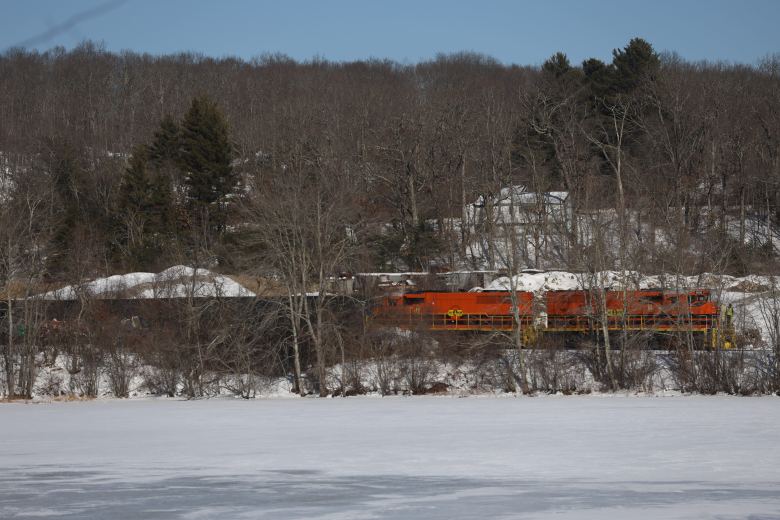
A train carrying liquid propane cars derailed Thursday morning in Mansfield, causing a shutdown of several roads, a shelter-in-place notice for some residents and a mass emergency response.
The derailment occurred about 9:05 a.m., and officials quickly closed Route 32 between Route 44E and Route 75. The road is expected to be closed for some time as emergency response teams work to clean up the accident.

The train had 14 cars, six of which, carrying liquid propane, derailed. Four of the derailed cars ended up partially in the Willimantic River, according to Mansfield Fire Chief John Roache.
“It’s primarily the six cars that we’re really worried about right now, where the … cars that were on their side and off the tracks completely,” Roache said.
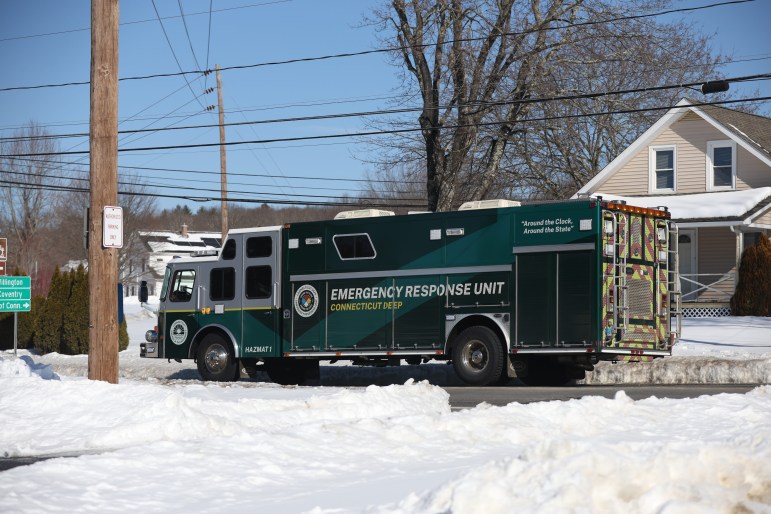
State police said there were no injuries.
A shelter in place order was issued for residents within a half mile of 1090 Stafford Road for a possible gas leak, but officials said at a noon press conference that they have found no evidence of a leak. They plan to continue monitoring it until the site is cleared which could be days.
Because of the remoteness of the area where the train derailed, it will take days to remove them, Roache said.
State officials said they issued the shelter in place order until they could get a sense of whether a leak had occurred.
“So our fear was, if there was a leak, you might not smell it in your house,” Roache said. “So just out of an abundance of caution, we are just telling people, just close your windows and stay inside for right now.”

The train was with the New England Central Railroad, which is owned by Genesee & Wyoming Inc., officials said.
Besides the liquid gas, it was carrying lumber, grain, and grease.
University of Connecticut officials said the train derailment did not impact the nearby campus. UConn spokeswoman Stephanie Reitz said the school did “send a notification to employees and students to inform them about the delays and encourage them to take other routes.”
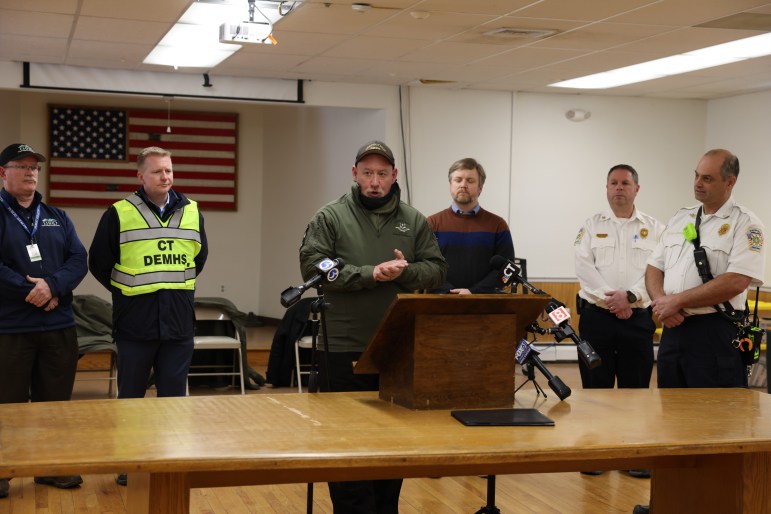
Several state agencies responded to the emergency and will be on site for several days, according to Rich Scalora, the supervising emergency response coordinator for the state Department of Energy and Environmental Protection.
Scalora said they put booms in the river as a precaution because the cars were in the river.
The cleanup process will be a challenge, Scalora said.
“How are they going to handle each car? Each car is going to be a little different, and they’re discussing right now — they’re still doing evaluation. Do they take the product off, or do they move the car intact?” Scalora said.