



A single school suspension can look like a minor disciplinary decision. In reality, it often marks the beginning of a permanent exit from education. When suspensions pile up, students miss instruction, fall behind academically, and begin to disengage with teachers, school counselors, and their friends at school. Eventually, returning to class feels pointless or at best students feel unwelcomed. This is how discipline quietly turns into pushout. While certain students, especially Black and Brown students are disproportionately affected, the consequences extend far beyond individual communities. When schools remove students instead of supporting them, the costs ripple across our economy, public health systems, and democracy.

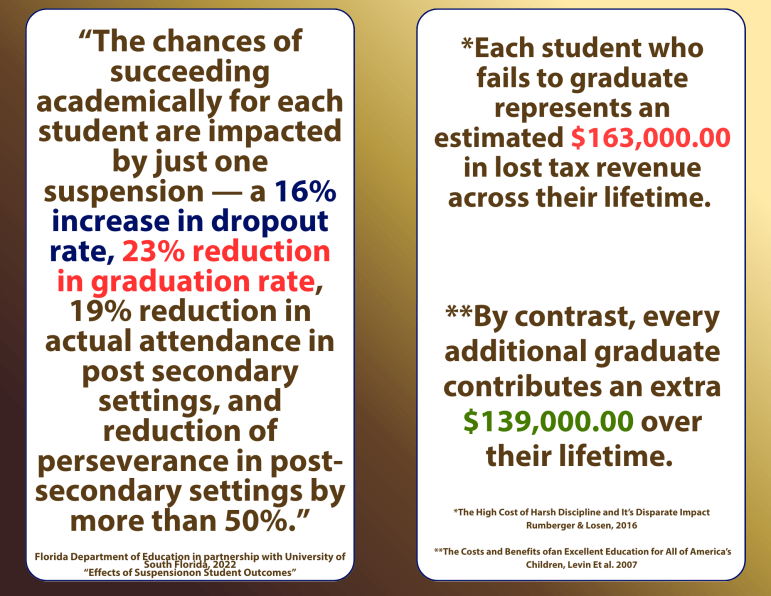
School suspension is one of the strongest predictors of dropping out, reinforcing a cycle of poverty that strains public resources. High school dropouts face higher unemployment rates and are more likely to rely on public assistance, costing taxpayers billions over their lifetimes. Each student who fails to graduate represents an estimated $163,000 in lost tax revenue across their lifetime. By contrast, every additional graduate contributes an extra $139,000 over their lifetime. Keeping students in school is not just an educational priority; it is a sound economic investment.
The misuse of exclusionary discipline policies also places a direct burden on social services. Research shows that improving graduation rates could save the nation between $7.9 billion and $10.8 billion each year in food assistance, housing support, and public aid. When schools push a child out through suspensions and expulsions, they are not just disciplining them; they are choosing to fund their future through the most expensive systems imaginable. In Connecticut, the cost to incarcerate a child is $273,750.00 per year, compared to only $22,054.00 per student in the K−12 public education system. These outcomes are the result of choices, not chance.
For students themselves, the effects are immediate and personal. A suspended child is often at home alone during school hours, falling further behind and absorbing the message that they are a problem to be removed, not a student worth investing in. Over time, that message sticks. Many never return.
Keeping students in the classroom is also a public health intervention. Graduates experience better long-term health outcomes and are 60 percent less likely to rely on Medicaid. Those who do not complete high school face higher rates of preventable illness, including heart disease and diabetes. Students who are pushed out of schools are six times more likely to abuse drugs or alcohol than individuals with a degree, leading to higher rates of addiction-related health issues and increased healthcare costs. Cutting the national dropout rate in half could save $7.3 billion each year on Medicaid, $12 billion on heart disease-related costs, and $11.9 billion on obesity-related expenses.
Beyond economics and health, exclusionary discipline weakens our democracy. Education prepares young people to participate in civic life, yet students who are suspended are less likely to vote, volunteer, or engage in their communities as adults. Harsh disciplinary practices send a damaging message that some voices matter less than others. Over time, this breeds disengagement and distrust in public institutions.
Our statewide coalition is working to transform how Connecticut schools respond to student behavior. Our legislation would make small but meaningful changes to current state law.
- Defines violent behavior narrowly as conduct involving physical injury, attempted physical injury, or credible threats posing an immediate risk of physical harm;
- Limits out of school suspensions to cases involving violent student behavior;
- Reduces maximum days allowed from 50 to 20 days of out of school suspension per student; and
- Strengthens protections and due‑process requirements for suspended students.
If we want strong communities and a healthy democracy, we must stop treating exclusion as discipline. Shifting resources away from punitive surveillance and toward restorative, anti-poverty school environments is essential to ensuring every child has a real chance to graduate and thrive. This is not only a moral issue for those most affected. It is a collective responsibility for anyone who cares about a prosperous, stable, and equitable society.