


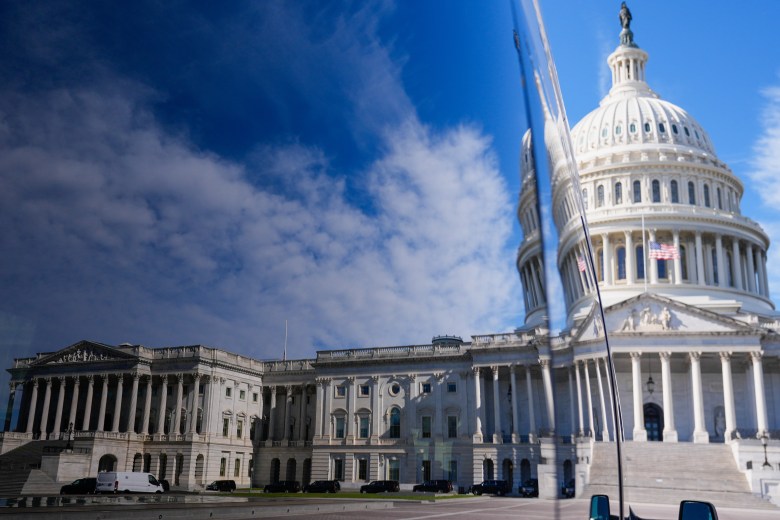
Connecticut will receive tens of millions of dollars in federal funding for local projects, marking the first time in a two years that states will benefit from earmarked funding for infrastructure initiatives, affordable housing development and education.
The state’s congressional delegation secured a combined total of more than $190 million to support over 175 projects in their districts and statewide. Dozens of towns and cities will see a windfall in federal funding whether for fire house renovations, police training, boosts for museums or transportation projects.
The funding — formerly known as earmarks — was tucked into spending packages that Congress passed in both November and February to fund most of the government through September. Several of Connecticut’s earmark requests, worth more than $10 million, however, are still tied up in the embattled bill to fund the U.S. Department of Homeland Security. Those seem unlikely to materialize amid ongoing negotiations.
During each annual appropriations cycle, lawmakers can make requests to steer money to their states and districts. But those dollars don’t become a reality if Congress can’t pass full-year spending bills and instead rely on short-term continuing resolutions, which have become the norm in recent years.
Earmarks included in fiscal year 2026 bills were delayed as Congress worked through a tumultuous funding process in recent months that led to two government shutdowns — a record-long one in the fall and another that closed half a dozen agencies for a few days in January.
But congressional appropriators see it as a major feat that they were able to return to a more regular process to fund most agencies through the rest of the fiscal year. U.S. Rep. Rosa DeLauro, D-3rd District, ranking member on the House Appropriations Committee, touted that bipartisan spending agreements rejected billions of dollars in proposed funding cuts by President Donald Trump, particularly for health and social services.
Instead, appropriators were able to increase funding by $415 million for the National Institutes of Health, $66 billion for rental assistance and $170 million for Head Start and child care.
“We put meaningful constraints on the Trump administration’s ability to abuse the budget process — reclaiming Congress’s power of the purse and reining in Project 2025 author Russ Vought,” DeLauro said in a statement last week as the partial government shutdown ended.
Across Connecticut’s five-member House delegation, lawmakers secured a total of $65 million for 64 projects, though many of those requests were made alongside their Senate colleagues. The state’s biggest cities historically benefit greatly, but the funding requests reach dozens of municipalities in all corners of the state.
In the House, some of the projects were requested solely by the member, while others can be a joint request with the senators from their state.
Senate earmarks, meanwhile, are requested jointly by Connecticut’s Democratic senators, Chris Murphy and Richard Blumenthal. They secured more than $126 million in Senate-only funding across the spending bills (not counting the ones made alongside a lawmaker in Connecticut’s House delegation).
About $21 million will go toward housing-related projects in Connecticut, with the vast majority for affordable housing development in places like Bridgeport, New Britain, New Haven, Norwalk, Goshen and New London.
Universities across the state will also get a sizable boost from the funding bills. The University of Connecticut’s small business development center will receive $885,000 to help with “digital transformation” of small businesses in the state. Southern Connecticut State University will get $2.2 million to help with a “high-tech community and workforce development hub.” And Central Connecticut State University will see $850,000 to similarly benefit its workforce and innovation hub.
Earmarks, now known as community project funding in the House and congressionally directed spending in the Senate, had faced a 10-year ban. DeLauro, who was then-chairwoman of the House Appropriations Committee, helped revive them in 2021 by introducing more limits and new rules aiming to help with transparency. Earmarks cannot exceed 1% of total discretionary spending.
Lawmakers and their immediate families must certify they have no financial ties to their requests. State, local and tribal governments as well as nonprofit entities can receive funding. But different rules apply for the House and Senate. House members can request up to 15 projects, but there is no cap on the number for senators.
Earmarks can be divisive. They can be mutually advantageous for members of Congress and the people they represent. Others see them as extraneous measures for pet projects that balloon congressional spending.
Politically, they are a way for members to tout the money they are bringing back home, especially in an election year, by bestowing recipients with oversized checks.
U.S. Rep. John Larson, who faces his first competitive primary since he was first elected to Connecticut’s 1st Congressional District, recently held a press conference with one of the recipients: Mothers United Against Violence’s Victim Impact Project. The group has received $1.8 million in federal funding over the past five years.
“The $500,000 in federal funding we announced today will support their work to prevent violence before it happens while providing families of victims and survivors with the support they need to heal,” Larson said late last month. “The entire Connecticut delegation, led by Rosa DeLauro on the House Appropriations Committee, will continue to deliver the critical funding groups like Mothers United needs to keep our children safe and end the horrific gun violence epidemic plaguing our nation.”
DeLauro highlighted her own earmark while talking about reforms that U.S. Immigration and Customs Enforcement, or ICE, could benefit from, like de-escalation training.
“I did a community project in my district. The University of New Haven asked for $1.5 million for de-escalation training for municipal police departments. De-escalation training is critically important,” DeLauro told reporters last week from the U.S. Capitol. “We have four regional centers for de-escalation training in the United States.”
One earmark request was rescinded last year amid a federal investigation looking into state Sen. Douglas McCrory’s involvement with entities that receive state and federal funding and his relationship with Sonserae Cicero, who runs some of those groups.
SHEBA Resource Center, a nonprofit run by Cicero, sought federal funding through the earmarks process a couple of times. She asked Connecticut’s senators to make a request of $3.5 million for fiscal year 2026. That money would have been used to help SHEBA convert a Hartford church she bought for $10 into new offices.
After news broke last summer about the investigation, the senators asked the Senate Appropriations Committee to no longer consider the $3.5 million request. It was not included in the final spending bills, and SHEBA received no federal funding.
Other earmarks sought by Connecticut, however, will be on hold as Congress works through the final bill to provide full-year for the Department of Homeland Security.
Another $10 million could flow to Connecticut if a DHS bill is eventually approved. But that looks unlikely with talk of another short-term bill or a possible shutdown of the agency coming at the end of the week.
Here is a round-up of some of the approved earmarks by Connecticut’s delegation:
U.S. Sens. Chris Murphy and Richard Blumenthal
Connecticut will see its largest earmarked funding coming from a Senate request through the bill funding Military Construction, Veterans Affairs, and Related Agencies.
The state will see $23 million for the submarine Pier 8 replacement at SUBASE New London in Groton. The bill also includes $7 million for a project to modernize an aviation support facility for the CT Army National Guard.
U.S. Rep. John Larson, D-1st District
In his Hartford-based district, Larson secured $3.1 million for Bristol’s Fire and Police Department’s CPAT and ASHER Training Facility as well as $2 million for trail improvements for Hockanum Linear Park and another $2 million for infrastructure improvements in East Hartford.
U.S. Rep. Joe Courtney, D-2nd District
In his eastern Connecticut district, Courtney landed $2 million for the Connecticut Department of Housing to help with the expansion of affordable housing at Country Place in Colchester to rehabilitate 194 units of family housing. He also secured nearly $2 million for Mansfield to go toward the second phase of a bike and pedestrian connection project.
U.S. Rep. Rosa DeLauro, D-3rd District
In her New Haven-based district, DeLauro was able to get $2.5 million for Naugatuck to go toward a Connectivity & Transit Oriented Development Project. Another $2 million in approved funding will benefit New Haven with the redevelopment of Westville Manor.
U.S. Rep. Jim Himes, D-4th District
In the southwestern corner of the state, Himes secured $2 million for Stamford’s Housing Authority and Charter Oak Communities with its redevelopment and construction of new units. Stamford will also get nearly $1.1 million for improvements in its stormwater management.
U.S. Rep. Jahana Hayes, D-5th District
In the sprawling district anchored in Waterbury, Hayes got $1.5 million for Southbury Public Library and $1.7 million for Talcott Mountain Science Center for Student Involvement in Avon.
The Connecticut Mirror/Connecticut Public Radio federal policy reporter position is made possible, in part, by funding from the Robert and Margaret Patricelli Family Foundation.