



As more than a foot of snow fell on parts of Connecticut in the early hours of Jan. 25, a massive shift was taking place within power plants across New England.
Oil-fired “peaker” power plants, left to idle for much of the year, were turned on as the need for power surged and the region’s fleet of gas-fired plants was unable to keep up with demand. At other dual-fuel plants, gas turbines were switched to run off stockpiles of oil, which is dirtier and typically more expensive to burn than gas.
Peak demand hovered around 19,000 megawatts for 10 straight days from late January into February. Matt Kakley, a spokesperson for the regional grid operator ISO New England, said it was the first time in nearly a decade the region saw such a stretch of high wintertime demand.
During that time, the region relied heavily on oil to produce electricity — a phenomenon that is not unusual for the occasional New England cold snap. But data shows that oil reliance lasted far longer than normal.
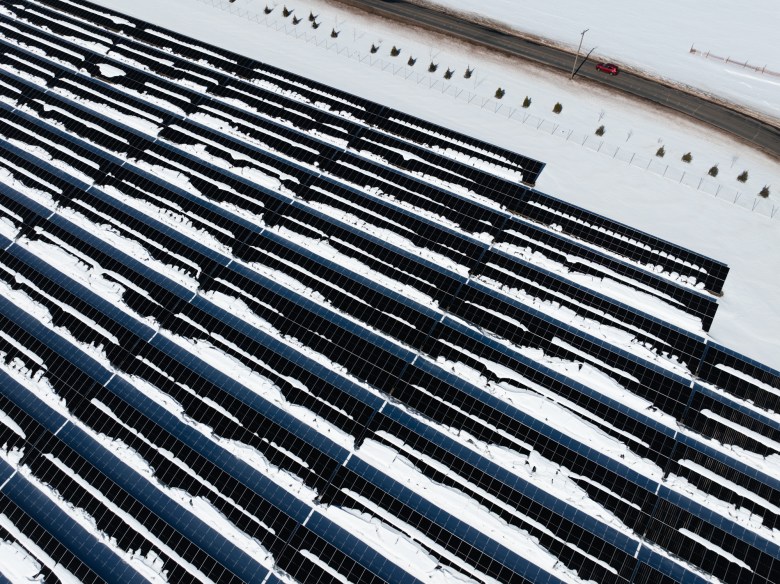
Frigid temperatures also prevented snow from melting off of solar panels, further scrambling the mix of resources needed to power the grid.
“I think what was kind of atypical is how long it went on,” Kakley said. “That level of long-duration cold snap we probably haven’t seen in New England since 2017-2018. And so what we’ve kind of been saying is that this is the most stressed the system’s been since then, so almost a decade.”
Others said that the sheer scale of the weather system — which at its peak stretched across 2,000 miles — made an impact unprecedented in recent memory.
“This has been the most logistically strained situation to get the right supplies to power plants that I have seen in my career,” said Dan Dolan, the president of the New England Power Generators Association. Dolan has worked in the industry for two decades.
Low temperatures pummeled the energy grid — in more ways than one
Throughout most of the year, New England relies heavily on natural gas brought in by pipelines to fuel its power generation. Whenever temperatures drop below freezing, however, the availability of that gas becomes constrained as it is burned in furnaces to keep homes and other buildings warm.
As a result, gas prices increase, making it less economical as a fuel source for power plants. That’s when the demand for oil kicks in.
Dolan said one of the unique challenges from this period of cold is that it affected power plants all along the Eastern Seaboard, not just in New York and New England.
As plants exhausted their supplies of oil to keep up with grid demand, they had to compete against other facilities in states like Maryland and North Carolina for fresh deliveries of oil via barge, trucks and tanker ships, Dolan said. Power plants in Connecticut typically utilize two types of oil: lighter, distillate oil is used by new dual-fuel plants, while older peaker plants tend to rely on heavier, tar-like oil also known as “bunker fuel.”
“It has actually taken an extra level of logistics scheduling, trying to order and set units up to be able to hit multiple facilities at once,” Dolan said.
The spot market price for wholesale electricity in Connecticut skyrocketed multiple times during the winter storm, driven up by high demand and the compilation of constraints facing the grid. For example, on Jan. 24, the marginal price of electricity during one five-minute interval reached a peak of $872 a megawatt hour, more than five-and-a-half times the monthly average of $155. (Supply rates in electric bills are typically established through longer-term contracts for electricity, so customers are insulated from such price spikes).
Data from ISO New England shows that the situation was compounded by the low functionality of solar panels. Extremely low temperatures curbed snow melt and stunted solar energy generation for days following the storm.
Mike Trahan, the executive director of Connecticut Solar & Storage Association, said such situations do pose a challenge for the industry, even though they are rare.
“Snow followed by cold can be problematic, especially for rooftop systems that sit flat on the roof. Those are the last ones to shed snow and reach their full efficiency,” Trahan said. “I think it’s accurate to say that this most recent cold snap was uncommon, and we probably haven’t had this kind of weather, based on what I read, in a decade.”
ISO New England measures the production of larger solar arrays that distribute power directly onto the grid. However, most rooftop solar panels operate behind-the-meter, meaning their output is not recording in generation data. Instead, ISO New England uses its own estimates to determine how much the demand for power off the grid is being replaced by behind-the-meter solar.
“The cold weather will drive natural gas prices high, and so that will make oil more economical. At the same time, demand on the system is higher because we’re not seeing as much as we did a week before from solar panels, because they’re covered in snow,” Kakley said. “We can see very cold weather without any snow, and that’s not going to impact the solar panels very much. But this was kind of a two-fer, so to speak.”
Not all renewable and clean-energy sources suffered as much as solar during the storm and subsequent cold weather. Nuclear performed at a near-constant output, meeting about one-quarter of the region’s demand.
Wind power also helped to pick up some of the slack from slumping solar production, reaching a peak of 29,854 megawatt hours of electricity on Jan. 30 — nearly nine times the amount produced by grid-scale solar. While ISO New England does not distinguish between offshore and onshore turbines in its wind data, Dolan said that Vineyard Wind — the partially-completed wind farm off the coast of Martha’s Vineyard — performed well during and after the storm.
“The anecdotal [evidence] is that it did, across the three weeks, produce a lot of energy,” Dolan said.
The amount of wind power could have been even greater if a second project, Revolution Wind, had come partially online before the storm. That project is expected to begin producing power in the next several weeks, according to developer Ørsted, after facing several delays due to stop-work orders from the Trump administration.
Planning ahead
The complications paired with the storm bring up multiple questions, as well possible solutions for dealing with similar winter weather events in the future.
For solar, Trahan said the impact from snow usually dissipates once it melts in a few days. Building more battery facilities to store that power for times of need would help the grid withstand temporary losses in solar production. He also said that would help to eliminate the need to burn oil during the coldest days of the year.
“The use of those peakers is concerning for those people who live around or live downwind of peakers, myself included, and that’s certainly that’s a health concern,” Trahan said. “If we’re looking for ways to avoid the use of those peakers … one of the ways to do that is to increase the use and the deployment of storage.”
Kakley said that ISO New England conducts rolling 21-day-ahead forecasts of weather and fuel supplies to ensure that generators have the resources necessary to keep their plants running.
“When you see this period of cold weather, if you get adequate replenishment of oil, you can kind of keep running the system that way for a long time,” Kakley said. “But where is that going to go? Are you going to use the oil faster than it can be replaced?
Dolan said there is “no silver bullet.” He said every little bit of extra energy generation helps, including renewables and new imports of hydroelectricity from Canada.
While he pointed out the problems that came with the extreme weather, Dolan also mentioned the resilience of the system through the high-demand days.
“Yes, there are tremendous emissions consequences. Certainly, prices have been way more volatile than is normal, but we have not seen a single major reliability issue on the system in some of the most severe weather that we’ve had in about a decade,” Dolan said. “I think that’s a testament to the extraordinary work and coordination occurring.”