


Gov. Ned Lamont has proposed a state-run graduate student loan program that would replace federal loans for professions like nursing, physical therapy, social work and education.
The Connecticut Supplemental Graduate Student Loan Program, part of Senate Bill 85, would give students continued access to low-interest loans, according to a press release from Lamont’s office. This comes after President Donald Trump’s One Big Beautiful Bill Act overhauled the federal student loan system, changing which degree programs are eligible for the higher-limit, lower-interest loans.
The loan program would be financed by $10 million in bonding and administered by the Connecticut Higher Education Supplemental Loan Authority (CHESLA), a quasi-public state authority providing Connecticut students with cost-effective financing for higher education.
“For decades, lower and middle-income students have depended on these low-interest loans to seek careers in good-paying professions, and now these recent federal changes are going to make graduate programs out of reach for many students who dream of pursuing a graduate degree,” Lamont said at a Thursday press conference introducing the initiative.
The federal law changes the definition of a “professional” degree. While the U.S. Department of Education has yet to release a comprehensive list of its defined degrees, Title 34 of the Code of Federal Regulations’ list of professional programs includes pharmacy, veterinary medicine, law, medicine and theology, among others.
Starting in July, students pursuing professional degrees would be able to borrow up to $50,000 annually, up to $200,000. Graduate degrees not deemed professional — including nursing, physical therapy, public health, doctorates of education and social work — will have a stricter limit: $20,500 annually or $100,000 total.
The Department of Education is also eliminating Graduate PLUS loans for new borrowers. This program offered federal student loans for graduate programs up to the full cost of tuition.
Lamont said he worries that the federal government’s changes are going to steer students away from pursuing graduate degrees not defined as professional.
“We actually should be doing more to encourage people to enter these fields,” Lamont said in his press release. “Creating this loan program at the state level is a way that we can help ensure that the opportunity for people to seek graduate degrees is still obtainable and not only for those whose families have the means.”
In a fact sheet released in November, the Department of Education said that “professional degree” is only an internal definition used to decide which programs qualify for higher loan limits, and is “not a value judgement about the importance of programs. It has no bearing on whether a program is professional in nature or not.”
Still, nurses across the country felt the sting of exclusion from their initial definition. Alisha Morrell, a registered nurse and AFT University Health Professional union member, said that more debt from higher education means patients will get less care.
“When the same politicians who called us heroes during COVID now say nursing isn’t a profession, it’s a slap in our face,” she said in a video with Code Red CT.
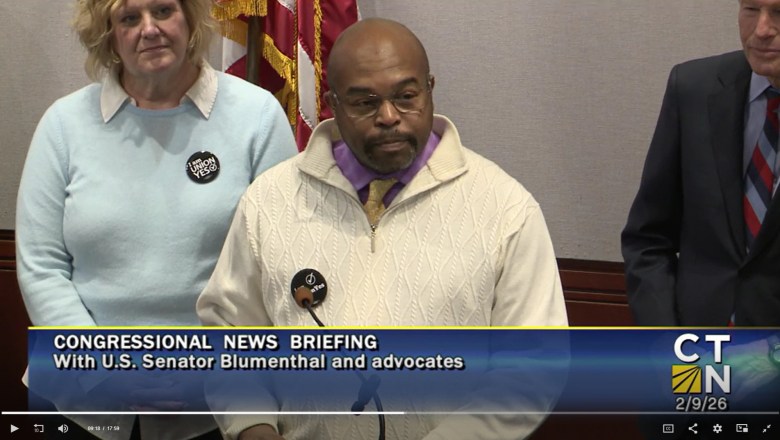
Educators and social workers were also angered that they were excluded from the federal government’s professional degrees. Vice President of Hartford Federation of Teachers Corey Moses said at a press conference that the loan caps leave prospective educators asking: “‘Do I wish to make a change or make a living?’”
“Mounting costs of education, living expenses and life choices make this vocation more and more difficult without funding and adequate resources to combat the shortages and answer the call,” Moses said at a press conference on Monday. “This deprofessionalization hits at the core that everyone should be able to follow a dream and be economically prosperous. Educators in this vocation took on a vow of charity and not poverty.”
Health care unions and other professional organizations in Connecticut celebrated Lamont’s proposed loan program, citing a pressing need to grow the health care workforce.
“The governor’s proposal recognizes what is at stake and will help mitigate some immediate impacts on current and aspiring providers,” said Jennifer Jackson, CEO of the Connecticut Hospital Association, in a press release. “It also serves as an important reminder that sustained, long-term solutions are essential to ensure Connecticut can continue to educate, recruit and retain the compassionate, highly skilled health care workforce on which our communities depend.”
Jackson said the new loan program will support “attainable pathways into high-demand fields” rather than create barriers as she says the federal government has.
Elizabeth Higgins, a registered nurse and University Health Professionals member, said at a press conference in early January that a CHELSA expansion would help people learn and stay in Connecticut.
“This is what good policy should do: Recognize a real need and respond in a way that strengthens people and communities,” she said. “Expanding [CHELSA] simply allows that program to do what it was built to do: help people who learn here, build their lives here and give back to Connecticut without being crushed by cost.”
Lamont’s proposal and the rest of Senate Bill 85 is currently under review by the Finance, Revenue, and Bonding Committee. A public hearing is expected to be scheduled in the next few weeks.