



|
Getting your Trinity Audio player ready...
|

Ted Stone doesn’t need to do much stretching.
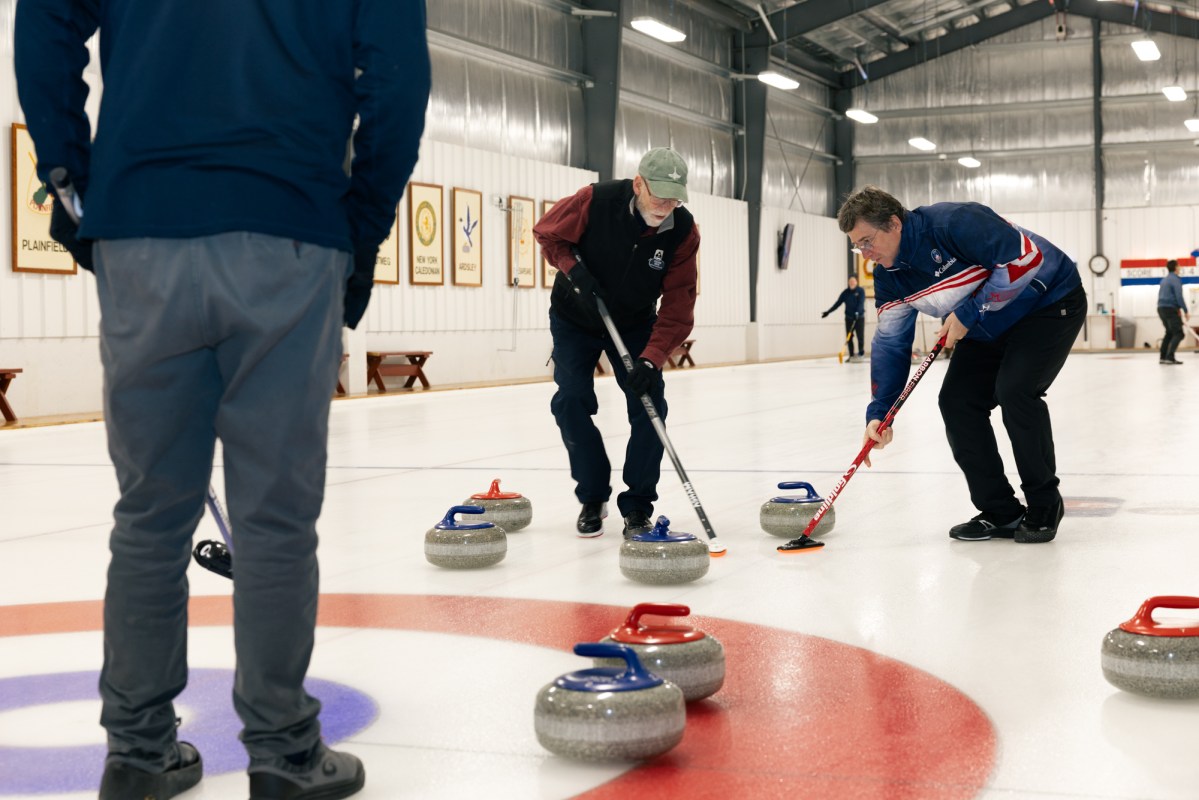
He’s 87 now and was watching a dozen younger men and women go through the pre-match limbering-up routine at the Norfolk Curling Club one wintry evening last week.
Stone, who has been curling for 64 years, said he’s acquiesced to Father Time and graduated to “the stick,” a device that allows him to glide stones down the 150-foot-long sheet of ice from an upright position — not the one-legged tuck favored by the young and seen on the Olympics.
A few flakes were falling outside, but the talk inside wasn’t about the weather. It was about how Sweden nipped the United States in the mixed-doubles curling gold medal match on the last stone earlier in the day.
Every four years, people across Connecticut rediscover curling — and the Norfolk Curling Club, about an hour northwest of Hartford in good weather — when the Winter Olympics are televised.
It’s one of those quirky sports that might encourage even the most committed couch potato to think “I could do that.” But it takes talent and practice to properly propel a 42-pound granite rock (hewn from one specific island off Scotland) down the ice, to say nothing of the touch required by the players who furiously sweep the ice in front of it to change its speed or “curl” its trajectory.
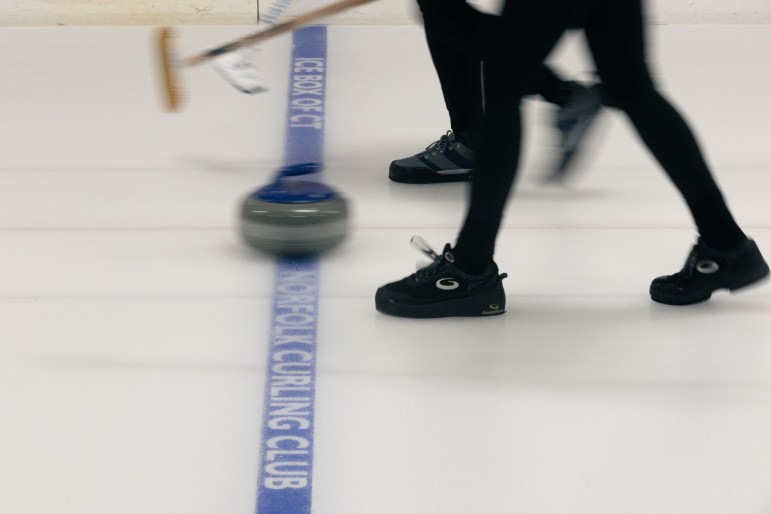
As the club celebrates its 70th anniversary, this year has been no different. More than 100 people are signed up to take a beginner’s curling class in the next three weeks, according to Peter Langan, the club’s president.
How many stick with it is another matter.
“Every four years, there will be people sitting in bars, watching the Olympics and saying they want to try curling. And most never do, but we do get some who try it and become members,” said Jonathan Barbagallo, the club’s ice technician, whose family members have been club members for decades.
That includes his 18-year-old daughter Samantha, who was stretching with the others in preparation for Tuesday night’s games.
The group also included a few from Lenox, Mass., who came for a 50th birthday party years ago at the club and never wanted to leave; a husband and wife from nearby Canaan who’ve been members for 35 years and never play together because “they argue too much,” and Langan, the club’s president a relative newcomer who joined during COVID when he stopped in after hiking along the nearby Appalachian Trail.
“I walked in and talked to a couple of members at the bar and joined immediately, even though it was a few months before I would even get on the ice to learn,” Langan said.
The 2011 fire
Tim Egan is one of the Lenox crew who makes the hour-long drive twice a week to curl. The 76-year-old and a group of about 10 friends have been members for over 12 years now. Egan said they all got their first taste of the club at a birthday party back in 2011.
“On a lark, we decided to have a friend’s 50th party at the club, and we all fell in love with the game and wanted to join,” Egan said.
But their membership was delayed.
One night just before Christmas in 2011, two local men set the club on fire after going on a crime spree in town, according to court documents. They were sentenced to 10 years in prison.
Deborah Lane-Olson was the treasurer of the club when the fire occurred.
“I remember a bunch of club people standing outside the ruins and saying, ‘What do we do now?'” Lane-Olson said. “There were a lot of people who didn’t come back, but there was a core group of 20-25 people who rebuilt it.”
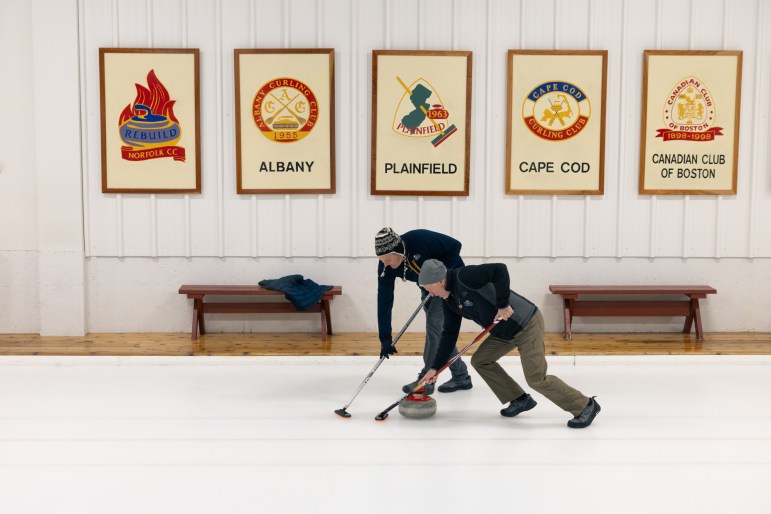
She said curling clubs from all over the country, but particularly from New England, chipped in funds. It took two years and about $1.6 million to build the new 12,500-square-foot club, which is about 2,500 square feet larger than the old one, which was partially wooden and dated back to 1956.
“It’s pretty amazing what we have now,” Lane-Olson said.
Labor of love
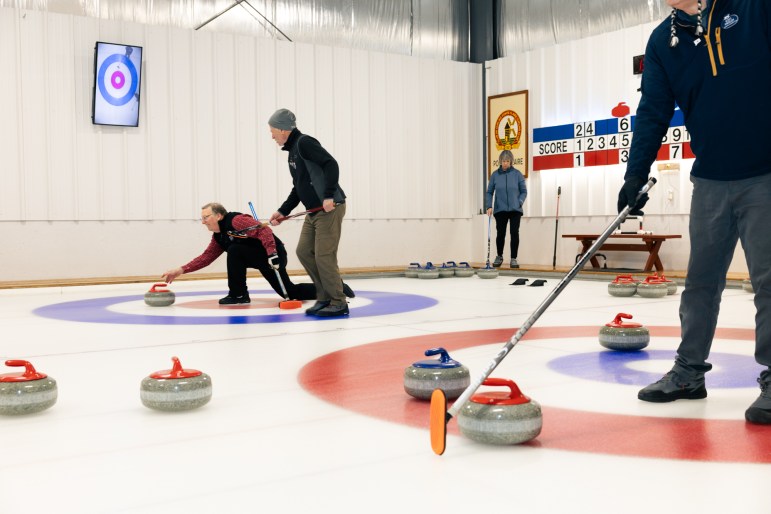
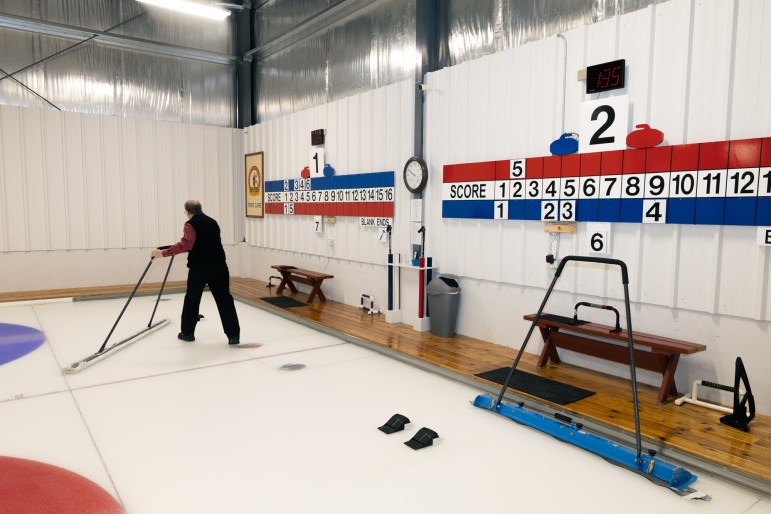
What they have now is more than just two sheets of ice with the familiar 12-foot circular targets, known as the “house,” on each end. There’s also a bar, a viewing area and men’s and women’s locker rooms.
The old club used a compressor bought second-hand from a Torrington ice cream shop to keep the ice cold, but the new building has state-of-the-art equipment to help maintain the ice for the season, which runs from October through April.
On league nights, Barbagallo and his fellow ice technician Michael Ventress prepare the ice for play.
First, they scrape it with a special machine and then “pebble it” by spraying two coats of hot, ionized water over the entire surface to create tiny bumps on the ice.
The bumps, which one member said look like tiny Hershey kisses, reduce the friction when the stones glide, making them easier to guide, or curl.
It’s a labor of love for Barbagallo, who has been a club member since he was a teenager. He has passed it on to his daughters.
Barbagallo said he fell in love with the game because, while it’s an individual sport, there’s also teamwork needed to succeed.
“It fit well with the sports I played in high school, like tennis, which were individual sports,” Barbagallo said. “Plus, I liked that I was pretty good at it.”
Barbagallo, along with his daughters and his father, play as a team in a Friday night league. Until recently, they were undefeated this season, he said.
Hoglines, hacks and grippers
The Norfolk Curling Club is one of two in Connecticut. The other is the Nutmeg Curling Club in Darien. The two play a “friendly” every year, and the winner gets to keep a small trophy at their clubhouse, Langan said, begrudgingly admitting the trophy currently sits in Darien.
Langan said Norfolk has about 115 members, although not all actually curl; some are content to watch the action from the club’s bar. That’s nearly double the members from the year of the fire.
A match takes about two hours. Each team has four players who throw two stones each. Inside the arena, it’s cold — about 40 degrees — and many people wear dark blue hooded sweatshirts or jackets with “Norfolk Curling Club” insignia as they play.
The sport has a language all its own.
The bullseye in the middle of the house is called the “button,” and the two buttons are 114 feet apart.
The goal is to slide as many of the eight stones as possible close to the button. The two teams alternate shots, and there’s often quite a bit of knocking each other’s stones out of the circle. A game lasts eight “ends.”
A “hack” is the rubber foothold curlers use to push off before releasing their stone. A “gripper” is a specially formulated rubber that you place over your shoes to provide traction on the ice. A “bonspiel” is a curling tournament usually held over a weekend where clubs come from all over to play multiple games.
There are two “hog lines,” one marking the spot before which a curler must release their stone, and the other on the other end of the sheet that the stone must pass for it to count.
A “skip” is the captain of the team, who shoots last and guides the other three players where to aim their shots.
The skip can be heard yelling “sweep” or “don’t sweep” or “hurry,” a command to the two sweepers that means to sweep faster in front of the stone as it makes its way down the ice. Sweeping can either speed the stone’s journey or redirect or “curl” it towards the house.
Fairy rocks
The curling stones the players were using Tuesday in Norfolk were made in the same place as the ones used in the Olympic games. They all come from a tiny island called Ailsa Craig, which roughly translates as “fairy rock” in Gaelic.
The island is about 10 miles off the coast of Scotland and is basically a giant mound of granite sticking out of the ocean. No one lives there anymore, aside from gannets and puffins.
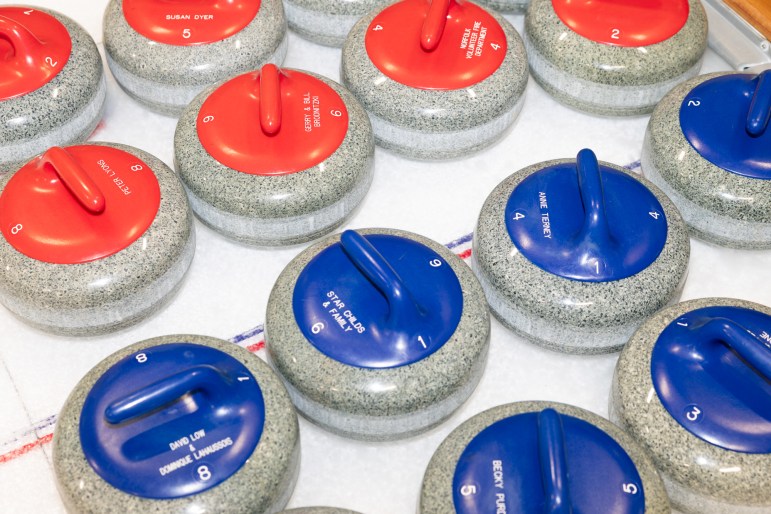
One company has the rights to remove the granite from Ailsa Craig and make the stones. Langan said the granite is unique because it is strong enough to withstand the constant smashing that occurs in a game.
The stones can cost up to $500 each, so no one owns their own. The club purchases them. One of the biggest losses during the fire was all of the club’s curling stones.
Barbagallo, who is also a long-time member of the town’s volunteer fire department, said he could hear the stones exploding as the building burned. Remnants of two of them now sit by the club’s fireplace.
‘Way too many arguments’
Both matches on this Tuesday came down to the last end and finished in a tie. Because it wasn’t a tournament game or championship game, they didn’t have a winner-take-all extra end.
Lane-Olson and her husband Terry were playing on different sheets this time. The two have been members for nearly 35 years. One day they saw the sign for the club out on Route 44 as they were passing through town and decided to check it out. They’ve been members ever since.
“When we joined the club, it was small — both the building and the number of members,” Lane-Olson said. “We liked that it was both a physical and intellectual game, trying to figure how to play certain shots.”
The couple never curls on the same team anymore.
“We learned very early on that we got into way too many arguments about who was right about how to play a particular shot and that it was better to play against each other than on the same team,” Lane-Olson said.

There are traditions to the sport. Everyone shakes hands when a match ends and then retires to the bar, where the winners are supposed to buy the losers a beer. Since both of Tuesday’s matches ended in a tie, there was a little uncertainty as to who buys the beers.
Stone sat next to Langan, who marveled at how Stone has been curling longer than he’s been alive.
Stone said he started playing in 1961 because of his parents. At first, he didn’t like the game much.
“I stunk, so I hated it,” Stone said. “But I started copying what some of the good players were doing, and I got better.”
Stone guesses he’s visited 30 or so curling clubs around the country, the most recent the club in Duluth, Minn., the home of the United States mixed doubles team that just missed gold.
Stone said he’s been “thinking about retiring” before mentioning he’ll be back for his regular Sunday morning league.