


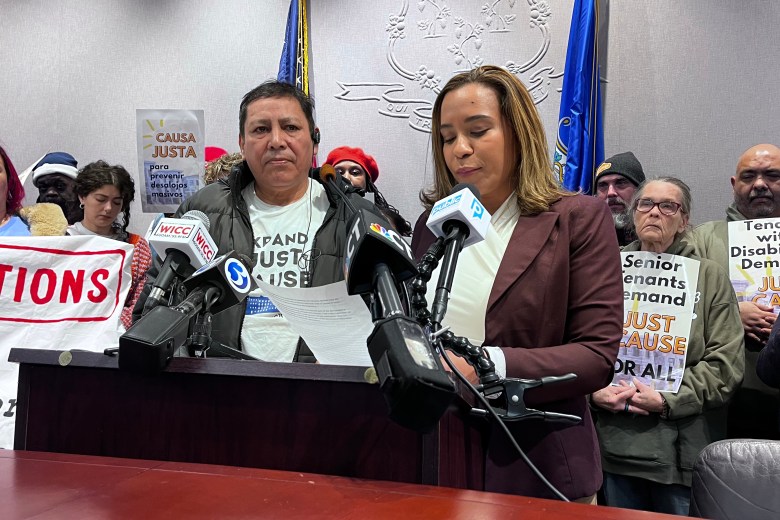
Renters rallied in Hartford on Tuesday in favor of eviction reform and lawmakers who spoke at the gathering talked about their new strategy for trying to pass a law to largely end no-fault evictions — ask the Senate to take it up first.
In past sessions, the bill has gone first to the House and hasn’t been called for a floor vote. So lawmakers said they will route it through the Senate first this year. No-fault or lapse-of-time evictions typically occur at the end of the lease, and tenants argued at the rally that these types of evictions are often retaliatory or discriminatory.
“Too many people believe eviction is a personal failure, instead of what it really is: a policy failure,” said Sun Queen, a New Haven tenant and activist. “Eviction is not an individual problem. It is a structural one. It is what happens when housing is treated like stock portfolios instead of human survival.”
This type of protection already exists for people with disabilities and seniors in Connecticut. Tenant advocates want to see it expanded to include a larger population.
Landlords and Republican lawmakers have argued against this change, saying it violates landlords’ property rights. At a press briefing earlier this year, members of the Connecticut Apartment Association, which represents landlords, said they use no-fault evictions to get rid of problem tenants who do things like make too much noise or smoke in non-smoking areas.
“The end of the lease is a time when both parties can say, ‘hey, I want to stay,’ or ‘hey, I want to go,’” said Lauren Tagliatela, a Connecticut landlord and member of the apartment association. “We use lapse of time very judiciously and very rarely, but it is an important tool to have.”
Housing Committee co-Chair Rep. Antonio Felipe, D-Bridgeport, said the proposal is a key part of ensuring affordability for renters. Many tenants have said that new landlords will buy buildings and push tenants out en mass so they can raise the rent.
“All I’m going to say is, if you can’t see the correlation between this and affordability, open your eyes,” Felipe said. “If you can’t see the fact that we have a rising homeless population along with the rise of rent, open your eyes.”
Homelessness has been increasing for the past few years in Connecticut. From January 2024 to January 2025, homelessness rose by about 10% statewide, according to an annual census of the population.
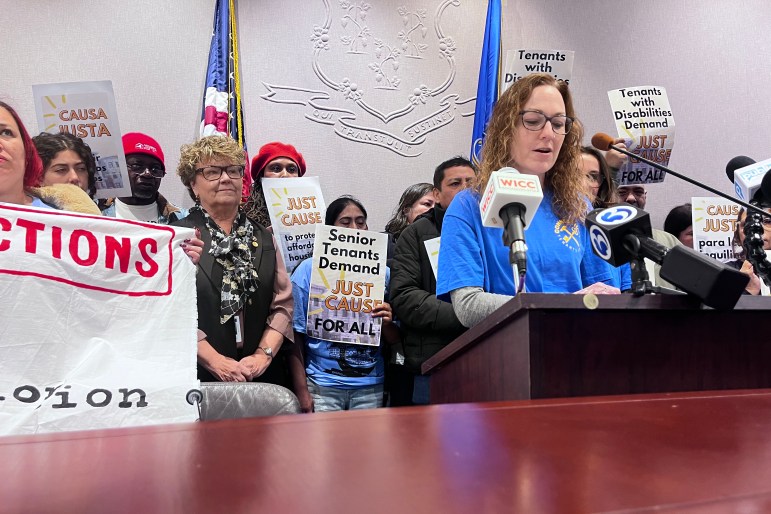
Housing Committee co-Chair Sen. Martha Marx said she won’t leave the committee until this bill passes.
“The eviction laws that we have in Connecticut right now are nefarious, and we need to make sure that everybody in our legislature — all those that vote against it — that everybody in their community knows what they voted against, because this is an election year,” Marx said.
Stephanie McHugh, a New London tenant union member, said out-of-state landlords especially are buying up properties and raising rents or evicting existing tenants.
Wilfredo Parra Aguilar, a Hartford tenant, said at Tuesday’s rally that no-fault evictions are also used to retaliate against renters who complain about “deplorable conditions,” as well as to discriminate against tenants based on immigration status.
“Unfortunately, it is not possible to count how many immigrant families are evicted without a cause, because many times we’re forced to leave early to avoid conflict or retaliation,” said Parra Aguilar, speaking through a translator. “There are families today who share a couch or a single room to keep moving forward and not end up sleeping on the streets.”