


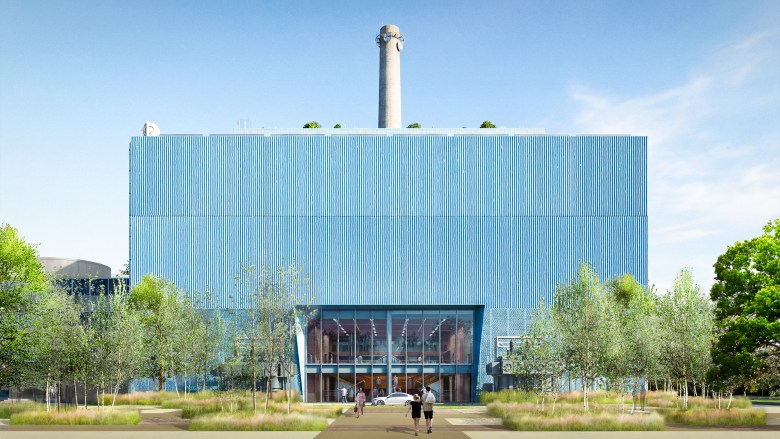
While out kayaking one afternoon near the entrance to Norwalk Harbor, Austin and Allison McChord found themselves drawn to the boxy, blue frame of the decommissioned power plant that has stood for decades on a prominent point overlooking Long Island Sound.
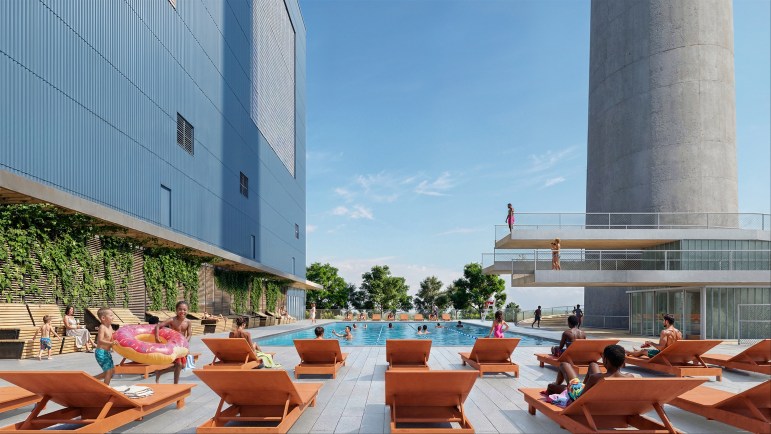
Over the last few years, the couple has invested tens of millions of dollars into a plan that would develop the site on Manresa Island into a public park centered around the old Norwalk Harbor Generating Station, which would be equipped with a community swimming pool, open-air cafes and a large event space.
While other efforts to refashion power plants into public spaces have largely focused on older, Art Deco buildings located near downtown areas, the McChords said they see potential in the more spartan aesthetic of the 1960s era coal- and oil-fired plant, which is surrounded by acres of forest.
During an initial visit to the site, Allison McChord recalled being struck by tile floors in the administration building and its narrow ribbon windows, an architectural element she described as a “trapped-in-time relic.” Walking into the cavernous turbine hall, she said her thoughts turned to its potential as a gathering spot.
If successful, the couple said they hope the project will serve as a model for similar structures along the East Coast that are nearing the end of their useful lives.
“I feel like there’s sometimes a sort of negative stigma to them, and that overwhelms the actual potential of those spaces and what they could be for the community, or the the greater region,” Allison McChord said.
On Thursday evening, the McChords unveiled their “final vision” for their ambitious revitalization project — now known as Manresa Wilds — to a crowd of several hundred gathered at Norwalk’s Maritime Aquarium, about a mile from the power plant. (Despite having “island” in its name, the property is actually located on a peninsula that was expanded while the plant was in operation.)
The revisions to the initial design announced at this week’s meeting included scaled-back plans for attractions such as a playground and active harbor, in favor of more natural landscapes and “passive” recreation areas. This was done in response to concerns expressed by some local residents about the amount of traffic that would be drawn to the site, according to project planners.
The first phase of the project, an area of walking trails, meadows and an outdoor classroom known as the “Northern Forest” is expected to open in 2027.
That will be followed by an extensive remediation effort on the rest of the property, beginning in 2028, to remove coal ash and other contaminants left over from decades of industrial use. In addition, the developers plan on clearing invasive plants and replacing them with native species. Austin McChord said the clean up effort and site preparation is expected to cost $410 million, funded entirely by a charity he and Allison established to oversee the park’s development.
“We are aware we are, you know, in pretty deep here,” he said.
Austin McChord, a native of Newtown, sold his data protection company Datto for $1.3 billion in 2017. He and his wife have already spent about $45 million to purchase the property and develop plans for the park. He declined to say how much it will cost to actually build some of the proposed facilities such as the pool, beachfront promenade and kayak launch, other than to say the estimate is less than the cost of remediation.

The Connecticut Department of Energy and Environmental Protection issued a stewardship permit for the McChords’ charity, Manresa Island Corp., on Dec. 31, outlining the next steps to investigate and clean up pollution on the property.
In a release handed out to reporters following Thursday’s forum, the developers touted the endorsements from state and local officials including Gov. Ned Lamont and Norwalk Mayor Barbara Smyth.
“Manresa Wilds is an innovative example of Connecticut at its best — bringing new life to historic spaces and creating something lasting for future generations,” Lamont said in the statement. “This project cleans up legacy pollution, restores the shoreline, and opens extraordinary waterfront land for the public to enjoy.”
Daniel Sundlin, a partner at Bjarke Ingels Group who worked on the design for the plant building, said during Thursday’s meeting that his firm received comments from many residents wondering why the developers wanted to preserve the hulking power plant.
“This is a magnificent structure, it’s built to last for generations,” Sundlin said, adding that the original construction used more than 4,600 tons of steel and 21,000 tons of concrete.
The power plant consists of an administrative building, turbine room and boiler building. It ceased operations in 2013, after being damaged by flooding during Hurricane Sandy.
The current renovation plan would transform the turbine room into an event space featuring some of the machinery left behind by the plant’s former operator. The administration building will feature a cafe, terraced restaurant and breakout rooms.
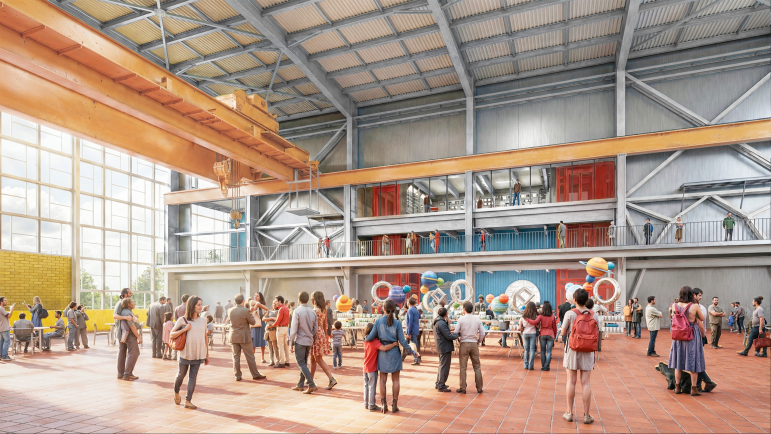
The boiler building, the largest of the three structures, will remain undeveloped through the currently planned phases of construction, which are scheduled to be completed in 2035. Potential future uses of that building include classrooms, an indoor play space or an oceanographic institute.
While some of the project’s earlier renderings showed the power plant wrapped in a transparent glass exterior, Sundlin said the current plan is to preserve most of the existing corrugated metal facade on the turbine hall building, which is painted in its own shade of “Manresa blue.”
On the lower floors of the turbine hall, he said, the facade will be replaced with a screen allowing for light to filter into gathering spaces, and for guests to see out. Sundlin said that no decision has been made yet on the exterior of the boiler building — which will be preserved and sealed off from the turbine hall until plans for its development are finalized.
The plans presented at Thursday’s meeting elicited generally favorable reviews, with several residents in attendance crediting the McChords for responding to local feedback.
Tod Bryant, a historic preservation consultant from Norwalk, was among those who supported the couple’s vision for incorporating many aspects of the power plant’s industrial past into the design.
“It’s a Bauhaus-like structure to begin with, and they’re really throwing tons of Bauhaus at it, including all the colors,” Bryant said. “I think it’s fabulous.”
Carolyn Wheeler, a resident of East Norwalk across the harbor from the power plant, called the project a “great gift” to the community and said the revisions addressed some of her concerns about the amount of traffic and crowds of people that might be attracted to the park.
“I’ve been a big fan from the beginning, but I remember worrying a little bit about some of the climbing walls and all that kind of stuff that they initially had,” Wheeler said. “Now I feel like it’s the right kind of activities that they have, the outdoors activities.”
James Connelly, another resident of East Norwalk, said his only hangup over the design was the decision to keep the plant’s 350-foot-high smokestack, which he would like to see lowered and turned into some other feature such as a lighthouse.
“You’re looking at it, it’s a smokestack, it represents pollution,” Connelly said. “A nice lighthouse… would be beautiful, an maybe observation deck.”
The executive director of Manresa Island Corp., Jessica Vonashek, said that while the concepts and renderings presented at Thursday’s meeting represented the final “vision” for the project, she said community feedback will continue to be incorporated during the design, construction and eventual operation of the park.
Speaking to the Connecticut Mirror following the event, Austin McChord said in the long term, he hopes the Manresa Wilds project will encourage other creative uses for similar power plants as they power down.
He pointed to ongoing discussions over the future of decommissioned power plants in Bridgeport and New Haven, where officials have already announced plans to tear down English Station and replace it with a public park and pool.
“So many of these [plants] are ready to begin this transformation into a future life,” McChord said. “We’re not saying that every power plant will do everything that we do… we hope that they copy our notes and don’t make the mistakes that we make, and learn from our successes.”