


The state could spend more than $60 million to expand and upgrade the Office of the Chief Medical Examiner and eliminate a space crunch that has risked its accreditation and led to office storing bodies awaiting autopsy in refrigerated containers behind the Farmington building.
“Our autopsy numbers have literally doubled in the last 10 years or so, and we don’t have enough storage space for bodies,” Chief Medical Examiner James Gill said. “We have four autopsy tables, where an office our size like New Mexico, with a population of 2 million, they’ve got 12 autopsy tables.”
The state approved $28 million in 2021 for the project, Gill said. Gov. Ned Lamont proposed $34.6 million for the expansion this year.
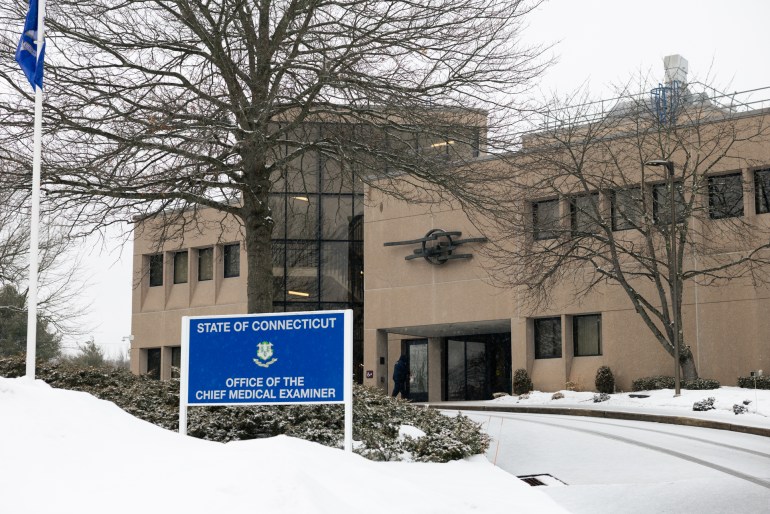
The medical examiner’s office, built in 1989 on Shuttle Road in the shadow of the UConn Health Center, would nearly double in size, according to the request for proposals recently advertised by the state.
Under the plan, the current 31,800-square-foot building would be completely renovated and upgraded after a new 20,000-square-foot addition is built behind the current facility.
Gill said the renovations are long overdue because the space crunch and lack of autopsy tables has impacted the office’s national accreditation.
“The building is 40 years old, and we’ve just really kind of outgrown this space, and it’s affecting our national accreditation, which has been downgraded because of the facility issues,” Gill said.
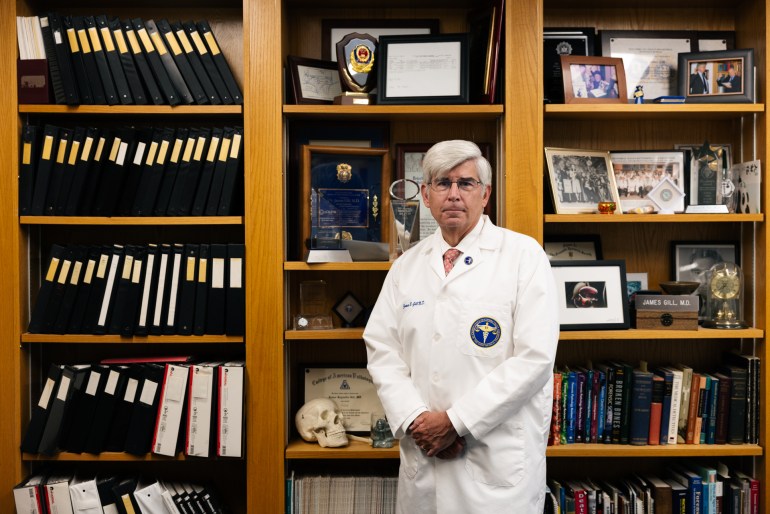
Last year, the office conducted more than 2,700 autopsies. The facility now has storage space for about 100 bodies, including a refrigerated container, that will double when the renovation is completed.
The number of autopsies handled by the office started increasing in the mid-2010s and peaked during the COVID years. Between 2020-2023, the office averaged more than 3,000 autopsies a year, with a high of 3,252 in 2021, according to data from the OCME.
Those numbers have dipped some during the past two years. In 2024, the office conducted 2,747 autopsies. Storage of bodies also was a bigger issue during COVID, when the office needed three refrigerated containers.
“At some one point, we had I think 170 to 180 bodies stored here, so we definitely need the 200-body storage capacity,” Gill said.
The medical examiner’s office does not review every death in Connecticut. Gill said there were about 33,000 deaths in the state last year.
Gill has gone before the Appropriations Committee repeatedly over the years seeking more funding — first for more pathologists, as there were only five when he became the chief state’s medical examiner in 2013. There are now nine.
Gill said the expansion plans have grown since about the state approved $28 million in 2021. The governor has proposed an additional $34.6 million, but that would have to be approved, or modified, by the legislature.
Besides investigating any death requested by law enforcement or any death at state-owned facilities, the office also reviews cremation applications. Those reviews have increased sharply since COVID. In 2019, the office conducted about 19,000 cremation reviews; that number was 22,450 in 2025, records show.
“The vast majority of the reported deaths to us are for cremation reviews,” Gill said. “Before a body can be cremated, we need to investigate the death to make sure it is not a medical examiner case.”
During COVID, as the deaths mounted in nursing homes across the state, it was common for the medical examiner to delay a cremation of a person who died in a long-term care facility to first determine if the person died as a result of COVID.
Besides the building expansion, the plans call for adding a secure entryway and a road connecting the offices directly to Route 4.
The state hopes to choose a contractor by the summer. The construction will have to be done piecemeal because the office will remain available 24 hours a day, seven days a week.
“The plan is to build a new autopsy room and refrigerated storage building behind our current building that would then connect to ours,” Gill said. “I would have loved to have a new building, but it just wasn’t cost effective.”