


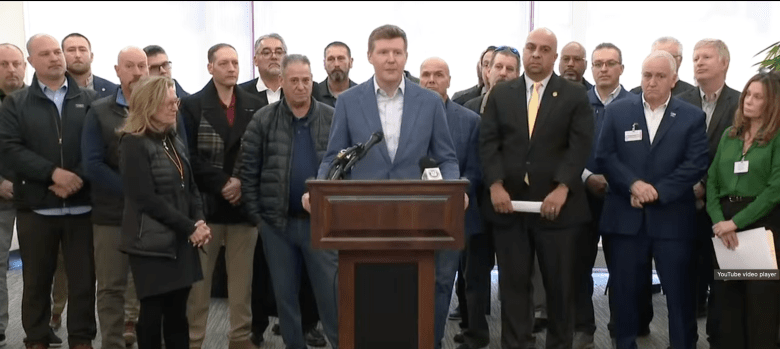
State Comptroller Sean Scanlon is backing legislation that would cut off companies that commit wage theft from contracting with the state.
The comptroller is putting his support behind Senate Bill 268, which contains several measures to root out wage theft — that is, when an employer does not pay an employee wages they’ve earned. Wage theft includes instances when an employee is paid for fewer hours than they worked or not given certain benefits; in other instances, employers steal tips or force employees to work during off hours.
Under the bill, the comptroller’s office would have the power to withhold payment from state contractors that are under Department of Labor investigations for wage violations until the investigation has concluded.
This is the second year in a row the Comptroller’s office has pushed for this legislation. Last year, a similar bill cleared the Senate but was not taken up by the House.
“The premise of this is really simple: We shouldn’t be rewarding companies with taxpayer dollars who are not rewarding their employees and their workers with fair wages,” Scanlon said during an afternoon press conference.
Lawmakers also expressed determination to pass the bill this session.
“People should be able to go to work, get paid fair wages to come home safe and not have to worry about being robbed by an unscrupulous contract,” Sen. Jorge Cabrera, D-Hamden, vice chair of the Labor and Public Employees Committee, said during the press conference. “So let’s get it done.”
For years, state officials have struggled to get their arms around the issue. Many of the state’s most vulnerable workers continue to miss out on receiving their full paychecks or are misclassified as independent contractors by their employers, advocates say. Over the years, that has cost Connecticut workers millions of dollars.
In 2024, the state Department of Labor reported a backlog of around 1,000 wage theft cases, with some waiting several months before they were examined by the state. The DOL has requested more wage-and-hour investigators to help deal with the backlog, but it has faced difficulty getting legislators to agree to the request, which would require more funding for the agency.
Joined by state lawmakers, union advocates and representatives of construction and building trade groups, Scanlon and other speakers described how passing S.B. 268 would be a critical step towards protecting victims.
“This is about accountability,” said Joelyn Leon, the executive director of the Foundation for Fair Contracting of Connecticut. “When public dollars are being used to fund the construction project, those dollars should go to companies that are performing the work, follow the law and treat their workers with respect and fairness.”
Others said the bill would help bring Connecticut’s wage theft laws more in line with other states.
“We are so far behind our neighboring states that people are being disbarred from neighboring states, and then they’re setting up camp in Connecticut,” said Joe Toner, executive director of the Connecticut Building Trades Council.
The problem of wage theft in the state goes back years. Previous reporting from the Connecticut Mirror has found that there were more than 13,000 complaints filed with the state Department of Labor between 2019 and 2023. Almost $17 million in wages has been returned to workers after these complaints were investigated.
The issue affects workers in the hospitality, retail and construction industries, in particular. Wages are more likely to be stolen from vulnerable workers in the state, including undocumented workers, women of color, workers with disabilities and those reentering the workforce after incarceration.
Speaking on Tuesday, local advocates noted that involving the comptroller’s office could be a powerful way to help on the issue.
“Wage theft does exist. It is a part of how unscrupulous companies make money,” said Kimberly Glassman, the director of compliance and government affairs for the International Union of Operating Engineers Local 478. “These [legislative] proposals help deter companies from breaking the law and from hurting working people here in the state of Connecticut.”
At a public hearing before the legislature’s Labor and Public Employees Committee Tuesday afternoon, the state labor commissioner offered support for the legislation.
“This is another tool in our toolbox if we are having difficulty collecting wages for workers,” Commissioner Danté Bartolomeo said.
Public testimony on the bill, both written and in-person, was broadly supportive.
But some contractors took issue with the particulars of the bill.
In written testimony, Andrew Kao, corporate counsel for The Middlesex Corporation, a Massachusetts-based construction organization, said companies could potentially get dinged before an investigation had actually been resolved.
“Since withholding under SB 268 hinges on the existence of a stop-work order, not on a final violation finding or adjudicated backwage amount, the Comptroller’s ability to withhold after 10 business days even if the stop work order is under timely contest effectively imposes financial penalties prior to final administrative resolution, i.e. punishment before adjudication,” Kao wrote.