



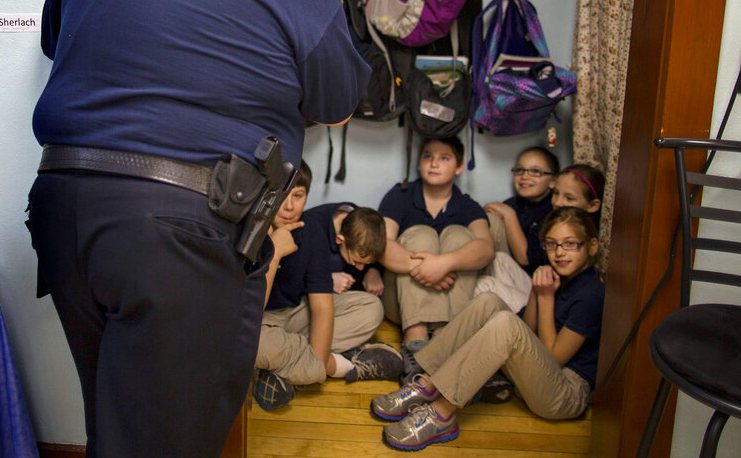
“Get down!” your teacher yells, pushing your classmates against the wall. Shocked and confused, you huddle on the cold linoleum floor. A shot rings out. You clutch your friend’s hand, squeeze your eyes shut, and wish the nightmare would end.
This scene unfolds with disturbing frequency in schools across America. But it also plays out during simulations designed merely to be drills. These hyperrealistic active shooter drills should be prohibited in Connecticut, and schools must modernize crisis response drills by adopting trauma-informed practices.
Although safety drills in schools are necessary to ensure that students and staff are prepared in an actual emergency, these drills should not cause harm. Studies show that drills increase the incidence of depression, stress, and anxiety by approximately 40%, and physiological health problems by over 20%, among students, staff, and their families.
These drills are particularly damaging to students with previous trauma from domestic violence, those living in communities with high rates of violence, and children with disabilities or developmental challenges . If drills retraumatize vulnerable students, can they truly be considered a safety measure?
Active shooter drills can hinder students’ abilities to trust and form connections with others. They may teach children to view adults and peers as potential threats, distort their sense of risk, and generally increase their anxiety and fear of the world around them. This impedes students’ development and could even endanger them during an actual crisis when trust in their teachers is critical. Drills can also confuse students because “ [y]oung children have a hard time telling the difference between fantasy and reality especially when stressed or anxious.
Despite the prevalence of these drills, their efficacy remains unclear. Everytown Research noted that there is an “absence of any strong conclusive evidence on drills’ effectiveness at ensuring safety during actual active shooter incidents.” One study demonstrated that adults with one-on-one simulation training had twice the chance of increasing danger in a real event. Although well-intentioned, these “ preparedness efforts may inadvertently cause children and adults to place themselves in additional danger ” when a true emergency arises, if they rigidly rely on the training instead of allowing common sense to guide their actions when more appropriate.
While even one school shooting is too many, they remain statistically rare; drill requirements should reflect that reality. Mass shootings on school grounds represent less than 1% of overall school gun violence incidents . Since 2000, an average of about five students or staff a year (out of 56 million students in the United States) have died in school active shooter incidents. The goal of crisis response drills must be to prepare students for rare emergencies without causing them harm; preparedness and psychological safety are not mutually exclusive. Drills should teach students what to do without convincing them they are in constant danger.
Connecticut has already outlined a better approach. Last year, a bill championed by Rep. Jennifer Leeper (D-Fairfield) sought to overhaul Connecticut’s school drill requirements. The bill changed their design and execution and created a consistent statewide plan, so that a child’s well-being does not depend on their zip code.
HB 7077, An Act Concerning Crisis Response Drills, incorporated recommendations from the bipartisan School Crisis Response Drills Working Group to ensure drills are trauma-informed and prioritize both the physical and psychological safety of students and staff. The bill required that drills be designed to prevent emotional harm and prohibited active shooter simulations; it mandated age-appropriate education before drills, advance notice to families and staff, and clear communication that a drill is not an actual emergency.
Although that bill was unanimously voted out of the Education Committee and passed the House with strong bipartisan support, it was not taken up in the Senate. We urge the legislature to pass it this session, and encourage CT residents to contact their elected officials to do the same. The bill reflects best practices from the growing body of evidence that hyperrealistic active shooter drills traumatize students.
A vote in favor of trauma-informed crisis drills is a vote to protect both the mental and physical health of children like us across Connecticut.
Allegra Early, Alma Goren-Eisenberg, Malini Parikh, and Oscar Pitkin write on behalf of the CT Against Gun Violence Youth Council.